
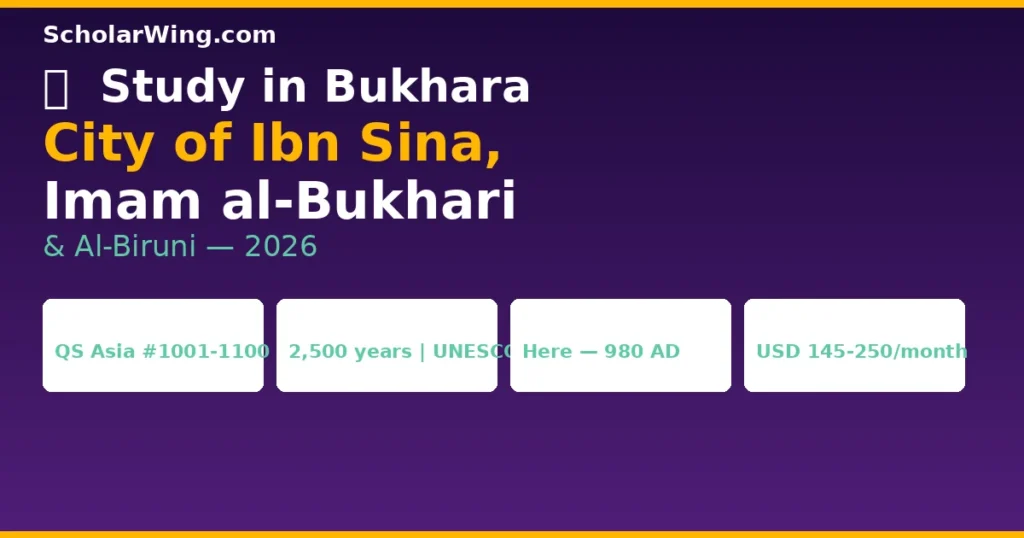
Every Medical Student Who Has Ever Studied Avicenna’s Canon of Medicine Has Studied the Work of Someone Born in This City
Tashkent has five international branch campuses. Samarkand has Timur’s imperial monuments and Ulughbek’s observatory. Bukhara has something different from both, a concentration of intellectual legacy from the Islamic Golden Age that has no parallel anywhere in Central Asia.
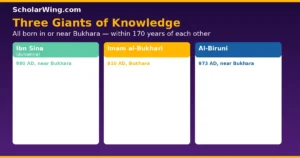
Ibn Sina (Avicenna) — the father of modern medicine, whose Canon of Medicine was the primary medical textbook in both the Islamic world and Europe for over 600 years — was born in Afshona, near Bukhara, in 980 AD. He wrote most of his foundational medical works while living in Bukhara.
Imam al-Bukhari — the greatest hadith scholar in Islamic history, whose Sahih al-Bukhari is considered the second most authentic Islamic text after the Quran — was born in Bukhara in 810 AD. He spent decades verifying 600,000+ hadith and confirmed 7,275 as authentic.
Al-Biruni — mathematician, astronomer, encyclopedist, and one of the greatest polymaths of any era — was born near Bukhara in 973 AD.
No other city in this entire series has produced three scholars of this individual caliber from a single century.
The university is located in Bukhara, which is more than 2,500 years old. It is the most complete example of the medieval city in Central Asia, with an urban fabric that has remained largely intact. The historic center of Bukhara is listed in UNESCO World Heritage List.
This is the city where you would study.
Top Scholarships in Bukhara
Bukhara State University (BukhSU) — The Main Institution
Opened in 1930, Bukhara State University is one of the biggest and oldest higher education and scientific establishments in Uzbekistan. In 2021, the number of students is more than 22 thousand, and the number of academic staff is nearly 900 in 13 faculties. There are more than 100 international cooperation agreements of the university with foreign partners. The number of international students has reached 324.
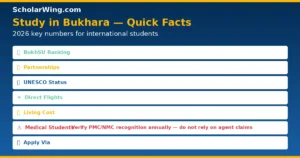
Ranking: Bukhara State University is ranked #1001-1100 in Asian University Rankings 2026.
Acceptance rate: The acceptance rate range is 10-19% — making BukhSU relatively selective compared to most other universities in this Uzbekistan series.
Graduate quality: Bukhara State University ranked 1st in Uzbekistan in 2018 national rankings in graduates quality.
International partnerships: Bukhara State University ranks among the top universities in Uzbekistan and Central Asia with a developed international partners network. The university is a constant member of international educational projects, such as Erasmus+, UNICEN and others. Close ties are established with international organizations like JICA, KOICA, British Council etc.
This partnership landscape is genuinely impressive:
- Erasmus+ — European academic mobility
- JICA — Japan International Cooperation Agency
- KOICA — Korean International Cooperation Agency
- British Council — UK educational and cultural partnerships
- UNICEN — University Network of Central Asia
Double degree programs: BukhSU actively promotes double degree options with partner universities — students can earn a BukhSU degree plus a degree from a European or Asian partner institution simultaneously.
Apply at: buxdu.uz or via studyin-uzbekistan.uz
The Ibn Sina Connection — Why This Matters for Medical and Science Students
Ibn Sina (980-1037 AD) wrote the Canon of Medicine (Al-Qanun fi al-Tibb) — a five-volume medical encyclopedia that systematized Greek medical knowledge, integrated Islamic medical discoveries, and added original clinical observations. This text was translated into Latin in the 12th century and used as the primary medical curriculum in European universities until the 17th century.
He also wrote the Book of Healing (Kitab al-Shifa) — 18 volumes covering logic, natural sciences, mathematics, and philosophy.
Ibn Sina is credited with:
- First describing meningitis
- Recognizing the contagious nature of tuberculosis
- Introducing the use of clinical trials
- Founding the conceptual framework of evidence-based medicine that modern medical education builds on
For students studying medicine or biology at Bukhara State Medical Institute or BukhSU’s science faculties, studying in Ibn Sina’s birthplace city is not just historical context, it is a living connection to the intellectual tradition they are entering.
The Imam al-Bukhari Legacy — For Islamic Studies and Religious Sciences
The Shrine of Imam al-Bukhari (Imam-ul-Bukhari Memorial Complex) is located 28 km from Bukhara city center, in the village of Hartang, now a major pilgrimage destination.
For students interested in Islamic studies, Arabic, hadith sciences, or Islamic theology, studying in Bukhara connects academic study to the most significant hadith scholarship tradition in Islamic history. No other academic city in the world carries this specific intellectual provenance.
Bukhara State Medical Institute (BSMI) — MBBS and Medical Programs
Bukhara State Medical Institute is another popular university that is desirable to Indian students for MBBS studies.
It’s medical programs are recognized by the World Health Organization (WHO), MCI, and NMC (National Medical Commission, India). All subjects of the course are taught in English.
Programs: MBBS, Dentistry, Pharmacy, Nursing Language: English-medium for international students Tuition: Approximately USD 2,200-3,500/year
Critical standard reminder: Always verify current PMC (Pakistan Medical Commission) and NMC (India) recognition before enrolling. Recognition must be confirmed annually through the official PMC or NMC websites — not assumed from historical lists or agent claims.
Bukhara’s UNESCO World Heritage — The Most Complete Medieval City in Central Asia
Bukhara is the most complete example of the medieval city in Central Asia, with an urban fabric that has remained largely intact.
This is what distinguishes Bukhara from Samarkand. While Samarkand has spectacular individual monuments (Registan, Gur-e-Amir), Bukhara has preserved its entire medieval urban structure streets, bazaars, mosques, madrassas, caravanserais, and bathhouses largely as they existed in the 9th-16th centuries. Walking through Bukhara’s Old City is walking through a complete, functioning medieval Islamic urban environment.
Key UNESCO heritage monuments:
Samanid Mausoleum (892-907 AD) — One of the oldest surviving Islamic architectural monuments in Central Asia. Built during the Samanid dynasty’s golden age, when Bukhara was the Islamic world’s eastern intellectual capital. Its brickwork geometry anticipates mathematical patterns not fully described in Western architecture for centuries.
Kalon Minaret (1127 AD) — So tall and so precisely built that Genghis Khan who destroyed most of Bukhara in 1220 reportedly ordered it to be spared upon seeing it, bowing his head to look up at its height (and according to legend, accidentally knocking off his hat, the first time he had bowed his head to anyone or anything).
Ark Fortress (5th century onward) — The royal citadel of Bukhara, continuously occupied for 2,500 years until 1920. The seat of the Bukharkhudats, the Samanids, Karakhanids, Timurids, Shaybanids, Astarkhanids, and finally the Emirs of Bukhara.
Poi Kalyan Complex — The ensemble around the Kalon Minaret: the Kalon Mosque (one of Central Asia’s largest), and the Mir-i-Arab Madrassa (still functioning as an Islamic educational institution, one of the few in the former Soviet space to have operated continuously).
Chor Minor (1807) — Four minarets, each topped with a different-colored dome, one of the most photographed structures in Central Asia.
Scholarships for International Students in Bukhara
Uzbekistan Government Scholarship: The same bilateral scholarship framework applicable to Tashkent and Samarkand applies to BukhSU. Apply through studyin-uzbekistan.uz and via your home country’s Ministry of Higher Education.
BukhSU Merit Scholarships: Bukhara State University offers a variety of scholarships to provide financial assistance to talented students, given to both international and national students. Contact the International Affairs Office at buxdu.uz for current scholarship availability and application requirements.
Erasmus+ Mobility Grants: BukhSU’s confirmed Erasmus+ membership means European exchange mobility grants are available for students enrolled at BukhSU partner universities in Europe who want to spend a semester in Bukhara and for BukhSU students wanting to exchange to European partner institutions.
JICA and KOICA Programs: BukhSU’s partnerships with Japan’s JICA and South Korea’s KOICA occasionally create scholarship or exchange opportunities specifically for BukhSU students. Monitor the JICA and KOICA websites for Central Asia-specific opportunities.
Cost of Living in Bukhara — Among the Lowest in This Series
Bukhara is a medium-sized city of approximately 300,000 people — smaller and cheaper than both Tashkent and Samarkand.
Typical monthly costs in Bukhara:
- Accommodation: USD 50-100/month (university dormitory or shared room)
- Food: USD 60-90/month (local bazaar food and traditional Uzbek cuisine very affordable)
- Transportation: USD 5-10/month (city is compact; taxis cheap)
- Personal expenses: USD 30-50/month
Total typical budget: USD 145-250/month — among the lowest in this entire series.
Getting to Bukhara
Bukhara has its own international airport (BHK) with direct flights from:
- Istanbul (Turkish Airlines)
- Moscow (multiple carriers)
- Dubai (FlyDubai)
- Various CIS destinations
From Tashkent: The high-speed Afrosiyob train connects Tashkent-Samarkand-Bukhara, Tashkent to Bukhara takes approximately 3-4 hours by this route.
This gives Bukhara better direct international connectivity than many other cities in this series, including a direct Istanbul connection that is particularly convenient for students from Pakistan and South Asia traveling via Istanbul.
Bukhara vs Samarkand — How to Choose
| Factor | Samarkand | Bukhara |
|---|---|---|
| University ranking | QS #1001-1200 global | QS Asia #1001-1100 |
| Historical identity | Timurid imperial capital | Islamic Golden Age birthplace |
| UNESCO status | Multiple individual monuments | Entire medieval city intact |
| Key scholar | Ulughbek (astronomy) | Ibn Sina, Imam al-Bukhari, al-Biruni |
| City size | Larger | Smaller, more intimate |
| Cost of living | USD 165-285/month | USD 145-250/month |
| Getting there | High-speed train from Tashkent | Direct flights from Istanbul, Dubai + train |
| Medical focus | Samarkand State Medical Uni | Bukhara State Medical Institute |
Choose Samarkand if: You want a larger city with the most spectacular individual architectural monuments and Silk Road International University.
Choose Bukhara if: You prefer a more intimate, completely preserved medieval environment, want the Ibn Sina/Imam al-Bukhari intellectual connection, or need direct international flight access from Istanbul or Dubai.
Practical Tips for Applying to Bukhara
1. Apply via studyin-uzbekistan.uz — avoid unverified agents The same principle as Samarkand applies. Pay tuition only to BukhSU’s official bank account. Verify bank details against the university’s published account before any payment.
2. Confirm your faculty’s language of instruction BukhSU has 13 faculties with varying language arrangements. Not all programs are English-medium. Contact the International Affairs Office to confirm language of instruction for your specific program before applying.
3. Book via Istanbul for South Asian students Bukhara’s direct Istanbul connection (Turkish Airlines) makes it significantly more accessible than Samarkand or Tashkent for Pakistani, Bangladeshi, and other South Asian students, one connection via Istanbul is often simpler than Tashkent transit.
4. Medical students — verify PMC/NMC recognition annually BSMI is WHO and NMC recognized per recent sources. Verify current recognition status with Pakistan Medical Commission (pmc.gov.pk) and NMC (nmc.org.in) annually. Never rely on agent claims.
5. BukhSU acceptance rate is 10-19% — prepare a strong application Unlike many Uzbekistani universities with open admissions, BukhSU is relatively selective. Prepare your SOP, CV, and recommendation letters properly. Use ScholarWing’s free document tools: SOP Generator · CV Builder · Reference Letter Generator
FAQ
What is Bukhara State University’s ranking?
Bukhara State University is ranked #1001-1100 in Asian University Rankings 2026 (QS Asia), and was ranked 1st in Uzbekistan in national graduate quality rankings in 2018.
Is Bukhara cheaper than Samarkand or Tashkent?
Yes, Bukhara is a smaller city with lower living costs. Estimated monthly budget: USD 145-250/month, compared to USD 165-285/month in Samarkand and USD 300-500/month in Tashkent.
Why is Bukhara significant for medical students?
Ibn Sina (Avicenna, 980 AD), whose Canon of Medicine was the standard medical textbook in Europe and the Islamic world for over 600 years, was born near Bukhara and conducted most of his foundational medical work there.
Does BukhSU participate in Erasmus+?
Yes, Bukhara State University is a constant member of international educational projects, such as Erasmus+. European mobility exchange opportunities are available through BukhSU’s European partner network.
How do I get directly to Bukhara?
Bukhara has its own international airport with direct flights from Istanbul (Turkish Airlines), Moscow, and Dubai, making it more directly accessible for international students than some other Uzbekistani cities.
Is BSMI’s MBBS recognized by NMC and WHO?
Per recent sources, yes, recognized by WHO, MCI, and NMC. Always verify current recognition status directly with pmc.gov.pk (Pakistan) or nmc.org.in (India) before enrolling — recognition can change between years.