
Senegal Is the Most Politically Stable Country in Sub-Saharan Africa — And Has a Scholarship Landscape to Match
The Republic of Senegal has never experienced a successful military coup. In a West African region where military interruptions to democracy have recently occurred in Mali, Guinea, Burkina Faso, and Niger, Senegal stands as the only major country in the sub-region with a continuous, unbroken democratic tradition since independence in 1960.
This political stability is not just a source of national pride. It has a direct scholarship implication: Senegalese applicants do not carry the political instability narrative that complicates applications from neighboring countries. When a Chevening, DAAD, or Fulbright selection committee asks “why will this person return and make an impact?”, Senegal’s functioning institutions, growing economy, and democratic culture provide a structurally stronger answer.
Beyond stability, Senegal occupies the same dual scholarship position as Mali and Guinea, a French-speaking OIC member country. This means access to both the Francophone scholarship world (Eiffel Excellence, ARES Belgium, AUF, Campus France) and the OIC scholarship world (IsDB, IsDB-France joint program, Turkiye Burslari). The IsDB confirms Senegal as an eligible member country, explicitly named alongside Nigeria, Mali, Uganda, and Burkina Faso.
Senegal has a first president — Léopold Sédar Senghor — who was himself a Sorbonne-educated poet, philosopher, and the father of the Négritude movement. French academic culture runs as deep in Senegal as anywhere in Francophone Africa.
Top Scholarships for Senegal Students
1. IsDB-France Scholarship — The Dual Francophone-Islamic Program (200 Places/Year)
As with Mali, Guinea, and Niger, Senegal is eligible for the most distinctive scholarship in this series, the joint program between France’s Ministry of Foreign Affairs and the Islamic Development Bank.
Senegal is explicitly confirmed in the list of 42 countries eligible for this program, combining Francophone academic access with Islamic Development Bank development funding in a single application.
What makes it uniquely suited for Senegal:
- Senegal is French-speaking — the French Ministry partnership is linguistically natural
- Senegal is an OIC member — the IsDB partnership is institutionally relevant
- 200 scholarships per year across 42 countries — meaningful volume
- Administered through Campus France’s established infrastructure
Fields covered: Life and health sciences, Environmental studies, Education, Engineering, Agriculture, Computing and IT, Basic sciences, Economics and banking, Social sciences.
Apply through: Campus France — campusfrance.org for the IsDB-France program. Contact Campus France Dakar or the French Embassy in Dakar for country-specific guidance.
Deadline: Typically January-February. Confirm current cycle at isdb.org and Campus France.
2. Eiffel Excellence Scholarship — France (€1,200-2,100/month)
Senegal has one of the strongest French academic traditions in West Africa, a direct legacy of Senghor’s Sorbonne education and the Négritude movement’s engagement with French intellectual life. Senegalese students applying to French universities are competing in an environment where Senegalese academic credentials are well-understood and respected.
What it covers:
- Master’s: €1,200/month (from January 2026)
- PhD: €2,100/month
- International transportation, insurance, housing search, cultural activities
The Senegal advantage: As a Francophone developing country with strong historical ties to French academic institutions, Senegalese applicants in engineering, public health, environmental science, economics, and governance are among the most competitive profiles for Eiffel consideration from West Africa.
Critical process: Applications submitted by French universities, students cannot apply directly. Contact your target French university’s International Relations office, which then nominates you to Campus France.
2027 cycle: Contact French university by September-October 2026 for internal deadline. Campus France deadline: typically January 8.
Apply through: campusfrance.org — contact Campus France Sénégal in Dakar.
3. IsDB (Islamic Development Bank) Merit Scholarship Programme
Applicants must be citizens of IsDB member countries — including many African nations such as Nigeria, Senegal, Mali, Uganda, Burkina Faso, and others. Senegal is explicitly confirmed.
What it covers: Full tuition fees, monthly stipend, health insurance, travel allowance.
Fields prioritized: STEM, agriculture, health, economics, social sciences, all directly relevant to Senegal’s development priorities in digital infrastructure, sustainable agriculture, public health, and ocean-based economy (fishing and maritime trade).
LDMC consideration: While Senegal is classified as a lower-income country, it does not rank as low on HDI as Niger or Mali. Senegalese applicants are competitive but should be aware the LDMC priority applies to lower-ranked countries. Strong academic records and development impact plans are essential.
Apply at: isdb.org — deadlines typically January-February.
4. Chevening Scholarship — United Kingdom (£1,378-1,690/month)
Chevening is the UK Government’s prestigious international scholarships programme. Senegal has a dedicated Chevening page, chevening.org/scholarship/senegal/
What it covers:
- Full university tuition fees
- Monthly living allowance: £1,690 (London) / £1,378 (outside London)
- Economy class return airfare
- Additional academic grants
Requirements:
- 2 years of work experience (~2,800 hours)
- IELTS 6.5+ or TOEFL iBT 79+
- Must return to Senegal after scholarship
Senegal’s Chevening narrative advantage: Senegal’s democratic stability, governance track record, and Vision Sénégal 2050 economic transformation program provide a compelling “return plan” narrative. Chevening explicitly seeks future leaders, a Senegalese applicant with a clear plan to contribute to digital transformation, sustainable development, or democratic governance has a naturally strong application.
Next cycle: Opens August 2027, closes November 2027.
Apply at: chevening.org/scholarship/senegal/
5. ARES Belgium Scholarships — Francophone Priority
Belgium’s ARES scholarship programs explicitly prioritize French-speaking African countries. Senegal is among the primary target nationalities.
What it covers: Full tuition + monthly living stipend + travel costs at Belgian universities.
Apply at: ares-ac.be — deadlines typically January-February.
6. AUF (Agence Universitaire de la Francophonie) Scholarships
The Université Cheikh Anta Diop (UCAD) in Dakar is an AUF member institution, giving Senegalese students at UCAD access to AUF mobility grants for study at other Francophone partner institutions globally.
The Université Gaston Berger and other Senegalese public universities are also AUF members, meaning AUF mobility is accessible to students across Senegal’s public university system.
Apply at: auf.org — AUF Bureau for West Africa (covers Senegal).
7. DAAD Scholarships — Germany (€934-1,300/month)
DAAD is fully accessible for Senegalese students through multiple programs.
Key programs:
DAAD Study Scholarships: €934/month for Master’s. Deadline mid-October.
DAAD EPOS (Development-Related Courses): DAAD In-Country/In-Region Scholarships offer full sponsorship, monthly stipends and research allowance for Africans to study in their region or countries. Senegalese applicants in agriculture, fisheries management, climate adaptation, governance, and public health have strong EPOS profiles.
DAAD Helmut Schmidt Programme: Public policy and good governance — directly relevant to Senegal’s democratic governance tradition.
Language: MOI Certificate accepted for English-medium programs — generate at: MOI Generator
8. CSC China Scholarship (CNY 3,000-3,500/month + Free Tuition)
Senegal maintained relations with the People’s Republic of China (having switched from recognition of Taiwan in 2005) and receives FOCAC scholarship allocations.
What it covers: Full tuition + monthly stipend + free accommodation + health insurance.
No IELTS required — MOI Certificate accepted for English-medium programs.
Apply through: Chinese Embassy in Dakar.
Deadline: Embassy track December-January.
9. Fulbright Foreign Student Program — USA
The US Embassy in Dakar administers Fulbright for Senegal. Given Senegal’s democratic governance tradition and growing digital economy, Fulbright applications in governance, public health, digital transformation, and sustainable development are competitive.
Apply through: US Embassy Dakar — sn.usembassy.gov
Deadline: Typically July-August. Confirm with the US Embassy Public Affairs Section.
10. Turkiye Burslari — Turkey (OIC Connection, No IELTS)
Turkiye Burslari is particularly accessible for Senegalese students: no IELTS required, OIC member connection, and a funded Turkish language preparation year.
What it covers: Full tuition + accommodation + monthly allowance (~USD 300-350) + Turkish language year.
Apply at: turkiyeburslari.gov.tr — deadline February.
11. Australian Awards — Australia
Australia Awards Africa is a recurring funder for Senegalese students. Senegal is among eligible developing countries.
What it covers: Full tuition + return airfare + living stipend + health insurance.
Apply through: Australian Embassy covering Senegal — dfat.gov.au/australiaawards
Deadline: Typically February-April.
12. GKS Korea (Global Korea Scholarship)
GKS Korea requires no English test and has a minimum GPA of only 2.64/4.0 — making it one of the most accessible major scholarships for Senegalese students.
What it covers: Full tuition + monthly stipend (~USD 650-700) + funded Korean language year + round-trip airfare.
Apply through: Korean Embassy. Embassy Track closes February.
13. MEXT Japan Scholarship
Open to Senegalese students via the MEXT Embassy Track at the Japanese Embassy in Dakar.
What it covers: Full tuition + monthly stipend JPY 143,000-147,000 (~USD 950-980) + round-trip airfare + Japanese language year.
Deadline: Embassy Track May-June.
14. Erasmus Mundus — Europe (€1,100-1,400/month)
Open to all nationalities. Senegalese students are eligible for all consortium programs, with French-medium consortium tracks particularly accessible.
Deadline: Most consortiums January-February.
15. Mastercard Foundation Scholars Program
Senegalese students from disadvantaged backgrounds with demonstrated academic excellence and community leadership are competitive applicants.
Apply through partner universities: mastercardfdn.org/scholarships
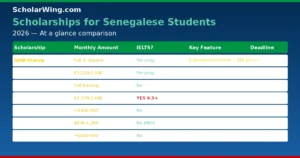
Quick Reference: Scholarships for Senegalese Students 2026-27
| Scholarship | Amount | IELTS? | Key Note | Deadline |
|---|---|---|---|---|
| IsDB-France | Full + stipend | Per program | Senegal confirmed in 42 countries | Jan-Feb |
| Eiffel Excellence (France) | €1,200-2,100/mo | Per program | French priority, univ. sponsored | Jan 8 |
| IsDB Merit | Full funding | No | Senegal explicitly named | Jan-Feb |
| Chevening (UK) | £1,378-1,690/mo | Yes 6.5+ | Dedicated Senegal page | November |
| ARES Belgium | Living stipend | No | Francophone priority | Jan-Feb |
| DAAD (Germany) | €934-1,300/mo | No (MOI) | EPOS + In-Region available | Aug-Oct |
| CSC China | CNY 3,000-3,500/mo | No (MOI) | FOCAC track | Dec-April |
| Turkiye Burslari | ~$300-350/mo | No | OIC, no IELTS | February |
| GKS Korea | ~$650-700/mo | No | Min GPA 2.64 only | February |
| Fulbright (USA) | Living stipend | Yes | US Embassy Dakar | July-Aug |
| AUF Mobility | Travel + stipend | No | UCAD is AUF member | Varies |
| Australian Awards | Full living | Yes 6.5+ | Confirmed for Senegal | Feb-April |
| Erasmus Mundus | €1,100-1,400/mo | Per program | French consortium tracks | Jan-Feb |
| Mastercard Foundation | Full funding | Varies | West Africa focus | Varies |
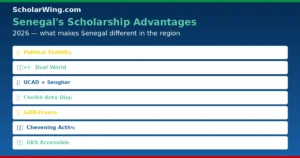
Senegal’s Unique Scholarship Strengths
1. Political Stability = Stronger “Return Plan” Narrative Every major scholarship asks why you will return and what impact you will make. Senegal’s unbroken democratic tradition since 1960, the only such record in the sub-region gives Senegalese applicants a structurally more credible answer than applicants from countries with recent political instability. Functioning institutions, democratic accountability, and Vision Sénégal 2050 provide concrete context for development impact plans.
2. The Senghor-UCAD French Academic Tradition Léopold Sédar Senghor’s Sorbonne education and his Négritude philosophy established Senegal as a country that takes French intellectual culture seriously. UCAD named after Cheikh Anta Diop, the scholar who revolutionized African historiography is one of West Africa’s most academically prestigious institutions. French universities and Campus France recognize Senegalese academic credentials better than most Francophone African countries.
3. Dual Francophone-OIC Access The IsDB-France joint program is specifically designed for countries at the intersection of French-speaking and OIC worlds. Senegal sits at this intersection as naturally as any country on the continent. Use both scholarship worlds most Senegalese students use only one.
The Cheikh Anta Diop Context — Why It Matters for Scholarship Applications
Cheikh Anta Diop (1923-1986) was a Senegalese scholar who in the face of significant academic resistance proved through linguistic, archaeological, and anthropological evidence that ancient Egyptian civilization was African, not “Mediterranean” or “Oriental.” He did this from Senegal, publishing work that forced a fundamental reconsideration of world history.
This is not just a historical fact. For Senegalese students applying to academic scholarships, Diop’s story is evidence that Senegal produces scholars who challenge and reframe knowledge, not just consume it. The Université Cheikh Anta Diop being named after him is a signal of what Senegalese academia values.
For scholarship essays about academic motivation, research goals, and contribution to knowledge, the Diop tradition is a genuinely distinctive and compelling Senegalese intellectual context.
Practical Tips for Senegalese Applicants
1. Start with IsDB-France — it’s designed for exactly Senegal’s profile French-speaking OIC member country, that is precisely who this program targets. 200 places, managed through Campus France, funded by both France and IsDB. Contact Campus France Dakar for guidance on the current cycle.
2. Use the stability narrative in every leadership scholarship For Chevening, DAAD EPOS, and Fulbright, ground your “return plan” in Senegal’s specific institutional strengths. Vision Sénégal 2050, digital transformation, maritime economy, and democratic governance are all concrete and credible.
3. Invest in IELTS for Chevening English preparation is the main barrier for French-educated Senegalese applicants. Allow 6-8 months. See: IELTS vs TOEFL vs Duolingo for Scholarship Applications 2026 — Which Test?
4. Use MOI Certificate for DAAD and CSC China Both accept a free Medium of Instruction Certificate for English-medium programs. Generate at: MOI Generator
5. Apply to both French-language AND OIC world scholarships simultaneously Eiffel + ARES + AUF for the Francophone world; IsDB + IsDB-France + Turkiye Burslari for the OIC world. Most Senegalese students apply to one cluster, the students who apply to both double their total pool.
FAQ
Is Senegal eligible for IsDB scholarships?
Yes, Senegal is explicitly named as an eligible IsDB member country alongside Nigeria, Mali, Uganda, and Burkina Faso.
Is Chevening active for Senegal?
Yes, Senegal has a dedicated Chevening page at chevening.org/scholarship/senegal/ — the program is active and accepting applications.
Is Senegal eligible for the IsDB-France joint scholarship?
Yes, Senegal is confirmed in the list of 42 eligible countries for the joint France Ministry of Foreign Affairs and Islamic Development Bank scholarship program of 200 places per year, administered through Campus France.
What makes Senegal’s scholarship application stronger than neighboring countries?
Senegal’s unbroken democratic tradition since 1960, functioning institutions, and Vision Sénégal 2050 provide a stronger “return plan” and “development impact” narrative than countries with recent military coups in the same region. This is a structural advantage in scholarship selection.
What is the easiest major scholarship for Senegalese students?
GKS Korea: no IELTS, minimum GPA 2.64/4.0, fully funded with Korean language year. Turkiye Burslari is similarly accessible — no IELTS, OIC connection.