
ENS International Selection
⚠️ You Get One Attempt at This — Ever
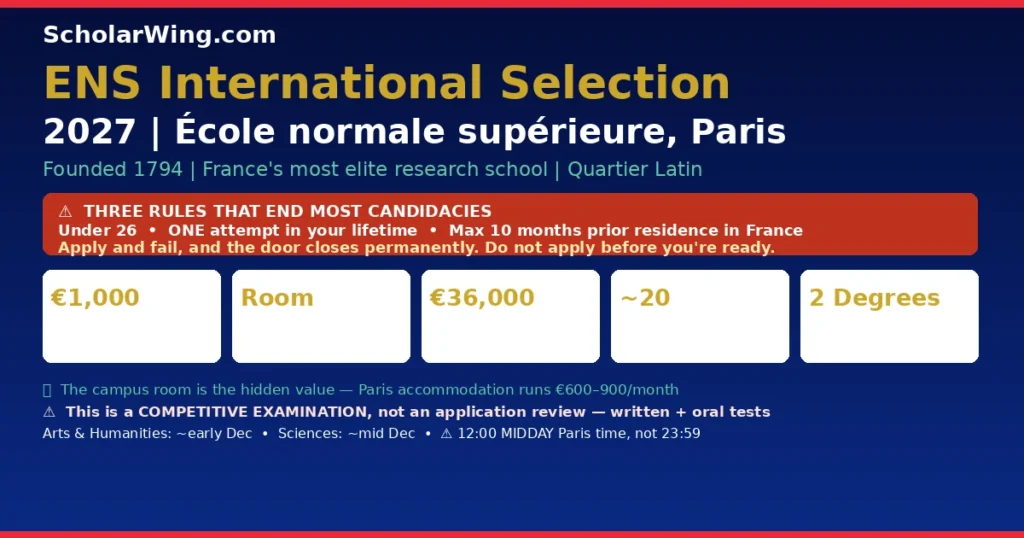
Before the money, the prestige or the process, three rules that end most people’s candidacy before it begins:
Candidates must be under 26 when they apply (must not have reached their 26th birthday). Candidates apply only once to the International Selection. And Candidates must not have lived in France more than 10 months during the academic year of the selection (September 1st – August 31st) nor the previous year.
| Rule | Detail |
|---|---|
| Age | ⚠️ Must not have reached your 26th birthday |
| Attempts | ⚠️ ONCE in your lifetime, no reapplying |
| France residence | ⚠️ Not more than 10 months in France during the selection year or the year before |
One attempt, ever. This is not like Chevening or DAAD where you try again next cycle. If you apply and fail, that door is permanently closed.
So do not apply in a year when you are not genuinely ready. If you are 22 with an average record, waiting until 24 with a stronger one is the correct decision.
What ENS Is
École Normale Supérieure (ENS) is a higher education establishment for pre-doctoral and doctoral studies (graduate school) as well as a top-level research Centre in France. ENS counts fifteen departments for education and research, spanning the main disciplines in humanities and sciences. It is the 1st French institution in many rankings. ENS Paris is situated in the very heart of Paris, in the “Quartier Latin”, which has been known for centuries for its rich intellectual and cultural activity.
Founded in 1794 and renamed in 1845, the École Normale Supérieure (ENS) is one of the most prestigious graduate schools in Paris, France. ENS has two main sections (literary and scientific) and has become a place for a few French students to pursue careers in government and academia.
ENS is France’s most elite academic institution small, research-intensive, and historically the training ground for the country’s leading intellectuals, scientists and public figures. Its alumni include a long list of Nobel laureates, Fields Medalists and philosophers.
Its students are called normalizes and international selection winners join that community on equal terms.
⚠️ ENS Paris and ENS Lyon Are Separate
This scholarship is provided by Ecole normale superieure de Lyon (ENS Lyon) and the value of this scholarship is Partial Funding, up to EUR 1,000 per month.
ENS Lyon runs its own International Selection with its own deadlines and process. This guide focuses on ENS Paris (ENS Ulm), but if your field fits Lyon better, it has particular strengths in the sciences and education research, check Lyon’s own page separately.
What You Receive
Integrated to the community of the normalizes, international students continue their studies at ENS and at the university at the same time, while benefiting from a 1000 euros grant for 3 years and from a room on one of the ENS campuses.
| Benefit | Detail |
|---|---|
| Monthly grant | €1,000/month |
| Duration | 3 years |
| Accommodation | ⭐ A room on an ENS campus |
| Total grant value | €36,000 over three years |
| Outcome | A master’s degree in your specialty and the diploma of École normale supérieure |
⭐ The Room Is a Major Benefit
Paris is one of Europe’s most expensive cities for accommodation. A student room typically costs €600–€900 per month.
ENS provides a room on campus. That transforms the value of a €1,000 monthly grant instead of housing consuming most of it, the grant covers food, transport, books and living. Combined with France’s very low public university tuition (typically a few hundred euros in registration fees), this functions as genuine full funding.
Two Qualifications, Not One
You graduate with both a Master’s degree in your discipline and the ENS diploma a distinctively French credential that carries substantial weight in French academia, research and public service.
Full Eligibility
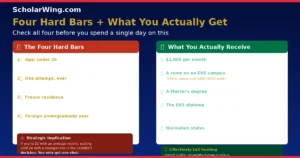
Candidates must not be after their 26th birthday on December 1st. Candidates must not have applied to the International Selection before. And Candidates must not have lived in France more than 10 months during the academic year of the selection (September 1st – August 31st) nor the previous year. Candidates must justify at least one year of undergraduate studies awarded by a foreign university during the calendar year preceding the start of applications.
| Requirement | Detail |
|---|---|
| Age | Under 26, not reached your 26th birthday (by ~1 December) |
| Previous applications | ❌ None, one attempt in a lifetime |
| France residence | Max 10 months in the selection year and the prior year |
| Foreign undergraduate study | ✅ At least one year validated at a foreign (non-French) university |
| Nationality | Open to all nationals except France |
| Academic record | Outstanding results |
| Entry level | 3rd year of bachelor (license 3) or 1st year of master (master 1) |
| Disciplines | Sciences and Arts & Humanities |
The Entry Level Explained
The Ecole normale supérieure aims at varying its students’ profiles and incorporates students to be enrolled in the 3rd year of bachelor in Math and in Computing science (licence 3) or 1st year of master (master 1), coming from all over the world and from all disciplines.
You enter at either:
- Licence 3 the third year of a French bachelor’s (for certain disciplines such as math and computer science), or
- Master 1 the first year of a master’s
This means the International Selection is for students finishing or having recently finished an undergraduate degree not for people mid-career or already holding a Master’s.
⭐ French Language
ENS is a French institution and much teaching, particularly in Arts & Humanities, is in French. Some science programmes accommodate English.
For Arts & Humanities candidates, strong French is effectively essential, the written and oral examinations are demanding. Science candidates have more flexibility but should still expect French to matter.
⚠️ Check the specific language requirements for your department on the ENS site before applying.
⚠️ This Is a Competitive Examination, Not an Application Review
This is the biggest structural difference from every other scholarship in this series.
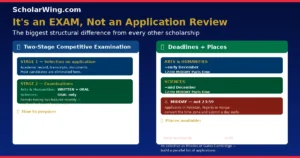
The examination takes place in 2 steps: a selection based upon application, then oral and written tests in Paris (Arts & Humanities) or oral exams only (Sciences) for shortlisted candidates.
Stage 1: Selection on Application
Your file is assessed: academic record, transcripts, and supporting documents. Most candidates are eliminated here.
Stage 2: Examinations
| Discipline | Format |
|---|---|
| Arts & Humanities | ⚠️ Written AND oral tests |
| Sciences | Oral examinations only |
Remote tests have featured in recent cycles, confirm the format for your year, as this materially affects travel costs.
The examinations are genuinely rigorous. ENS is testing intellectual capability in the French academic tradition expect questions requiring you to think aloud, defend positions, and demonstrate depth rather than recall.
How to Prepare
- Study past examination formats for your discipline on the ENS site
- Practice oral defense of your subject in French (or English where permitted)
- Read broadly in your field beyond your syllabus, ENS values intellectual range
- If travelling to Paris, budget flights and accommodation
Number of Places
The number of scholarships offered by ENS is 10 positions for scientific disciplines and another 10 positions for literary disciplines.
| Section | Positions (2024/25 reference) |
|---|---|
| Sciences | ~10 |
| Arts & Humanities (literary) | ~10 |
| Total | ~20 worldwide |
⚠️ Number of positions: Varies between cycles.
Roughly twenty places for the entire world. This is comparable to Rhodes or Gates Cambridge in selectivity treat it accordingly and build a parallel list.
Deadlines
In the 2026 cycle, Arts & Humanities closed on December 3, 2025 and Sciences closed on December 15, 2025, both at 12:00 midday Paris time. For the 2027 cycle, check the official ENS page in autumn 2026 before relying on any deadline.
The application form and documents must be submitted online before 3 December (12.00 midday, Paris time) for Arts & Humanities and 15 December (12.00 midday, Paris time) for Sciences.
| Section | Typical Deadline |
|---|---|
| Arts & Humanities | ~early December, 12:00 midday Paris time |
| Sciences | ~mid-December, 12:00 midday Paris time |
⚠️ Note the midday cutoff. Not 23:59 12:00 noon Paris time. Applicants in Pakistan, Nigeria or Kenya should convert the time zone carefully and submit a full day early.
2027 Planning Timeline
| When | Action |
|---|---|
| Now | Verify the four hard eligibility bars |
| Summer 2026 | Gather transcripts; confirm your French level |
| Autumn 2026 | ⚠️ Check the official ENS page for confirmed dates |
| October–November 2026 | Prepare and complete the online application |
| Early December 2026 | Arts & Humanities deadline |
| Mid-December 2026 | Sciences deadline |
| Early 2027 | Shortlisting; examinations |
| September 2027 | Studies begin |
Documents
Typical requirements include:
| Document | Notes |
|---|---|
| ✅ Academic transcripts | All university study |
| ✅ Proof of at least one year of foreign undergraduate study | Core eligibility evidence |
| ✅ Proof of age | Passport |
| ✅ Academic references | From your university |
| ✅ Statement of motivation and research interests | Why ENS, why this discipline |
| ✅ CV | Academic record |
| ✅ Language evidence | Where required by your department |
⚠️ Confirm the exact document list for your section on ens.psl.eu.
Who This Suits
✅ Strong fit if you:
- Are under 26 and finishing (or have just finished) an undergraduate degree
- Have outstanding academic results, this is an exam-based elite selection
- Have genuine research ambitions and intellectual range
- Have strong French, especially for Arts & Humanities
- Have not previously applied to the International Selection
- Have not lived in France for more than 10 months recently
❌ Poor fit if you:
- Are 26 or older — no exceptions
- Have already applied once, you cannot reapply
- Already hold a Master’s degree or are mid-career
- Have good but not exceptional results remember, you only get one attempt
- Have no French and are applying in Arts & Humanities
How This Compares
| Feature | ENS Intl Selection | Eiffel (France) | Clarendon (Oxford) |
|---|---|---|---|
| Grant | €1,000/mo × 3 yrs | ~€1,200/mo | Full fees + living |
| Accommodation | ⭐ Room provided | ❌ | ❌ |
| Age limit | ⚠️ Under 26 | Varies | ❌ None |
| Attempts | ⚠️ One, ever | Multiple | Multiple |
| Selection | ⚠️ Competitive exam | Institution nominates | Application review |
| Places | ~20 worldwide | Several hundred | 200+ |
| Outcome | Master’s + ENS diploma | Master’s | Master’s / DPhil |
| Level | Licence 3 / Master 1 | Master’s / PhD | Master’s / DPhil |
ENS is the most selective and most restrictive but the combination of a three-year grant, campus accommodation, and the ENS diploma is unmatched in France.
Quick Reference
| Element | Detail |
|---|---|
| Programme | ENS International Selection |
| Institution | École normale supérieure – PSL (ENS Paris / ENS Ulm) |
| Also runs at | ENS Lyon, separate process |
| Founded | 1794 |
| Grant | €1,000/month |
| Duration | 3 years (€36,000 total) |
| Accommodation | ⭐ Room on an ENS campus |
| Outcome | Master’s degree + ENS diploma |
| Entry level | Licence 3 or Master 1 |
| Disciplines | Sciences • Arts & Humanities |
| Places | ~10 + ~10 (≈20 worldwide) |
| Nationality | All except France |
| Age | ⚠️ Under 26, must not have reached 26th birthday |
| Attempts | ⚠️ ONE in a lifetime |
| France residence | ⚠️ Max 10 months in selection year and prior year |
| Prior study | ≥1 year undergraduate at a foreign university |
| Selection | ⚠️ Two-stage competitive examination |
| Arts & Humanities exam | Written and oral |
| Sciences exam | Oral only |
| Arts deadline | ~early December, 12:00 midday Paris time |
| Sciences deadline | ~mid-December, 12:00 midday Paris time |
| Official site | ens.psl.eu |
FAQ
How much is the grant?
€1,000 per month for 3 years, plus a room on one of the ENS campuses.
Is there an age limit?
Yes, candidates must be under 26 when they apply and must not have reached their 26th birthday.
Can I apply more than once?
No, candidates apply only once to the International Selection.
Can I apply if I have lived in France?
Not if you have lived in France more than 10 months during the academic year of the selection nor the previous year.
What qualification do I finish with?
A master’s degree in your speciality and the diploma of École normale supérieure.
How is the selection conducted?
In two steps: a selection based upon application, then oral and written tests in Paris for Arts & Humanities, or oral exams only for Sciences.
How many places are there?
Around 10 for scientific disciplines and 10 for literary disciplines.
When are the deadlines?
Around 3 December for Arts & Humanities and 15 December for Sciences, both at 12:00 midday Paris time. Verify annually.
Which nationalities can apply?
Open to all nationals except France.
Free Application Tools
- Motivation Letter: Motivation Letter Generator
- SOP / Study Plan: SOP Generator
- CV: Free CV Builder
- Reference Letter: Reference Letter Generator
- MOI Certificate (if needed): MOI Generator
- Research Proposal (PhD): Research Proposal Generator