
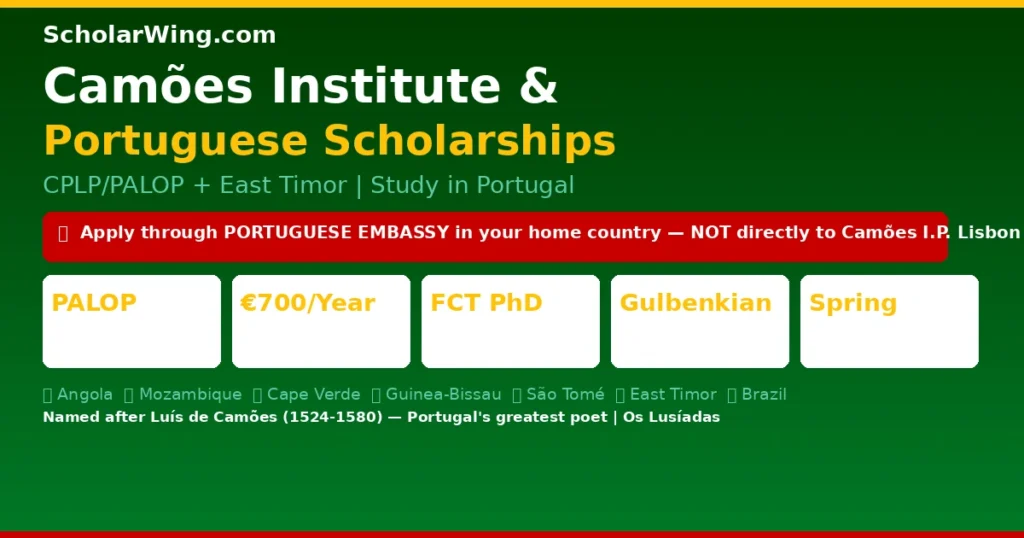
The Portuguese Scholarship System Is Not One Program — It Is a Layered Ecosystem Built Around a Language
Most scholarship guides present “the Camões scholarship” as a single program with one deadline, one amount, and one application portal. This framing is inaccurate.
The Portuguese government’s scholarship support for students from Portuguese-speaking countries is a layered system with multiple programs, multiple funders, and country-specific implementation:
- Camões I.P. — the central government agency for PALOP and bilateral scholarships to study in Portugal
- The Gulbenkian Foundation — complementary science Master’s scholarships for PALOP students
- FCT (Foundation for Science and Technology) — 1,550 fully funded PhD positions open to international students
- EU-rate propinas for CPLP students — the financial advantage that makes Portugal among the most accessible EU study destinations for Portuguese-speaking African students
Under the co-operation programs established with each of the countries with Portuguese as the official language, grants are awarded annually for university and polytechnic education, for students who are nationals and residents in Portuguese-speaking African countries (PALOP) and East Timor who are not Portuguese citizens but wish to attend higher education courses in Portugal.
This guide covers the full ecosystem, Camões, Gulbenkian, and FCT, for students from PALOP countries, East Timor, and other countries with bilateral Portuguese educational agreements.
Who Was Luís de Camões — The Poet Behind the Institution
Camões – Instituto da Cooperação e da Língua, I.P. is named after Luís Vaz de Camões (c. 1524/25-1580), Portugal’s greatest poet and one of the most significant figures in all of Western literature.
Camões wrote Os Lusíadas (The Lusiads, 1572), an epic poem celebrating Portuguese maritime exploration, the voyage of Vasco da Gama to India, and the spirit of an expanding Portuguese civilization encountering the world. Written during Camões’s own years of travel through Africa, India, and the Far East (including time in Mozambique and Goa), Os Lusíadas became the foundational text of Portuguese cultural identity.
Naming Portugal’s international cooperation and language promotion agency after Camões signals the institution’s core mission: the Portuguese language as a bridge between cultures, a legacy of encounter, and a bond between nations, specifically the nine nations of the CPLP where Portuguese is an official language.
June 10 is Portugal’s national day, also Camões Day, celebrated in all CPLP countries as the Day of the Portuguese Language and Culture.
The CPLP and PALOP — Understanding the Framework
CPLP — Community of Portuguese Language Countries
The CPLP was established on 17 July 1996 by a decision of the Conference of Heads of State and Government of Angola, Brazil, Cape Verde, Guinea-Bissau, Mozambique, Portugal and São Tomé and Príncipe, a community of almost 200 million Portuguese speakers. In 2002, East Timor joined this community. Equatorial Guinea joined in 2014.
Nine CPLP member countries:
- 🇦🇴 Angola
- 🇧🇷 Brazil
- 🇨🇻 Cape Verde
- 🇬🇶 Equatorial Guinea (2014)
- 🇬🇼 Guinea-Bissau
- 🇲🇿 Mozambique
- 🇵🇹 Portugal
- 🇸🇹 São Tomé and Príncipe
- 🇹🇱 East Timor / Timor-Leste
PALOP — Portuguese-Speaking African Countries
PALOP (Países Africanos de Língua Oficial Portuguesa) refers specifically to the five African CPLP members (excluding Brazil and East Timor):
- 🇦🇴 Angola
- 🇨🇻 Cape Verde
- 🇬🇼 Guinea-Bissau
- 🇲🇿 Mozambique
- 🇸🇹 São Tomé and Príncipe
Most Camões scholarship programs use “PALOP” as the eligibility criterion for African applicants, with East Timor treated as a separate but equal partner in the program framework.
Program 1: Camões I.P. — PALOP and East Timor Higher Education Scholarships
Under the co-operation programs established with each of the countries with Portuguese as the official language, grants are awarded annually for university and polytechnic education, for students who are nationals and residents in Portuguese-speaking African countries and East Timor (not Portuguese citizens) but wish to attend higher education courses in Portugal.
This is the main Camões scholarship program, the one most guides refer to when they say “the Camões scholarship.”
What It Covers:
Camões scholarships cover propinas (tuition fees) and provide a monthly living stipend for degree study or research in Portugal.
- Propinas (tuition fees): Covered at EU rate (~€700/year rather than non-EU €3,000-7,000/year)
- Monthly living stipend: Varies by country — paid monthly or quarterly by the Portuguese Embassy
- Study levels: Undergraduate (Licenciatura) and Postgraduate (Master’s, Doctoral)
- Duration: One academic year, renewable annually until course completion
Renewal Process:
Scholarships that are valid for one academic year are renewable for an equal period until the course finishes. The grant renewal process requires the submission of all the necessary documents by the 31st of December each year.
How to Apply:
In each country, the number of grants available, the documents required and the deadlines for submitting the necessary documentation is the responsibility of the respective local authority. Camões, I.P. will only consider applications received through its official channels.
Applications can only be made from the student’s homeland. Grant payments are made by the Portuguese Embassy on a monthly or quarterly basis via bank transfer to the student’s account.
Practical application route:
- Contact the Ministry of Education or Higher Education in your home country (Angola, Mozambique, Cape Verde, Guinea-Bissau, São Tomé, East Timor)
- Contact the Portuguese Embassy in your country for current-year quota and deadline information
- Apply through the official local authority channels — NOT directly to Camões I.P. in Lisbon
- Camões I.P. website: instituto-camoes.pt
Why this decentralized approach? Each country’s bilateral cooperation agreement with Portugal specifies different quota sizes, field priorities, and administrative processes. Angola’s scholarship quota differs from Cape Verde’s; Guinea-Bissau’s application process differs from Mozambique’s. The home country’s education ministry is the entry point for all applications.
The CPLP Financial Advantage — EU-Rate Propinas
This is the most structurally significant financial benefit for PALOP and East Timor students studying in Portugal and it applies even without a specific scholarship:
CPLP and lusophone programs offer special quotas and funding for students from Portuguese-speaking nations, often with reduced propinas equivalent to the EU rate.
Standard Portuguese university propinas (tuition fees):
- EU/EEA students: ~€700/year
- Non-EU international students: ~€3,000-7,000/year
CPLP students: Qualify for the ~€700/year EU rate under special quotas, making Portuguese higher education dramatically more affordable than for other international students.
Combined with the Camões monthly stipend, PALOP and East Timor students in Portugal pay approximately what Portuguese and EU students pay, a foundational financial advantage before any additional scholarship funding.
Program 2: Gulbenkian Foundation — PALOP Master’s Scholarships in Sciences
These scholarships support master’s studies at Portuguese higher education institutions for nationals of the African Countries of Portuguese Official Language (PALOP) Angola, Cape Verde, Guinea-Bissau, Mozambique, and São Tomé and Príncipe, in the fields of mathematics, physics, chemistry, and biology.
The Calouste Gulbenkian Foundation is one of the world’s largest private philanthropic foundations, established by the Armenian-Portuguese oil magnate Calouste Gulbenkian. Its Lisbon headquarters operates extensive education, arts, and science programs, including specific PALOP scholarship support.
What Gulbenkian Covers:
- Full tuition at Portuguese higher education institution
- Monthly living stipend (amount varies by specific award)
- A one-time travel allowance: Cape Verde and Guinea-Bissau: €800; Angola, Mozambique, and São Tomé and Príncipe: €1,250.
- Personal accident insurance during travel
Eligibility (Gulbenkian PALOP):
Applicants must have permanent residence in their country of origin. Must be applying for a master’s degree in mathematics, physics, chemistry or biology. Must hold a bachelor’s degree from a university in their country of origin with a minimum grade average of 14 out of 20. Maximum age: 30 years.
Key distinctions:
- Science fields only — not humanities, business, or social sciences
- Age limit: 30 years
- Grade 14/20 minimum from undergraduate degree
- Must live in home country (permanent residence, not diaspora)
- Not for integrated master’s programs — separate master’s degree only
Apply at:
MyGulbenkian account at gulbenkian.pt, applications submitted by the candidate directly. Independent jury selection.
Program 3: FCT — 1,550 Fully Funded PhD Positions
FCT doctoral grants cover propinas and pay a monthly stipend of around €1,260/month for PhD students, plus social-security contributions. Open to Portuguese and international students through annual calls.
The FCT (Fundação para a Ciência e a Tecnologia, Foundation for Science and Technology) is Portugal’s main national research funding agency, equivalent to Germany’s DFG or the UK’s UKRI. Its annual PhD studentship call is one of the most significant research funding opportunities in Southern Europe.
Why FCT matters for international students:
- 1,550 fully funded PhD positions per year — an enormous number
- Open to international students (not just Portuguese)
- €1,260/month stipend is among the highest for PhD funding in Southern Europe
- Social security contributions paid by FCT
- Propinas (tuition) covered
- Study in any Portuguese university or research institute
Fields: All scientific and research fields — science, technology, humanities, social sciences, arts
Apply at: fct.pt — annual calls typically open in spring
Timeline: Annual call — check fct.pt for current cycle
Other Portuguese Funding Sources
Erasmus Mundus Joint Master’s
Erasmus Mundus Joint Masters are far more generous, paying around €1,400/month plus all propinas and travel. While not Portugal-specific, many Erasmus Mundus consortiums include Portuguese universities. Open to all nationalities.
DGES Social Support (Ação Social)
Post-enrollment social support scholarship for students enrolled in Portuguese universities. Apply through the Portuguese university’s social support services after enrolling.
Bilateral Country Agreements
Most Portuguese government scholarships require applications through specific channels, often involving your home country’s embassy or consulate. Early preparation is essential, with application deadlines typically 6-9 months before the academic year begins.
Portugal has bilateral education agreements with many countries beyond CPLP, including Brazil, Morocco, Brazil, and others. Check with the Portuguese Embassy in your country for current bilateral scholarship availability.
University-Specific Scholarships
Portuguese universities (Universidade de Lisboa, NOVA University, Universidade do Porto, University of Coimbra) have their own merit scholarships for outstanding international students. Check each university’s financial support office.
Application Timeline — Spring Deadlines for Autumn Entry
Unlike scholarships with fixed annual deadlines, Camões scholarship deadlines vary by country. However, a general pattern applies:
Applications usually go through the Camões Institute website or your home-country embassy, with deadlines in spring for autumn entry.
General timeline:
| Period | Action |
|---|---|
| January-February | Contact Portuguese Embassy in your country — ask about current year scholarship availability and quota |
| February-April | Contact home country Ministry of Education about Camões scholarship nominations |
| March-May | Camões I.P. programs typically open for current cycle |
| June-September | DGES and university-specific applications open |
| September | Most Portuguese academic year begins |
| December 31 | Annual renewal documents deadline for existing scholars |
Practical first step: Do NOT start at the Camões I.P. website in Lisbon. Start at the Portuguese Embassy in your home country (Angola, Mozambique, Cape Verde, Guinea-Bissau, São Tomé, or East Timor). The Embassy is the gateway for PALOP scholarship information and has country-specific quota and deadline information.
Studying in Portugal — What to Expect
Cost advantage: Portugal is one of Europe’s most affordable countries. Outside Lisbon and Porto, monthly living costs (rent, food, transport) are manageable on a scholarship stipend. Lisbon and Porto are more expensive but still significantly cheaper than Paris, Amsterdam, or Stockholm.
Language: Most Camões and Gulbenkian scholarships assume Portuguese language proficiency. FCT PhD positions may be available in English depending on the research group. Portuguese B2 proficiency is typically expected for degree programs taught in Portuguese.
Free Portuguese language courses are provided to scholarship recipients under some programs, check country-specific provisions.
Part-time work: International students holding a valid student residence permit are legally permitted to work part-time up to 20 hours per week during active semesters, and full-time during academic holidays.
European mobility: Portugal is an EU member and Schengen country. As a student in Portugal, you have legal access to travel freely within the Schengen Area.
Country-Specific Application Contacts
🇦🇴 Angola
Contact: Portuguese Embassy in Luanda + Angola’s Ministry of Higher Education, Science, and Technology (MESCTI)
🇲🇿 Mozambique
Contact: Portuguese Embassy in Maputo + Mozambique’s Ministry of Science and Technology, Higher and Technical-Professional Education
🇨🇻 Cape Verde
Contact: Portuguese Embassy in Praia + Cape Verde’s Ministry of Education
🇬🇼 Guinea-Bissau
Contact: Portuguese Embassy in Bissau + Guinea-Bissau’s Ministry of National Education
🇸🇹 São Tomé e Príncipe
Contact: Portuguese Embassy in São Tomé + Ministry of Education
🇹🇱 East Timor / Timor-Leste
Contact: Portuguese Embassy in Dili + Ministry of Education
Note on East Timor: There is a specific regime for the application to Timorese subjects and residents of East Timor who intend to apply for scholarships granted in this context by the Portuguese State (Decree no. 23/1977 of 2 March).
Scholarship Comparison — Portugal’s Main Programs
| Program | Funder | Who | Level | Amount | Fields |
|---|---|---|---|---|---|
| Camões PALOP | Camões I.P./Govt | PALOP + East Timor | BSc/MSc/PhD | Tuition + stipend (country-specific) | All fields |
| Gulbenkian PALOP | Gulbenkian Foundation | PALOP only (under 30) | Master’s only | Stipend + travel grant | Maths, physics, chemistry, biology ONLY |
| FCT PhD | FCT/Govt | All international | PhD only | €1,260/month + propinas | All research fields |
| Erasmus Mundus | EU | All nationalities | Master’s | €1,400/month | Specific consortiums |
| DGES Social Support | DGES | Enrolled students | All levels | Means-tested | All fields |
Practical Tips for PALOP/East Timor Students
1. Start with the Portuguese Embassy in your country — not Lisbon The Camões scholarship is administered through home country channels. The Portuguese Embassy in your capital is your first contact point. They have country-specific quota information, current-year deadlines, and guidance on documentation.
2. Apply for EU-rate propinas even without a scholarship CPLP students qualify for the €700/year EU propinas rate at Portuguese public universities. If you can fund your living costs, Portuguese tuition becomes very affordable compared to other EU destinations, this reduces the minimum financial need from a scholarship.
3. Gulbenkian is for science students only — check before investing time Gulbenkian PALOP scholarships are restricted to mathematics, physics, chemistry, and biology. If your field is engineering, social sciences, humanities, or business, Gulbenkian is not the right track.
4. FCT PhD — 1,550 positions is a large number The FCT annual PhD call funds 1,550 positions, an enormous number for a country of 10 million. International students are explicitly eligible. If you are pursuing a PhD in any scientific or humanities research field, FCT is your highest-priority Portuguese scholarship target.
5. Portuguese language proficiency Most undergraduate and postgraduate programs taught in Portuguese require B2 Portuguese. FCT PhD programs may be available in English. Free language courses may be provided to scholarship holders, confirm in your country’s specific program terms.
6. Check bilateral agreements for non-PALOP countries Portugal has established bilateral education cooperation agreements with many countries beyond the CPLP. Brazil, Morocco, and other countries may have bilateral scholarship programs with Portugal. Contact the Portuguese Embassy in your country to ask specifically about bilateral agreements.
FAQ
What is the Camões Institute?
The Camões Institute (Instituto Camões) is Portugal’s agency for language and cultural cooperation, funding international students, particularly from Portuguese-speaking countries (CPLP) and from countries with bilateral agreements.
What are the PALOP countries?
PALOP = Países Africanos de Língua Oficial Portuguesa: Angola, Cape Verde, Guinea-Bissau, Mozambique, and São Tomé and Príncipe. East Timor is also treated similarly in Camões programs despite being in Southeast Asia.
How do PALOP students apply for Camões scholarships?
Applications can only be made from the student’s homeland. The number of grants available, documents required and deadlines are the responsibility of the respective local authority in each country. Camões, I.P. will only consider applications received through official channels. Contact the Portuguese Embassy in your country.
What does the FCT PhD pay?
FCT doctoral grants cover propinas and pay a monthly stipend of around €1,260/month plus social-security contributions. Open to Portuguese and international students.
What are the Gulbenkian PALOP scholarships?
Master’s scholarships at Portuguese universities for nationals of PALOP countries in mathematics, physics, chemistry, and biology. Maximum age 30, minimum grade 14/20, must be resident in home country. Travel allowance: €800 (Cape Verde/Guinea-Bissau) or €1,250 (Angola/Mozambique/São Tomé).
What propinas do CPLP students pay at Portuguese universities?
CPLP students often qualify for reduced propinas equivalent to the EU rate, approximately €700/year rather than the €3,000-7,000/year non-EU rate.
Free Application Tools
- Motivation Letter: Motivation Letter Generator
- SOP / Study Plan: SOP Generator
- CV: Free CV Builder
- Reference Letter: Reference Letter Generator
- MOI Certificate (if needed): MOI Generator
- Research Proposal (PhD): Research Proposal Generator