
The Brazilian Government Scholarship Is Not Called “CAPES” — But CAPES Runs Everything
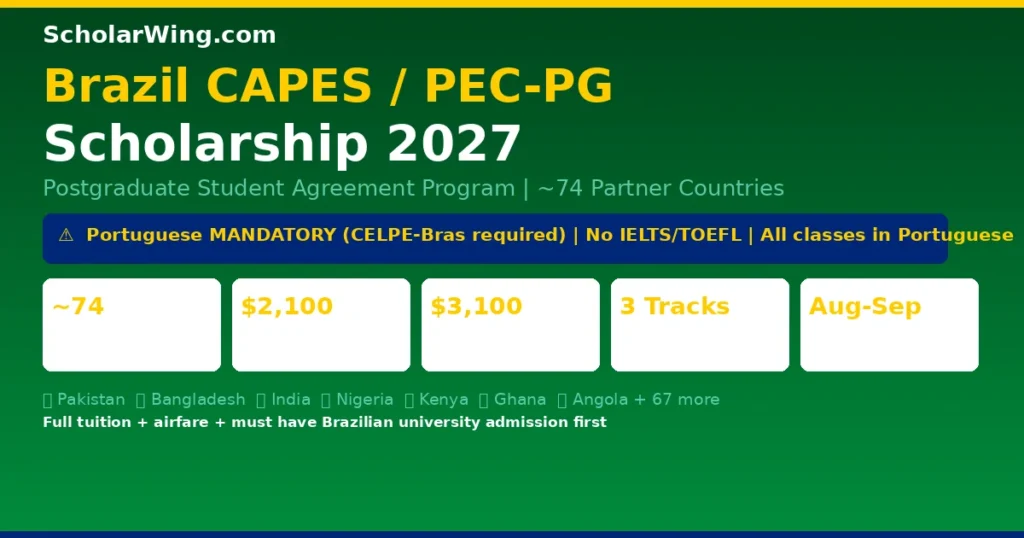
When people search for “Brazilian CAPES scholarship,” they are usually looking for the flagship Brazilian government postgraduate scholarship program. Strictly speaking, the scholarship is called PEC-PG, the Programa de Estudantes-Convênio de Pós-Graduação, or Postgraduate Student Agreement Program.
CAPES (Coordenação de Aperfeiçoamento de Pessoal de Nível Superior) is the Brazilian federal agency that co-administers and approves PEC-PG scholarship. It is one of the most powerful educational agencies in Latin America — responsible for evaluating, funding, and regulating every postgraduate program in Brazil. When CAPES approves your PEC-PG scholarship, it is using the same institutional authority that governs the quality of all of Brazil’s 6,000+ postgraduate programs.
The PEC-PG is managed by the Ministry of Foreign Affairs (MRE), the Coordination for the Improvement of Higher Education Personnel (CAPES) and the National Council for Scientific and Technological Development (CNPq). It functions as an international cooperation initiative, attracting foreigners to Brazil and encouraging the exchange of knowledge between partner countries, while also benefiting Brazilian institutions through the contact of Brazilian students and faculty with qualified researchers working abroad.
Applicants from PEC-PG partner countries across Africa, Asia, the Middle East, Europe, and the Americas may apply, approximately 74 countries.
Before anything else, one critical fact must be stated:
Since classes are taught in Portuguese, proof of language proficiency is mandatory. Candidates must demonstrate proficiency in Portuguese, typically via the CELPE-Bras certificate.
Portuguese is mandatory. Brazil’s postgraduate programs are conducted in Portuguese. This is not an English-medium scholarship. If you do not speak Portuguese, this scholarship requires a language investment before you can access it but for students willing to learn Portuguese, it opens access to some of the world’s most sophisticated research universities at an affordable cost.
CAPES, PEC-PG, PEC-G, CNPq — The Brazilian Scholarship Ecosystem Explained
Brazil’s international scholarship system has several interconnected programs. Clarifying them prevents confusion:
CAPES (Coordenação de Aperfeiçoamento de Pessoal de Nível Superior)
Brazil’s federal agency for postgraduate education not itself a scholarship, but the authority that approves PEC-PG awards, evaluates Brazilian postgraduate programs, and sets the quality standards that make a Brazilian degree internationally credible.
PEC-PG (Programa de Estudantes-Convênio de Pós-Graduação)
The main scholarship program for international postgraduate students. Managed jointly by MRE + CAPES + CNPq. Covers Master’s, PhD, and Sandwich Doctorate for students from ~74 partner countries. This is what most people mean when they say “CAPES scholarship.”
PEC-G (Programa de Estudantes-Convênio de Graduação)
The undergraduate track for Bachelor’s degree study in Brazil. Different eligibility, different application process. Countries that have an educational, cultural, or scientific and technological cooperation agreement with Brazil participate currently 73 countries.
CNPq (Conselho Nacional de Desenvolvimento Científico e Tecnológico)
Brazil’s national science and technology development council co-administers PEC-PG alongside CAPES and MRE.
For this guide: We focus on PEC-PG the postgraduate scholarship most often called the “Brazilian CAPES scholarship.”
Three Scholarship Tracks Under PEC-PG
The Brazil PEC-PG Scholarship supports three tracks: Full Master’s degree (up to 24 months), Full Doctorate/PhD (up to 48 months), and Sandwich Doctorate (6-10 months partial research in Brazil).
Track 1: Full Master’s (up to 24 months)
Complete a Master’s degree at a Brazilian Higher Education Institution. The program is taught in Portuguese. Monthly stipend: approximately $2,100/month + $400/month health insurance.
Track 2: Full PhD/Doctorate (up to 48 months)
Complete a Doctoral degree at a Brazilian HEI. Applicants must already hold a Master’s degree. Taught in Portuguese throughout. Covers the full duration of the PhD program.
Track 3: Sandwich Doctorate (6-10 months)
For a Sandwich Doctorate (PhD exchange/short-term stay in Brazil, 6-10 months): monthly stipend is $3,100 plus $400 per month for health insurance.
The Sandwich Doctorate is for PhD students currently enrolled in a doctoral program in their home country who want to spend 6-10 months in Brazil completing a specific research chapter or project. This track does not require full relocation, it is a research exchange within an existing PhD.
Full Financial Package
The scholarship provides a monthly stipend, health insurance, tuition waiver, and round-trip airfare.
Coverage by Track:
| Benefit | Master’s | Sandwich PhD | Full PhD |
|---|---|---|---|
| Monthly stipend | ~$2,100 | ~$3,100 | Similar to Master’s |
| Health insurance | +$400/month | +$400/month | +$400/month |
| Full tuition | ✅ Waived | ✅ Waived | ✅ Waived |
| Round-trip airfare | Partial/full | Partial/full | Partial/full |
| Research resources | ✅ Labs, supervisors | ✅ Research facilities | ✅ Labs, supervisors |
| Duration | Up to 24 months | 6-10 months | Up to 48 months |
Important financial warning: Applicants must be financially responsible for costs until receipt of the first stipend payment, including travel to Brazil. The stipend begins after arrival and processing budget for your first month of costs independently.
Eligible Countries — ~74 Partner Nations
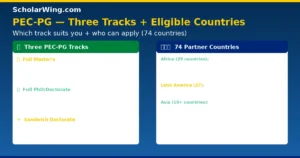
Applicants from PEC-PG partner countries across Africa, Asia, the Middle East, Europe, and the Americas may apply, approximately 74 countries.
Africa (29 Confirmed Partner Countries):
South Africa, Angola, Algeria, Benin, Botswana, Burkina Faso, Cape Verde, Cameroon, Côte d’Ivoire, Egypt, Ethiopia, Gabon, Ghana, Guinea-Bissau, Equatorial Guinea, Mali, Morocco, Mozambique, Namibia, Nigeria, Kenya, DR Congo, Republic of Congo, São Tomé and Príncipe, Senegal, Tanzania, Togo, Tunisia, Zambia.
Latin America & Caribbean (27 Confirmed Countries):
Argentina, Barbados, Belize, Bolivia, Chile, Colombia, Costa Rica, Cuba, El Salvador, Ecuador, Guatemala, Guyana, Haiti, Honduras, Jamaica, Mexico, Nicaragua, Panama, Paraguay, Peru, Dominican Republic, Saint Lucia, Saint Vincent and the Grenadines, Suriname, Trinidad & Tobago, Uruguay, Venezuela.
Asia (Confirmed):
Bangladesh ✅, China, South Korea, India ✅, Iran, Lebanon, Pakistan ✅, Syria and others.
Other Regions:
Various European and Middle Eastern countries with bilateral cooperation agreements. Check the full current list at capes.gov.br or mre.gov.br.
The Portuguese Language Requirement — The Critical Barrier
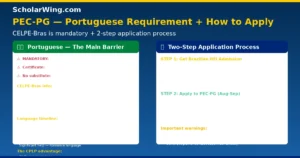
Since all academic activities and courses are conducted in Portuguese, proficiency in the language is required at the time of application. Candidates must have a certified Portuguese language proficiency certificate (CELPE-Bras) or proof of intention to obtain it if required.
CELPE-Bras (Certificado de Proficiência em Língua Portuguesa para Estrangeiros) is the official Brazilian Portuguese proficiency certificate administered by INEP (Instituto Nacional de Estudos e Pesquisas Educacionais). It is the only Portuguese certificate officially recognized by the Brazilian government for academic and immigration purposes.
CELPE-Bras levels:
- Intermediate
- Upper-Intermediate
- Advanced
- Upper-Advanced
Most PEC-PG programs require Intermediate level minimum; research-focused PhD programs often require Upper-Intermediate or Advanced.
Where to take CELPE-Bras: CELPE-Bras is administered at Brazilian Embassies and Cultural Centers (Instituto Cultural Brasileiro or affiliated centers) in partner countries. In Pakistan, contact the Brazilian Embassy Islamabad. In Nigeria, the Brazilian Embassy Abuja. And In India, the Brazilian Embassy New Delhi.
For non-Portuguese speakers — language investment timeline: Portuguese is linguistically close to Spanish (if you speak Spanish, Portuguese reading comprehension comes faster) and has roots shared with Italian and French. For English-only speakers, reaching Intermediate Portuguese from zero typically requires 6-12 months of dedicated study. The investment is significant but Portuguese opens not just Brazil but all CPLP countries (Portugal, Angola, Mozambique, Cape Verde, Guinea-Bissau, São Tomé e Príncipe, East Timor).
No IELTS or TOEFL required but Portuguese replaces them.
How to Apply — Two-Step Process
Step 1: Secure Brazilian HEI Admission
Before applying, candidates must have received formal acceptance from a Brazilian Higher Education Institution (HEI).
You cannot apply for PEC-PG without first being accepted by a Brazilian university for your Master’s or PhD program.
How to find a Brazilian supervisor/program:
- Visit capes.gov.br search for CAPES-evaluated programs in your field
- Browse programs at top Brazilian universities: USP, UNICAMP, UNESP, UFRJ, UFMG, UFSC
- Contact potential supervisors directly — email Brazilian professors in your research field
- Confirm the program is taught in Portuguese and CAPES-evaluated (necessary for PEC-PG)
Major Brazilian Research Universities:
| University | Location | Strengths |
|---|---|---|
| USP (Universidade de São Paulo) | São Paulo | QS top 200 globally — medicine, engineering, sciences, humanities |
| UNICAMP (Universidade Estadual de Campinas) | Campinas, SP | Technology, sciences, engineering |
| UNESP | São Paulo state | Sciences, agriculture, engineering |
| UFRJ (Universidade Federal do Rio de Janeiro) | Rio de Janeiro | Sciences, engineering, health |
| UFMG (Universidade Federal de Minas Gerais) | Belo Horizonte | Sciences, social sciences, arts |
| UFSC (Universidade Federal de Santa Catarina) | Florianópolis | Engineering, technology |
| UnB (Universidade de Brasília) | Brasília | Law, social sciences, international studies |
Step 2: Apply to PEC-PG
Candidates can register according to the available positions. The selection process by Brazilian HEIs will occur in multiple rounds, followed by CAPES review and final approval.
Annual application window: August-September (for the following year’s cohort) Estimated 2027/2028 opening: August 2026
Application process:
- Register on the PEC-PG online platform (capes.gov.br or the dedicated PEC-PG portal)
- Upload all required documents
- Brazilian HEIs review applications in multiple rounds (September-October)
- CAPES final document analysis and approval (November)
- Final results published (December for Master’s/PhD, May for Sandwich Doctorate)
Documents Required:
| Document | Detail |
|---|---|
| ✅ Passport | Valid, from PEC-PG partner country |
| ✅ Academic transcripts | All previous degrees |
| ✅ Degree certificates | Bachelor’s (for Master’s applicants) + Master’s (for PhD applicants) |
| ✅ HEI acceptance letter | Brazilian university acceptance — MANDATORY before applying |
| ✅ Research proposal | Describing your proposed Master’s/PhD research |
| ✅ CELPE-Bras certificate | Or proof of intent to obtain |
| ✅ Letters of recommendation | Typically 2 academic references |
| ✅ CV | Academic and professional history |
| ✅ Medical certificate | Health clearance |
| ✅ Financial responsibility declaration | Confirming you can cover costs until first stipend |
Brazil as a Study Destination
Brazil is the world’s 9th largest economy, the largest country in Latin America, and the world’s largest Portuguese-speaking nation (215 million people). Its research university system is among the most sophisticated in the Global South:
Academic strengths: Brazil has world-class programs in agriculture and tropical sciences (the Embrapa agricultural research network is globally recognized), medicine, engineering, biodiversity and environmental sciences, social sciences, and humanities.
Research infrastructure: USP’s Institute of Physics and Institute of Chemistry have produced Nobel Prize-adjacent research. Brazil’s agricultural research on soy, sugarcane ethanol, and tropical agriculture is globally influential.
Living costs: São Paulo and Rio de Janeiro are more expensive than other Brazilian cities, but remain significantly cheaper than European or North American universities. The stipend of $2,100/month is adequate for student life in most Brazilian cities outside the most expensive neighborhoods.
Cultural richness: Brazil’s cultural diversity African, Indigenous, European, and Asian influences creates a uniquely dynamic research environment for social scientists, anthropologists, and public health researchers.
Brazilian Portuguese: Once learned, opens access to the CPLP 9 nations with 280 million speakers. Portugal (EU access), Angola, Mozambique (two of Africa’s fastest-growing economies), and others.
Country-Specific Notes
🇵🇰 Pakistan
Pakistan is a eligible PEC-PG partner country. Pakistani students in engineering, agriculture, medicine, and social sciences can apply. The main barrier is Portuguese contact the Brazilian Embassy in Islamabad for CELPE-Bras examination schedule and language preparation resources.
🇧🇩 Bangladesh
Bangladesh is eligible. Bangladesh’s climate science, agricultural research, and public health scholars will find excellent counterpart programs at Brazilian universities studying tropical agriculture, climate adaptation, and public health systems.
🇮🇳 India
India is eligible. Given India’s large research community and strong bilateral ties with Brazil (both BRICS members), India-Brazil academic collaboration is active. Engineering, medicine, sciences, and social sciences all have strong Brazilian counterparts.
🌍 Africa (29 countries)
Nigeria, Kenya, Ghana, Ethiopia, Morocco, Egypt, Angola, Mozambique — all eligible. For Lusophone African students (Angola, Cape Verde, Guinea-Bissau, Mozambique, São Tomé), Portuguese is not a barrier. For Francophone African students (Senegal, Côte d’Ivoire, Mali, Togo, Benin), French language ability accelerates Portuguese learning significantly. Anglophone Africans (Nigeria, Kenya, Ghana, Tanzania, Zambia) face the most investment in language preparation but gain access to one of the world’s most dynamic research systems.
Practical Tips
1. Start Portuguese now — not when the application opens CELPE-Bras preparation is the timeline-defining factor. If you want to apply for the 2027/2028 cycle (August 2026 opening), begin Portuguese study immediately and schedule a CELPE-Bras exam at the Brazilian Embassy in 2026.
2. Contact Brazilian professors before the application cycle opens HEI acceptance is required before PEC-PG application. Email Brazilian professors in your field months in advance. Explain your research interest, your background, and your intention to apply through PEC-PG. A supportive professor significantly improves your admission chances.
3. Choose university and city carefully São Paulo (USP, UNICAMP, UNESP) has the most programs but higher costs. Rio de Janeiro (UFRJ) is vibrant but expensive. Smaller cities (Florianópolis, Belo Horizonte, Campinas) offer better cost-of-living on the stipend.
4. Budget for your first month independently Applicants must be financially responsible for costs until receipt of the first stipend payment, including travel to Brazil. Have a month’s expenses in reserve before departure.
5. Research cannot be for military purposes This fellowship program is not available to those conducting research for military uses or purposes. Dual-use research areas need careful framing.
Quick Reference
| Element | Detail |
|---|---|
| Official program name | PEC-PG (Programa de Estudantes-Convênio de Pós-Graduação) |
| Administered by | MRE + CAPES + CNPq |
| Partner countries | ~74 (incl. Pakistan, Bangladesh, India, 29 African) |
| Tracks | Master’s (24mo) + Full PhD (48mo) + Sandwich PhD (6-10mo) |
| Master’s stipend | ~$2,100/month + $400 health insurance |
| Sandwich PhD stipend | ~$3,100/month + $400 health insurance |
| Tuition | 100% waived |
| Airfare | Partial/full round-trip |
| Portuguese | MANDATORY — CELPE-Bras certificate |
| IELTS/TOEFL | NOT required |
| HEI acceptance | Required BEFORE PEC-PG application |
| Application window | August-September annually |
| 2027 cycle expected | August 2026 |
FAQ
What is PEC-PG?
The PEC-PG is managed by the Ministry of Foreign Affairs, CAPES, and CNPq as an international cooperation initiative, offering fully funded postgraduate scholarships to students from Brazil’s ~74 partner countries.
Is Portuguese mandatory?
Yes, since classes are taught in Portuguese, proof of language proficiency is required. Candidates typically need the CELPE-Bras certificate.
Is IELTS or TOEFL mandatory?
No, the program does not require IELTS/TOEFL. Portuguese proficiency is the language requirement instead.
What is the monthly stipend?
For a Full Master’s program, approximately $2,100/month plus $400/month health insurance. For Sandwich Doctorate, approximately $3,100/month plus $400/month health insurance.
Do I need Brazilian HEI acceptance before applying?
Yes, candidates must have received formal acceptance from a Brazilian Higher Education Institution before applying for PEC-PG.
How many countries are eligible?
Approximately 74 partner countries across Africa, Asia, the Middle East, Europe, and the Americas.
When does the application open?
Annually in August-September.
Free Application Tools
- Motivation Letter: Motivation Letter Generator
- SOP / Study Plan: SOP Generator
- CV: Free CV Builder
- Reference Letter: Reference Letter Generator
- MOI Certificate (if needed): MOI Generator
- Research Proposal (PhD): Research Proposal Generator