
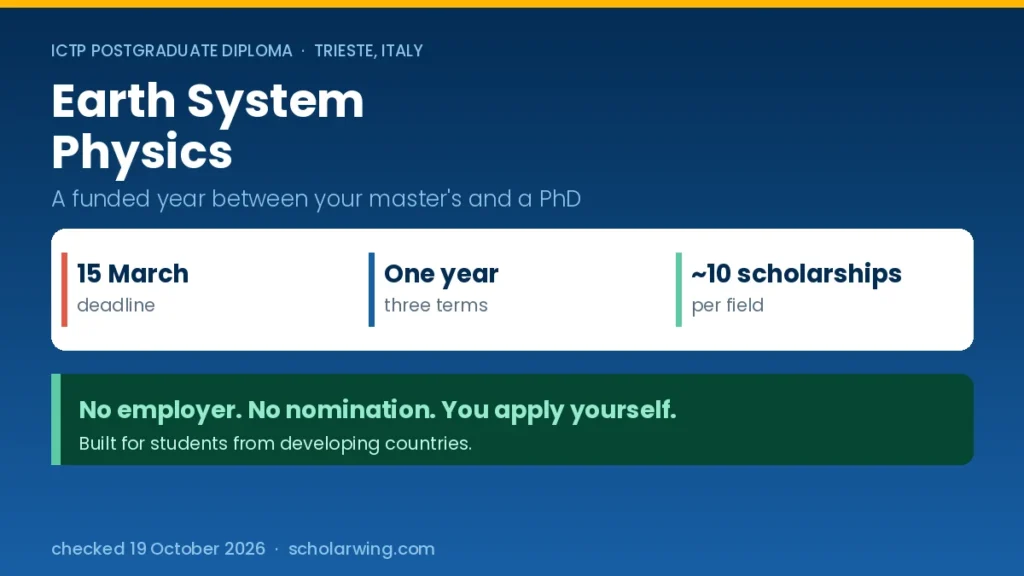
ICTP Earth System Physics:
There is a gap in most people’s plans between finishing a master’s in Pakistan and being competitive for a funded PhD abroad. The Earth System Physics stream at ICTP exists to fill exactly that gap.
It is a one-year, fully funded diploma in Trieste, aimed at students from developing countries, and it functions as a bridge rather than a destination. You arrive with a master’s and leave with a year of serious physics behind you and supervisors who can write about your work.
The deadline is 15 March. Our main ICTP Postgraduate Diploma guide covers the entry requirements, the scholarship and how the programme came about; this post covers what the Earth System Physics year is actually like and who should choose it.
How the year actually runs
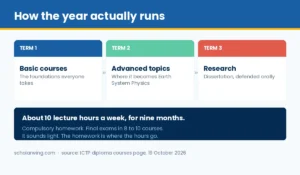
Three terms, and the shape matters more than the syllabus.
Term one: basic courses. The foundations everyone needs, regardless of which stream admitted them.
Term two: advanced topics in your field. This is where Earth System Physics becomes Earth System Physics rather than general physics.
Term three: research under a faculty supervisor. The last three months go on a dissertation, defended orally.
ICTP publishes the workload, and it is real: about ten hours of lectures a week across the first nine months, with compulsory homework, and final exams in each of the eight to ten courses you take. Grades come from problem sets and those exams.
Ten lecture hours a week sounds light to anyone used to a Pakistani timetable. It is not. The homework is where the hours go, and the exams are per course rather than aggregated.
Who this stream suits
A master’s graduate in physics, mathematics, meteorology, environmental science or a related subject who wants to work on climate, the atmosphere, the oceans or the solid Earth, and who needs a stronger physics and modelling foundation before a PhD.
It suits three people in particular.
Someone whose master’s was good but whose university is unknown abroad. A year at ICTP puts a recognized name on your record and gives you referees whose letters admissions committees read.
Someone who wants the climate side rather than the forecasting side. Earth System Physics is a physics stream, built around understanding the system, not around operational weather service work.
Someone who cannot reach the other routes. Which brings us to the comparison that matters.
Where this sits in the field
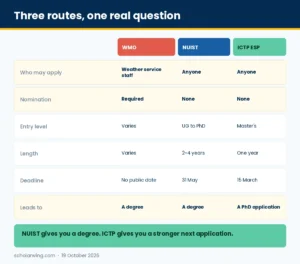
Three routes dominate funded study in this area, and they differ on one question: who may apply.
| WMO Fellowships | NUIST | ICTP ESP | |
|---|---|---|---|
| Who may apply | National weather service staff only | Anyone | Anyone from a developing country |
| Nomination | Required, by your Permanent Representative | None | None |
| Entry level | Varies | Undergraduate to doctoral | Master’s-equivalent |
| Length | Varies | 2 to 4 years | One year |
| Deadline | No public date | 31 May | 15 March |
| What it leads to | A degree, then back to your service | A degree | A PhD application |
Our WMO Fellowships guide explains the nomination rule in full, and our NUIST guide covers the Chinese route. If you do not work at the Pakistan Meteorological Department, the WMO column shuts you out, and the real choice lies between the other two.
The honest distinction: NUIST gives you a degree. ICTP gives you a year that makes your next application stronger. Pick on which of those you need.
What ICTP looks for
A degree equivalent to an MSc in physics, mathematics or a related field, and fluency in English. ICTP built the programme for students from developing countries, which places Pakistani applicants inside its intended group rather than at its edges.
Around ten scholarships per field, covering travel and living expenses.
Beyond that, the application turns on the same thing every research application turns on: whether you can describe a problem you have actually worked on and what you would do next with it. Our personal statement guide covers that argument.
Step-by-step
Step 1, now: check your degree against the MSc-equivalent bar. This is the gate, and nothing else rescues a shortfall.
Step 2, November: request transcripts with a grading scale. Pakistani universities are slow with the scale, and European admissions offices need it.
Step 3, December: read ICTP’s Earth System Physics section pages and note two or three researchers whose work overlaps yours. You will write better for having read them.
Step 4, January: write the application around one problem, not around your admiration for the field.
5, February: brief your referees.
Step 6: submit before 15 March, not on it.
Step 7: plan the PhD applications for the following autumn, while you are in Trieste. That is what the year is for.
FAQ
What is the deadline?
15 March.
Is it funded?
Yes. Around ten scholarships per field, covering travel and living expenses.
How long is it?
One year, in three terms.
What qualification do I need?
A degree equivalent to an MSc in physics, mathematics or a related field, plus fluency in English.
Is it a master’s?
No. It is a postgraduate diploma, designed as a bridge toward a PhD.
How heavy is the workload?
About ten hours of lectures a week over the first nine months, with compulsory homework and final exams in eight to ten courses.
Is there a thesis?
Yes, in the final three months, defended orally.
Who is it for?
Students from developing countries, which includes Pakistan.
How does it compare with NUIST?
NUIST awards a degree over two to four years. ICTP is one year and prepares you for a PhD application.
Can I apply if I do not work at a weather service?
Yes. Unlike WMO fellowships, this needs no employer and no nomination.
Where do I apply?
Through ICTP’s Postgraduate Diploma Programme pages.