
The Barakat Trust:
Most research funding in this field asks for a doctorate you do not have yet. The Barakat Trust does something different.
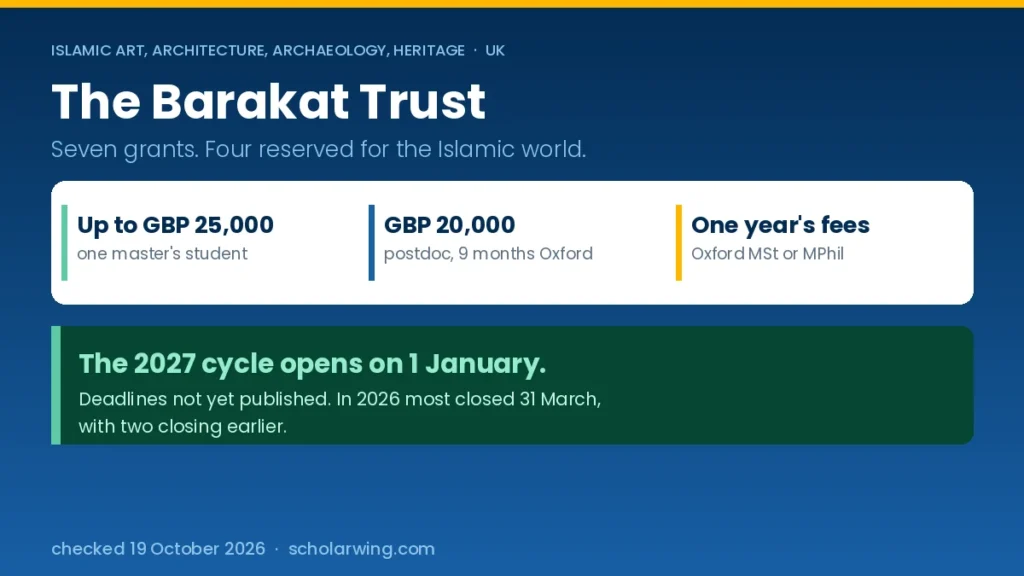
Four of its seven grants go only to applicants from the Islamic world, and one of them pays up to £25,000 to a single student starting a taught master’s. Pakistan sits inside that group, not at its edge.
The 2026 cycle has closed. The 2027 cycle opens on 1 January, and the Trust has not posted the 2027 dates yet. On last year’s pattern most categories closed on 31 March, with two closing earlier than that. So the useful work happens now, in the ten weeks before the window opens.
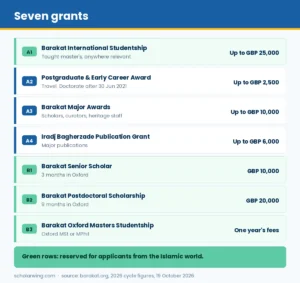
Seven grants, and who each one is for
| Code | Grant | Amount | For |
|---|---|---|---|
| A1 | Barakat International Studentship | Up to £25,000 | One student from the Islamic world accepted on a taught master’s in a relevant subject |
| A2 | Postgraduate Student & Early Career Award | Up to £2,500, travel | Postgraduate students, and early-career scholars whose doctorate came after 30 June 2021 |
| A3 | Barakat Major Awards | Up to £10,000 | Scholars, curators and heritage professionals, normally attached to a research institution |
| A4 | Iradj Bagherzade Publication Grant | Up to £6,000 | Major publications on Islamic art, architecture, archaeology or conservation |
| B1 | Barakat Senior Scholar | £10,000 | One established scholar from the Islamic world, three months in Oxford |
| B2 | Barakat Postdoctoral Scholarship | £20,000 | One postdoctoral scholar from the Islamic world, nine months in Oxford |
| B3 | Barakat Oxford Masters Studentship | One year’s fees | One student from the Islamic world accepted on an Oxford MSt or MPhil in Islamic Art and Architecture |
Read A1 and B3 together, because they answer different situations. A1 travels with you to whichever relevant taught master’s accepts you. B3 pays Oxford’s fees for one specific pair of degrees. A reader aiming at Oxford should know both exist; a reader aiming anywhere else should know A1 does not care which university admits them.
Both require an acceptance first. A1 makes no grant without proof of admission, so your university application comes before this one.
Two rules that end applications
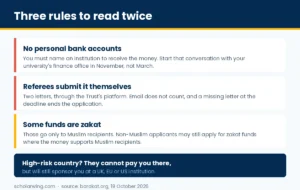
One: the Trust cannot pay a personal bank account. Individuals may apply, but you must name an institution to receive the money — a university, a museum, a charity or a company.
Settle this early. If you are a student, your university is the obvious recipient, but someone in its finance office has to agree to receive and administer the grant, and that conversation takes weeks in most Pakistani institutions. A reader who discovers this in late March has lost the cycle.
Two: your two referees submit their own letters through the Trust’s online platform. Email is not accepted. The Trust rejects any application missing either letter at the deadline, and mentions no discretion.
So the referee conversation starts in January, not March, and it has to include the platform rather than a request for a PDF. Our guide on asking a professor for a reference letter covers the brief, and for Barakat you add one line explaining that the letter goes in through a portal they will be emailed about.
The zakat note
Some of the Trust’s funds are zakat, which can only go to Muslim recipients.
The Trust also states that non-Muslim applicants may still apply for zakat funds where the money supports Muslim recipients, such as staff or trainees on a project. That is a more open position than the word usually implies, and it is worth stating accurately rather than letting readers assume either way.
Where you live, and where you can be paid
The Trust has funded projects in over forty countries, and it cannot pay grants into sanctioned countries.
One clause deserves attention from readers in difficult places. The Trust cannot pay a grantee inside a high-risk country, but will still sponsor them if a UK, EU or US institution accepts them and they obtain a visa. That is a route rather than a refusal, and almost nobody writes it down.
The 2026 dates, as a planning guide
| Grants | Expression of interest | Full application |
|---|---|---|
| A1, A2, A4, B1, B3 | — | 31 March 2026 |
| A3 | 15 February 2026 | 15 March 2026 |
| B2 | 1 March 2026 | 31 March 2026 |
Two categories ran earlier than the rest, and A3 closed sixteen days before everyone else. Treat these as the shape of the 2027 cycle rather than as dates, and confirm the real ones when the Trust publishes them in January.
The Trust also runs question-and-answer sessions in Arabic and English from January to March, which is unusual and worth attending rather than guessing.
Step-by-step
Step 1, now: pick your category. A1 if you are heading to a taught master’s anywhere. B3 if that master’s is Oxford’s MSt or MPhil in Islamic Art and Architecture. A2 if you are already a postgraduate and need travel money.
Step 2, now: sort your university admission, because A1 and B3 both require an acceptance before any grant is made.
Step 3, November: find your institution. Identify who will receive the funds and get a named person in that finance office to agree. This is the step that quietly decides everything.
Step 4, December: brief your two referees, and tell them the letters go through a portal rather than by email.
5, 1 January: download the right form for your category from the Trust’s site, after entering your email, and save it to your device before filling it in.
Step 6, January to March: attend a Q&A session. Ask the question you are least sure about.
Step 7, February: if you are applying for A3 or B2, remember the expression of interest comes first and earlier.
8: name your PDFs properly, in the format the Trust asks for, such as “K.Saleh_ApplicationForm”.
Step 9: submit early. Late or incomplete applications are not considered.
If this is not your field
The Trust funds Islamic art, architecture, archaeology, heritage and conservation specifically. For broader historical research with a doctorate, our Gerda Henkel guide covers a German foundation with no deadline and no nationality rule. For degree funding across the humanities generally, start with our arts and humanities scholarships page.
FAQ
When does the 2027 cycle open? 1 January 2027. The Trust has not published the deadlines yet.
What were the 2026 deadlines?
31 March for most categories, with A3 closing 15 March after a 15 February expression of interest, and B2 requiring an expression of interest by 1 March.
What is the largest grant?
The Barakat International Studentship, up to £25,000, for one student from the Islamic world.
Can a master’s student apply?
Yes. A1 and B3 are student awards, and A2 covers postgraduate students.
Do I need an offer from a university first?
For A1, yes. The Trust makes no grant without proof of acceptance.
Can the money come to my own bank account?
No. You must name an institution to receive it.
How do reference letters work?
Two referees submit through the Trust’s online platform. Email does not count, and the Trust rejects any application missing either letter at the deadline.
What is the zakat rule?
Some funds are zakat and can only go to Muslim recipients. Non-Muslim applicants may apply for zakat funds where the money supports Muslim recipients.
What if I live in a high-risk country?
The Trust cannot pay you there, but will still sponsor you if a UK, EU or US institution accepts you and you get a visa.
How many countries has it funded?
Over forty.
Who do I contact?