
WIPO DL-101 2026:
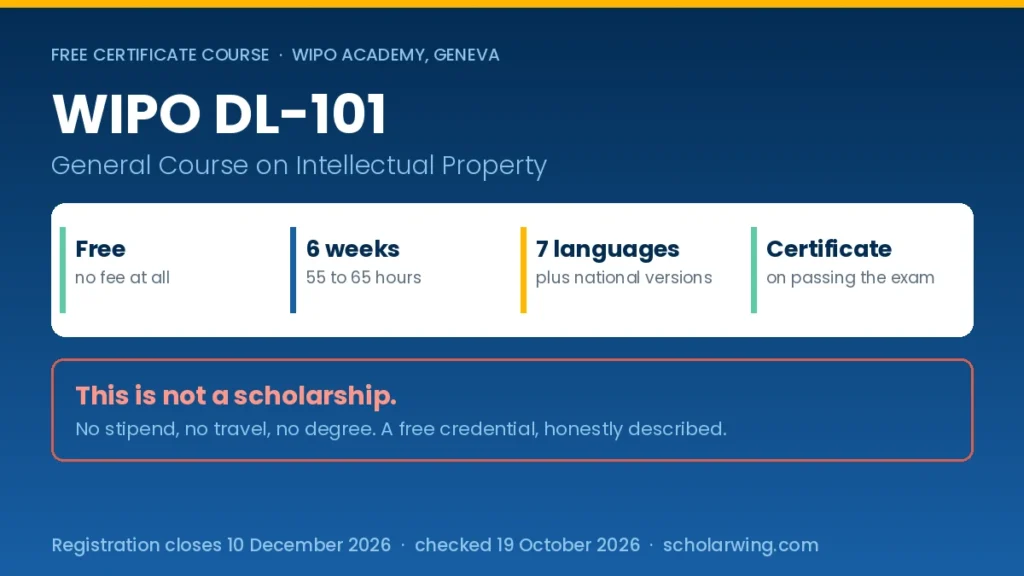
Start with the part most listicles leave out. DL-101 is not a scholarship. Nobody pays your rent, nobody flies you to Geneva, and nothing here becomes a degree.
What it does give you is a certificate from the World Intellectual Property Organization, a United Nations agency, for a course that costs nothing and takes about six weeks. For a law student, an engineer with an invention, a designer, a writer or anyone drafting a research proposal on IP, that line on a CV costs six weeks and zero rupees.
Registration for the current session closes on 10 December 2026, so a reader who starts this week finishes comfortably.
The basics
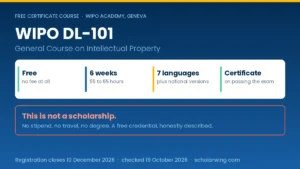
| Item | Detail |
|---|---|
| Fee | Free of charge |
| Length | Six weeks |
| Study load | Roughly 55 to 65 hours of material |
| Format | Online and self-paced |
| Assessment | Online multiple-choice final exam |
| Certificate | Electronic certificate of completion on passing |
| Languages | Seven: English, Arabic, Chinese, French, Russian, Spanish, Portuguese |
| Current session | 30 January 2026 to 15 December 2026 |
| Registration closes | 10 December 2026 |
WIPO also publishes an accessible format for people who are blind, visually impaired or otherwise print-disabled, and several national IP offices run their own language versions on top of the seven above.
Start with DL-001 instead, if IP is new to you
DL-101 builds on a shorter course, the Primer on Intellectual Property (DL-001). If you have never studied IP, do that one first. It is also free, it is much shorter, and it stops the first two modules of DL-101 feeling like a wall.
If you already studied IP in a law or business degree, skip the primer and register directly.
What the course covers
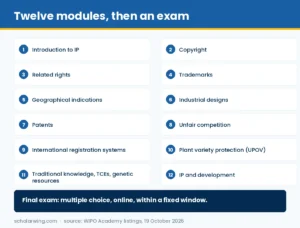
Twelve modules and a final exam. The ground runs from an introduction to IP through copyright and related rights, trademarks, geographical indications, industrial designs, patents and unfair competition, then into the international registration systems, plant variety protection, traditional knowledge, traditional cultural expressions and genetic resources, and finally intellectual property and development, including the WIPO treaties and the WIPO Development Agenda.
The last three areas are the reason this course is worth more to a Pakistani reader than a generic IP primer. Traditional knowledge, geographical indications and the development agenda are exactly where a country with crafts, textiles, agricultural products and regional foods has real stakes, and most introductory IP material from elsewhere barely touches them.
What this is not
Be honest with yourself before you register.
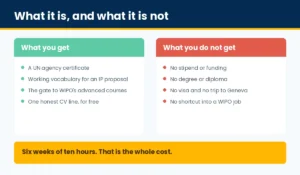
It is not funding. It is not a degree or a diploma. And it is not a route to a visa or to Geneva. Finishing it does not put you in front of a WIPO recruiter, and no admissions committee treats it as a qualification.
What it does do is three smaller things that add up. It gives you a verifiable certificate from a UN body for a CV that may be thin on credentials, which is worth adding through our free CV builder. It gives you the vocabulary to write a serious research proposal or personal statement on an IP topic rather than a vague one, and our personal statement guide covers turning that into an application. And it is the entry point to WIPO’s advanced and specialized courses, which is where the subject actually dee
Who should take it
A law student heading toward an LLM in IP, and anyone building a case for law scholarships, where a demonstrated interest beats a stated one.
An engineering or science student with something patentable, who currently has no idea how patents work and will hand away rights without noticing.
A designer, artist, musician or writer, because copyright and related rights decide whether your work earns anything.
A small business owner dealing in textiles, food or crafts, where trademarks and geographical indications are the whole game.
And a student who needs one honest credential on a CV this winter and has six weeks.
Eligibility criteria
1. No formal eligibility bar. WIPO describes the audience as students, young scholars, lawyers and anyone seeking general IP knowledge.
2. No degree requirement, and no entrance test.
3. DL-001 recommended first if IP is new to you, though the pages do not list it as a hard prerequisite.
4. One of the seven course languages, or a national office version if your office runs one.
5. Registration before the deadline. For this session, 10 December 2026.
6. A pass in the final multiple-choice exam to receive the certificate. Finishing the material alone does not produce one.
Step-by-step application process
Step 1, today: open the WIPO Academy course catalogue and find DL-101 in your chosen language. The catalogue lists the live sessions and their registration windows.
Step 2: decide on DL-001 first. Fifteen minutes reading its outline tells you whether you need it.
Step 3: register. Create the Academy account and enroll. There is no fee to pay and no document to upload.
Step 4: plan six weeks, not six days. Sixty hours across six weeks is ten hours a week. Across a final week it is a failed exam.
Step 5: do the in-module assessments as you go. They exist to show you where the exam will catch you.
Step 6: watch for the exam details. WIPO sends them ahead of the exam period, and the exam runs within a fixed window rather than whenever you are ready.
Step 7: download the certificate and put it on your CV properly — course name, WIPO Academy, year, and the certificate reference.
Step 8: go straight to the advanced courses. DL-101 is the gate to WIPO’s specialized programmes on patents, trademarks, copyright and more, and the momentum is worth keeping.
FAQ
Is DL-101 free?
Yes. WIPO lists it as free of charge.
Is it a scholarship?
No. There is no stipend, no travel and no degree.
How long does it take?
Six weeks, with roughly 55 to 65 hours of material. Published figures differ slightly between WIPO’s own listings.
Do I get a certificate?
Yes, an electronic certificate of completion, on passing the final exam.
What is the exam like?
Multiple choice, taken online within a fixed timeframe.
Which languages?
English, Arabic, Chinese, French, Russian, Spanish and Portuguese, plus versions run by some national IP offices.
Do I need a law degree?
No. There is no degree requirement.
Should I take DL-001 first?
If IP is new to you, yes. DL-101 builds on it.
When does registration close?
10 December 2026 for the current session, which runs to 15 December 2026.
Will this get me a job at WIPO?
No. Treat it as a credential and a foundation, not a recruitment route.
Can I do it alongside a degree?
Yes. It is self-paced, and ten hours a week is the realistic load.