
ICTP Diploma 2027:
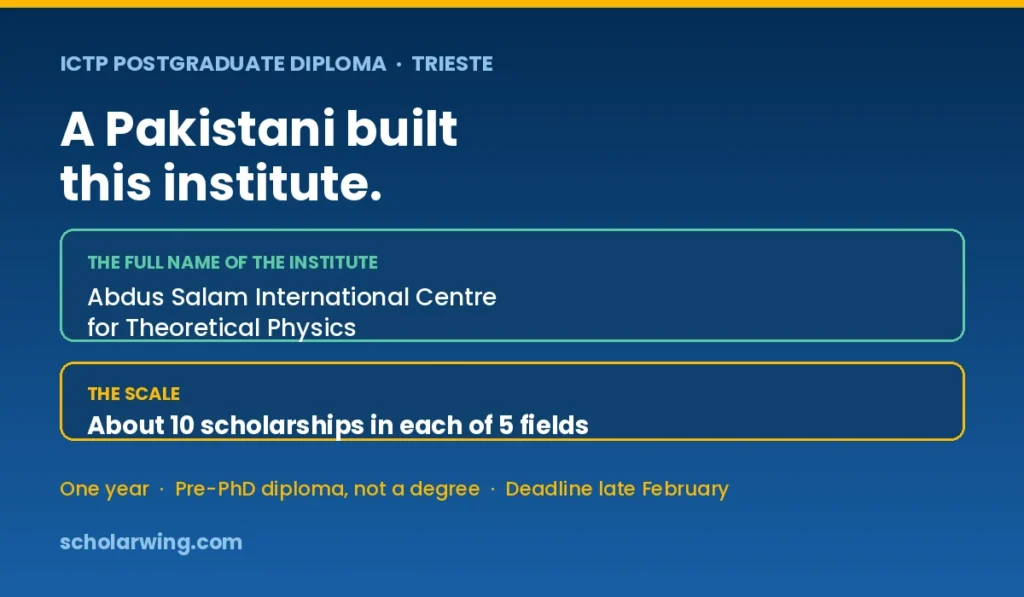
The full name of the institute is the Abdus Salam International Centre for Theoretical Physics.
Pakistan’s only science Nobel laureate founded it in Trieste, and he founded it for a specific reason: so that physicists and mathematicians from countries like his own would not have to leave science because their universities lacked the money. Sixty years later it still runs on that idea, and the Postgraduate Diploma is the front door.
Most Pakistani students have never heard of it. That is the opportunity.
What it actually is
One year in Trieste, Italy. Two semesters of coursework, then a research project and a dissertation. You come out with the ICTP Postgraduate Diploma.
Say the honest thing first: this is a diploma, not a master’s and not a PhD. It exists to take a strong graduate from a developing country and prepare them to enter a doctorate abroad that they could not have entered directly. That is a narrow purpose, and it is the right purpose for a great many Pakistani physics and mathematics graduates whose degrees are good but whose universities are invisible to foreign admissions committees.
If a PhD place is what you are ultimately after, read it alongside our PhD scholarships guide. The Diploma is the step before that one, not a substitute for it.
The five streams
You apply to exactly one:
| Stream |
|---|
| High Energy, Cosmology and Astroparticle Physics |
| Condensed Matter Physics |
| Earth System Physics |
| Mathematics |
| Quantitative Life Sciences |
Earth System Physics deserves a note for Pakistani readers. It covers climate, atmosphere, oceans and seismology, and Pakistan has serious work in all four — monsoon variability, glacier melt in the north, the Makran subduction zone, flood modelling in the Indus basin. A candidate who connects the stream to real national problems writes a stronger file than one who writes about a love of physics.
Mathematics applicants should also look at the IMU Breakout Fellowship, which funds a math’s PhD inside a developing country and works on a nomination rather than an application.
What it pays
ICTP offers a limited number of scholarships, around ten per field, covering travel and living expenses during the stay.
Five streams at roughly ten each puts the scale near fifty places a year, which is generous beside almost anything else in physics funding for developing countries. ICTP selects on university performance and academic recommendations, so your transcript and your two referees carry the weight.
Eligibility criteria
1. A degree equivalent to an MSc in physics, mathematics or a related field. In Pakistan that means an MSc, an MPhil, or a four-year BS depending on how ICTP assesses it, and that assessment is worth asking about directly before you assume either way.
2. Fluency in English. ICTP asks for fluency rather than naming a test score, which is unusual and helpful. If your English is strong but untested, that works in your favor here in a way it does not elsewhere. Our scholarships without IELTS page covers the wider set of routes that do the same.
3. A developing-country background. The programme is aimed at students from disadvantaged countries, and the scholarships go to candidates from developing countries.
4. Young and early career. ICTP describes applicants as “young, qualified graduates” without printing an age limit.
5. Strong academic recommendations. Selection rests on university performance and references, so brief your referees properly. Our guide on asking a professor for a reference letter covers how.
6. One stream, chosen deliberately. You apply to a single subject area, not to the programme in general.
Dates
| Cycle | Deadline |
|---|---|
| 2026-2027 | 28 February 2026 on the poster, extended to 15 March 2026 |
| 2027-2028 | Expect late February 2027 |
ICTP also ran a question-and-answer session on 23 February at 14:00 CET in the last cycle. Watch for the equivalent, because a live session with the people who read the applications is worth an hour of anyone’s time.
Check diploma.ictp.it from early January.
Step-by-step application process
Step 1, now: settle your stream. Five choices, one application. Pick the one your degree and your interests actually support, not the one that sounds most impressive.
Step 2, November: start the transcript process. Pakistani universities are slow with certified documents and the February window is short.
Step 3, November: ask your two referees. Give them three months, your transcript, your stream, and a paragraph on why you want this. A reference written in a hurry reads like one.
Step 4, December: email ICTP about your degree. If you hold a four-year BS rather than an MSc, ask diploma@ictp.it directly whether it meets the requirement. Do not guess, and do not let a scholarship site guess for you.
Step 5, January: watch the site. The call and the deadline usually appear together with about a month’s notice.
Step 6, February: write the application around a problem. ICTP funds people who will take the physics home. Name the Pakistani question your stream touches, then name what you would do with a year of proper training.
Step 7: attend the Q&A session if ICTP runs one again.
Step 8: submit early. ICTP extended the deadline in the last cycle. Treat that as luck rather than a pattern.
If ICTP does not fit
If your degree does not meet the MSc-equivalent bar, the normal route is a funded master’s abroad first, and our DAAD guide covers the largest of those. If you want to stay in Pakistan for a mathematics doctorate, the IMU Breakout Fellowship linked above is the one route built for that.
FAQ
Is this a master’s degree?
No. It is a one-year Postgraduate Diploma, designed to prepare you for a PhD abroad.
What qualification do I need?
A degree equivalent to an MSc in physics, mathematics or a related field.
Does a Pakistani four-year BS count?
Ask ICTP. The requirement is stated as MSc-equivalent and the assessment is theirs to make.
Do I need IELTS?
ICTP asks for fluency in English and does not name a test score on the call we read. Confirm for your cycle.
How many scholarships are there?
Around ten per field, across five fields, covering travel and living expenses.
Which stream should I pick?
The one your degree supports. For Pakistani readers, Earth System Physics connects most directly to national work on climate, glaciers, floods and seismology.
Is Pakistan eligible?
Yes. The programme exists for students from developing countries, and ICTP’s founder was Pakistani.
When is the deadline?
Late February. The last cycle was set at 28 February and extended to 15 March.
Where is it? Trieste, in northern Italy.
Can I apply to two streams?
No. One subject area, one application.