
IMU Breakout Fellowship 2027:
Almost every scholarship on this site moves you somewhere else. This one pays you to stay.
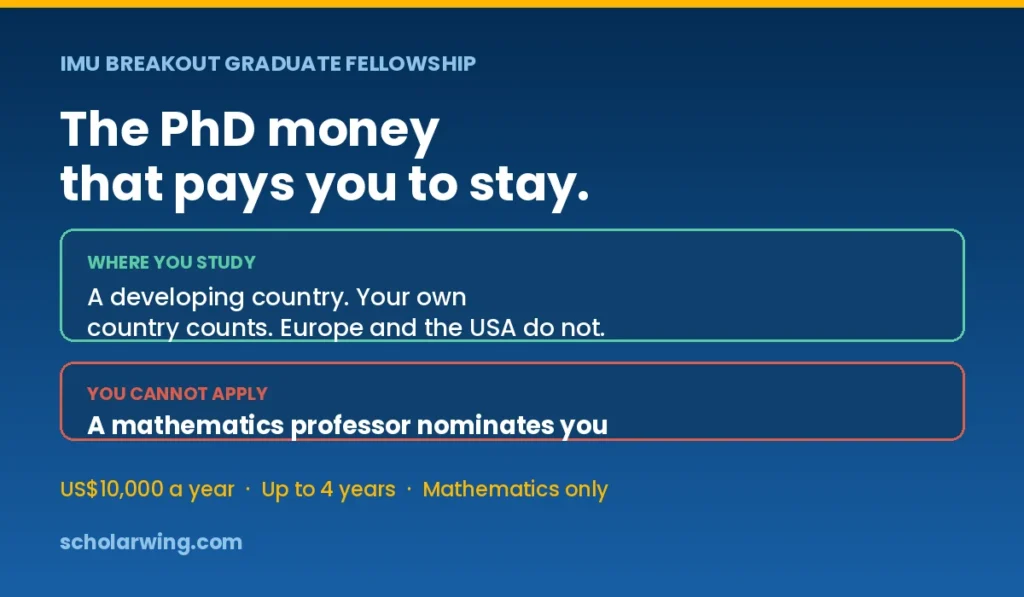
The International Mathematical Union funds mathematics PhDs inside the developing world, including in your own country. You can take it at a Pakistani university. You cannot take it to Oxford, and the rules state that restriction outright rather than implying it.
There is a second rule that catches everyone. You cannot apply. The IMU states it in one line: “Individual PhD candidates cannot apply themselves for the fellowship.” A professor nominates you, or nothing happens.
Who this is for
Mathematics, and mathematics only. The IMU invites “professional mathematicians to nominate highly motivated and mathematically talented students,” and the Commission for Developing Countries runs it.
A physics, computer science or statistics student does not fit, though genuinely mathematical work inside those fields often does. If your thesis would sit comfortably in a mathematics department, you are in the right place.
The bigger question is where you intend to study. If you want a funded PhD abroad, read our PhD scholarships guide or the CSC China route instead, because this fellowship cannot take you to Europe or North America. If you plan to do your doctorate at home, or anywhere else in the developing world, almost nothing else on the internet funds that properly.
What it pays
| Item | Detail |
|---|---|
| Annual cap | US$10,000 a year |
| Duration | Up to four years, or until the PhD is finished, whichever comes first |
| Tuition | Covered |
| Travel to the institution | Covered |
| Housing | Covered |
| Basic living expenses | Covered |
| Renewal | Depends on satisfactory progress in annual reports |
Put that number in context before you judge it. Ten thousand US dollars a year does not go far in London. In Lahore, Karachi or Islamabad it funds a doctorate properly, and it does so while you stay near your family, keep your language, and build a research group that stays in the country afterwards. That is the entire point of the fellowship.
Eligibility criteria
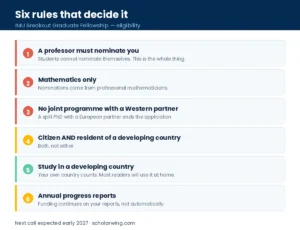
1. A professor must nominate you. The nominator needs a PhD, a post at a university or research center, and must currently supervise mathematics Master’s or PhD students. The IMU is explicit that students cannot nominate themselves.
2. Mathematics. The fellowship exists for mathematically talented students, nominated by professional mathematicians.
3. Citizenship and residence in a developing country, as the IMU defines the list. You must be both a citizen of and resident in one.
4. Study at a recognized university or research institution in a developing country. Your own country counts.
5. No joint programmes with institutions in non-developing countries. This is the rule that disqualifies people quietly. A split PhD with a European partner, however prestigious, ends the application.
6. Annual progress. Funding continues on the strength of your yearly reports, not automatically for four years.
Dates
The 2026 call closed on 30 May 2026 at 23:59 CET. The IMU expects the next call to open in early 2027.
That gives you roughly three months, and you need most of them, because the deadline you are working to is not the IMU’s. It is the day your professor agrees.
The part that actually decides it
Everything above is public. This section is why the post exists.
Your application is a nomination, so your real task between now and the call is persuading one mathematician to spend their own time on you. Professors nominate students they already believe in. They almost never nominate someone who appears in their inbox in February with a request and a deadline.
Start this month. Find the mathematician in your department, or at a nearby university, whose field overlaps your interest. Read two of their papers properly. Go to their office with a question about the second one, not with a request.
Let them see you work. Sit in on a seminar. Ask for a reading list and come back having read it. Offer to present something. A nomination puts a professor’s reputation on your name, and you earn that over months, not over an email.
Bring a direction, not a plan. You do not need a finished proposal to be nominated, and you do need to sound like someone with a question worth four years. Our PhD research proposal guide covers how to shape one once the conversation is going.
Then ask properly. When the relationship is real, ask directly, early, and make it easy to say yes: tell them the fellowship exists, that nomination is required, roughly when the call opens, and offer to prepare everything they would otherwise have to assemble. Our guides on finding a PhD supervisor and emailing a professor both apply here.
Step-by-step
Step 1, October to December: build the relationship with a potential nominator. This is the whole fellowship.
Step 2, December: check the IMU’s grants page for the new call. They publish no advance notice.
Step 3, January: confirm Pakistan’s place on the IMU’s developing-country list in writing. Almost certainly yes, and get it confirmed anyway.
Step 4, January: confirm your intended PhD has no joint arrangement with a non-developing-country institution. If it does, choose differently or lose the fellowship.
Step 5, February: ask your nominator formally, with everything prepared.
6: submit through your nominator, before the deadline rather than on it.
Step 7, afterwards: keep your annual reports honest and on time, because renewal rides on them.
FAQ
Is it only for mathematics?
Yes. The IMU runs it and nominations come from professional mathematicians.
Can I apply myself?
No. The IMU states that individual PhD candidates cannot apply themselves. A professor must nominate you.
Can I use it to study in the UK, Europe or the USA?
No. You must study at a recognized institution in a developing country, and joint programmes with non-developing-country institutions are excluded.
Can I do the PhD in my own country?
Yes. Nominees may study in their home country, and for most readers that is the point of it.
Is Pakistan eligible?
Pakistan sits in the IMU’s developing-country category, and you should confirm against their current list before relying on it.
How much is it?
Up to US$10,000 a year, covering tuition, travel to the institution, housing and basic living expenses.
How long does it last?
Up to four years, or until you complete the PhD, whichever comes first. Renewal depends on your annual reports.
When does the next call open?
The 2026 call closed on 30 May 2026. The IMU expects the next one in early 2027.
What if no professor will nominate me?
Then this fellowship is closed to you this cycle, and the honest answer is to spend the year earning one rather than hunting for a workaround.