
SQU Oman Scholarship 2027:
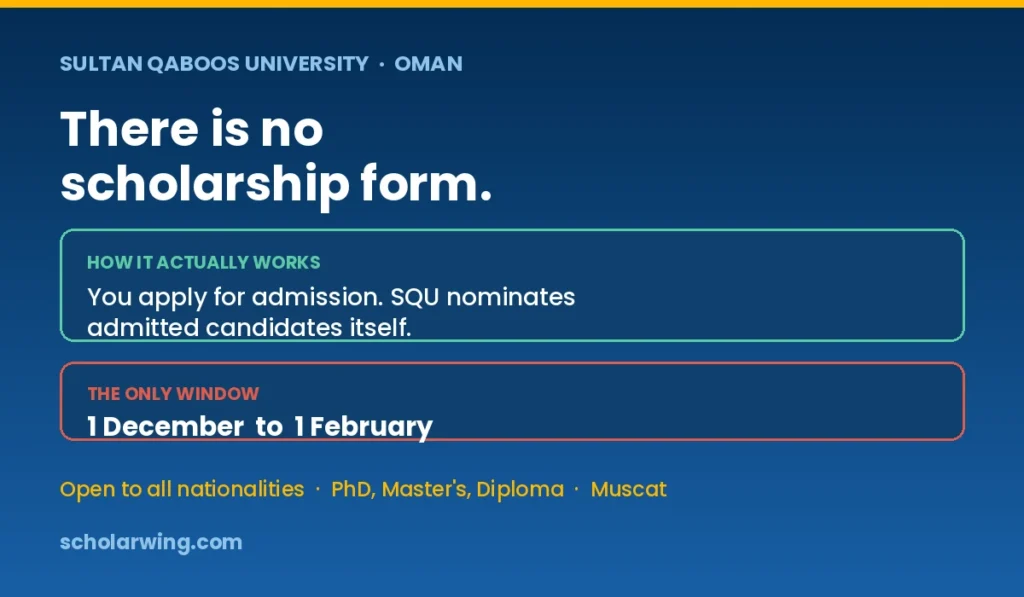
There is no SQU scholarship form. You will look for one, and you will not find it, because it does not exist.
Sultan Qaboos University runs its international postgraduate scholarship on a different model from almost everything else we cover. You apply for admission. If SQU gives you an unconditional offer, its International Students Section puts your name forward for the scholarship by itself. Nobody fills in a second application.
That single fact changes where your effort goes. The admission file is the scholarship application. There is no later stage to rescue a weak one.
The only date that matters
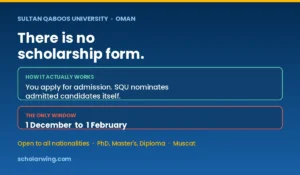
SQU’s postgraduate applications run from 1 December to 1 February, for study starting the following September. The application fee is 10 Omani Rials, non-refundable.
That window is nine weeks, and it falls across the winter holidays in Pakistan, which is when attestation offices and university registrars move slowest. Start collecting documents in October, not December.
What SQU offers
Three levels for non-Omani applicants: PhD, master’s and postgraduate diploma. SQU’s own terms describe “a limited number of scholarships and sponsorship seats governed by conditions and regulations”, without printing the number.
Elsewhere that number appears as two master’s scholarships a year. We could not confirm it with SQU, and we are printing it anyway with that warning attached, because a reader deciding where to spend nine weeks deserves to know the scale even when the figure is uncertain. If it is right, this is one of the most competitive awards on our site. Treat SQU as a serious long shot alongside a safer application, not as a plan on its own.
What it pays
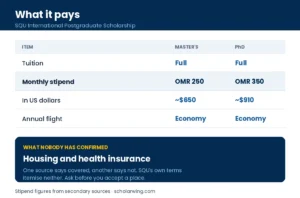
| Item | Master’s | PhD |
|---|---|---|
| Tuition | Full | Full |
| Monthly stipend | OMR 250, about US$650 | OMR 350, about US$910 |
| Annual flight | Two-way economy to your nearest international airport | Same |
| Probation and course-repetition fees | Covered | Covered |
What we cannot confirm is housing and health insurance. One source says the scholarship covers on-campus accommodation and insurance. Another says housing, health insurance, application fees and bridging course costs all fall on you. SQU’s own terms document settles neither.
This matters more than any other line in the post. In Muscat, accommodation is the difference between a comfortable stipend and a tight one. Write to SQU and ask before you accept anything, and do not let a scholarship site decide your budget.
Eligibility criteria
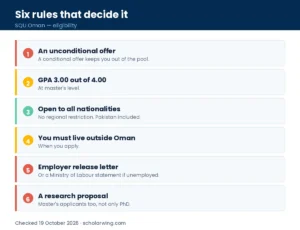
1. An unconditional admission offer. Everything begins here. A conditional offer does not put you in the pool.
2. GPA of 3.00 out of 4.00 at master’s level.
3. English. SQU’s own terms set the admission bar at IELTS 5.5 or TOEFL 69 for master’s and diploma programmes taught in English, and IELTS 6.0 or TOEFL 79 for PhD programmes. The scholarship itself may ask for more. One source puts the scholarship requirement at IELTS 6.0 or TOEFL iBT 61, which sits above the master’s admission bar. If your score lands between 5.5 and 6.0, that gap decides whether you get in but miss the money, so confirm it directly. If English testing is your obstacle in general, our scholarships without IELTS list covers routes that skip it.
4. Residence outside Oman when you apply.
5. Full-time enrolment for the whole scholarship.
6. Open to all nationalities. Pakistan included, with no regional restriction of the kind that shuts Pakistanis out of several Gulf and European schemes.
The documents that actually delay people
SQU asks for the usual attested degree certificate and transcripts, plus a CV, two recommendation letters, an English certificate, and your passport, ID and photo. Three more items catch people out.
A release letter or study leave from your employer. If you work, SQU wants your employer’s written agreement. If you do not work, SQU wants a statement from the Ministry of Labour instead. Most applicants discover this in January.
A research proposal. Not only for PhD applicants. It sits in the general postgraduate document list, so a master’s applicant needs one too. This is the item that takes weeks and the one most people underestimate. Our personal statement guide covers the thinking, though a proposal is a different animal: name a question, name why Oman is the place to study it, and name what you will do with the answer.
Attested transcripts with the grade classification key. SQU wants the key that explains your university’s grading scale, not just the marks. Pakistani universities rarely issue it unless you ask by name.
Step-by-step application process
Step 1, October: start attestation. Degree, transcripts and the grading key. This is the long pole and the window opens on 1 December.
Step 2, October: ask your employer for the release letter. Or get the Ministry of Labour statement if you are not working.
Step 3, November: write the research proposal. Give it four weeks, not four days.
Step 4, November: sit or book your English test. Aim for IELTS 6.0 rather than 5.5, since the scholarship bar may sit above the admission bar.
Step 5, 1 December: apply for admission and pay the 10 Omani Rial fee. Early in the window, not late.
Step 6: aim for an unconditional offer. Answer every query from the Deanship of Postgraduate Studies the day it arrives. A conditional offer keeps you out of the scholarship pool.
Step 7: do nothing else about the scholarship. There is no second form. The International Students Section nominates admitted candidates itself.
Step 8: if selected, you sign the contract in the fourth week of your studies. Budget for arrival costs before that signature, especially if the housing question is still unresolved.
How SQU compares with our other Gulf and OIC routes
SQU is unusual in a useful way. Compare it with the Heydar Aliyev Grant in Azerbaijan, where your government must nominate you before you may even register, or with Türkiye Bursları, which runs one annual window and accepts candidates without IELTS. SQU asks no ministry for permission and needs no nomination from Pakistan. Your own admission file carries the whole thing.
Against that, the number of awards looks very small. Our wider study in Oman guide covers the other Omani universities and the Cultural and Scientific Cooperation Program, which is a separate route worth reading before you commit to SQU alone.
FAQ
Where is the scholarship application form?
There is none. You apply for admission, and SQU’s International Students Section nominates admitted candidates automatically.
When do applications open and close?
From 1 December to 1 February, for study starting the following September.
What does it cost to apply?
10 Omani Rials, non-refundable.
How much is the stipend?
OMR 250 a month for master’s students, about US$650, and OMR 350 for PhD students, about US$910.
Does it cover accommodation?
Our sources disagree and SQU’s own terms do not itemise it. Ask SQU directly before you accept a place.
Can Pakistanis apply?
Yes. The scholarship is open to all nationalities, with no regional restriction.
What English score do I need?
SQU’s terms set admission at IELTS 5.5 or TOEFL 69 for master’s and diploma, and IELTS 6.0 or TOEFL 79 for PhD. The scholarship may require more, so aim for 6.0.
Do I need a research proposal for a master’s?
Yes. It appears in the general postgraduate document list, not only the PhD one.
Do I really need a letter from my employer?
Yes, a release letter or study leave. If you are unemployed, SQU asks for a Ministry of Labour statement instead.
How many scholarships are there?
SQU says only “a limited number”. One secondary source puts it at two master’s scholarships a year. Plan on it being very small.
Can I apply while living in Oman?
No. You must reside outside Oman when you apply.