
Nursing Scholarships Abroad: Your Barrier Is Registration, Not Money
More nurses write to us about scholarships than almost any other group, and most of them are solving the wrong problem.
Here is the distinction that changes everything.
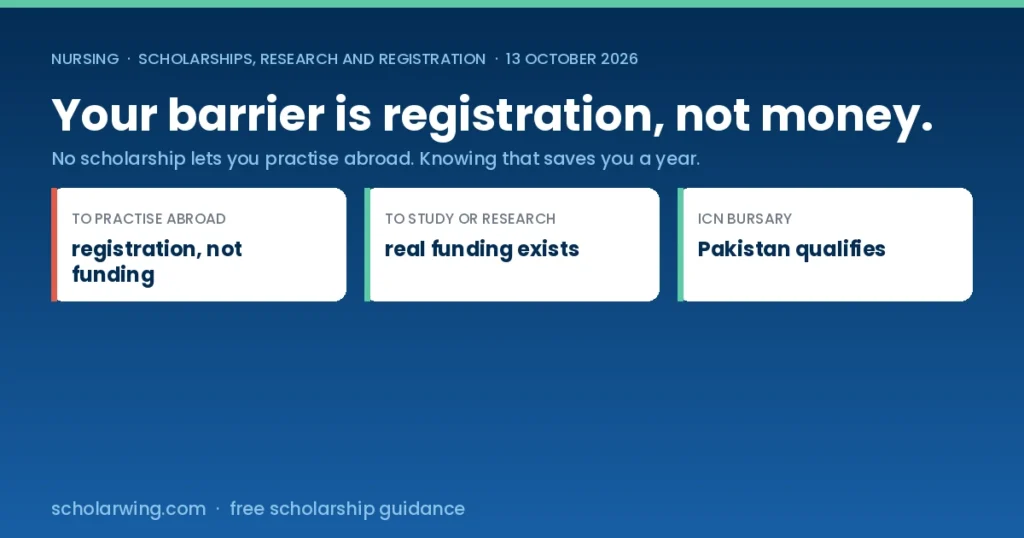
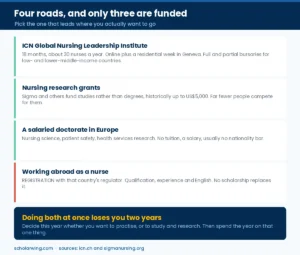
If you want to work as a nurse abroad, no scholarship does that. The route runs through registration — the nursing regulator in that country assessing your qualification, your experience and your English, and entering you on its register. That is a licensing process with its own fees, examinations and timelines. A scholarship cannot substitute for it, and no amount of searching will produce one that does.
If you want to study or research nursing abroad, funding genuinely exists, and most of it never appears on scholarship websites because it sits with nursing organizations rather than governments.
Work out which of those two you actually want, because they lead in completely different directions. Most of the frustration we see comes from people chasing the second while needing the first.
Route one: ICN’s Global Nursing Leadership Institute
The International Council of Nurses runs the Global Nursing Leadership Institute, and it is the strongest thing on this page for a senior Pakistani nurse.
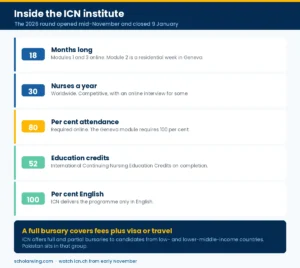
It runs for 18 months, takes about 30 nurses a year worldwide, and builds policy-level leadership rather than clinical skill. Scholars develop a policy project aligned with regional health priorities and work alongside ICN, the WHO and other global health institutions. Graduates receive 52 International Continuing Nursing Education Credits.
The format matters. Modules 1 and 3 run online, and Module 2 is a residential week in Geneva that you must attend in person. ICN requires 80% attendance at the online sessions and 100% at the Geneva module.
Now the part that makes it reachable. ICN states that full and partial bursaries may be available to candidates from low- and lower-middle-income countries. A full bursary covers programme fees and visa or travel costs. A partial bursary gives a 50% discount on fees. ICN decides how many it gives by the number of applications arriving.
Pakistan sits in the lower-middle-income group, which places Pakistani applicants inside the bursary category.
The programme runs entirely in English, and ICN says applicants need strong written and spoken English. Shortlisted candidates may face an online interview.
For the 2026 institute, applications opened in mid-November 2025 and closed on 9 January 2026. The Burdett Trust for Nursing supports the programme.
Route two: nursing research grants
Sigma, the international nursing honor society, runs a set of research grants including Small Grants historically worth up to US$5,000, with roughly ten to fifteen awarded a year. Its published criteria have given preference to novice researchers without other national research funding, and to Sigma members where other qualifications are equal.
Several named grants sit alongside it, each typically up to US$5,000, covering areas such as clinical nursing research, women’s health, oncology and pediatrics.
We reached an older cycle page rather than a current call, so treat the figures as the shape of the programme rather than this year’s terms, and check sigmanursing.org for the current round before building anything.
These are research grants, not scholarships. They fund a study, not a degree. For a nurse who wants to publish and move towards an academic post, that difference works in your favor, because far fewer people compete for them.
Route three: the salaried doctorate, which nurses overlook
This is the least known and often the best.
Across Europe a PhD is employment. No tuition fee, no scholarship application, a salary, and usually no nationality restriction. You apply for an advertised doctoral position and, if you win it, the university employs you.
Nursing science, health services research, patient safety, palliative care and public health all run doctoral positions on exactly this model in Sweden, Denmark, the Netherlands, Norway and Finland. A nurse with a master’s degree and clinical experience competes seriously for these, and many groups specifically want someone who has worked on a ward.
Our DTU Denmark post, Örebro guide and ORFeus guide explain how that market works and where the positions are advertised.
And for a taught master’s, the routes in our public health guide accept nurses, not only doctors. Public health, health policy and health management are open fields.
Eligibility criteria, route by route
ICN Global Nursing Leadership Institute
- A nurse, anywhere in the world. ICN states that nurses worldwide may apply.
- Senior enough to influence health policy. The programme targets senior nurses rather than early-career ones.
- Strong written and spoken English, since ICN delivers the programme only in English.
- Able to attend the residential week in Geneva in person, and to meet the 80% and 100% attendance rules.
- For a bursary: from a low- or lower-middle-income country. Pakistan qualifies on that classification.
- Selection runs competitively, and shortlisted candidates may face an online interview.
Sigma research grants
- A qualified nurse, with applications and all supporting material in English.
- Preference historically to novice researchers without other national research funding.
- Preference to Sigma members where other qualifications match.
- A defined research project, since these fund studies rather than study.
European doctoral positions
- A master’s degree in nursing, nursing science, public health or a related field.
- Research fit with the advertised position, which matters more than grades.
- No nationality restriction in most cases, and no tuition fee at all.
The application process, step by step
For GNLI
Step one. Check the calendar now. The 2026 round opened in mid-November and closed 9 January. Watch icn.ch from early November.
Step two. Decide your policy project before you write anything. This is a policy-leadership programme, and the application turns on what you intend to change in your own health system. “I want to develop as a leader” is not a project. “I want to change how my province credentials nurse prescribers” is.
Step three. Request the bursary explicitly in your application. Bursaries go to candidates from low- and lower-middle-income countries, and ICN decides allocation by the number of applications received.
Step four. Plan the Geneva week honestly. You must attend in person and achieve 100% attendance for that module. Confirm your employer will release you before you apply, not after you are accepted.
Step five. Prepare for an online interview, since ICN may invite shortlisted candidates to one.
Step six. Contact ICN with questions. They publish a contact telephone number, +41 22 908 01 00, and an enquiry address on their site.
For Sigma grants
Check sigmanursing.org for the current call, since cycles change. Expect an online submission system, a deadline for the application and a separate, later deadline for letters of support — in the cycle we read, letters were due five days after the application itself. Build that into your plan.
For a European doctoral position
Search EURAXESS and the national academic job boards for advertised positions in nursing science or health services research, then apply as you would for a job, with a CV and a motivation letter rather than a scholarship form.
Frequently asked questions
Can a scholarship let me work as a nurse in the UK or Australia?
No. Working as a nurse requires registration with that country’s nursing regulator, which assesses your qualification, experience and English and may require an examination. That is a licensing route with its own costs, and no scholarship replaces it. Go to the regulator’s own website for the current requirements.
So are there really no scholarships for nurses?
There are, and this page lists three routes. They fund leadership development, research and academic study. None of them fund clinical practice, because clinical practice is a job you must first be licensed to do.
Does GNLI cost money?
ICN says successful applicants fund their own participation, and it offers full or partial bursaries to candidates from low- and lower-middle-income countries. A full bursary covers programme fees and visa or travel costs. ICN does not publish the fee amount, so ask them directly.
Is GNLI online or in person?
Both. Modules 1 and 3 are online. Module 2 is a residential week in Geneva that you must attend in person.
How many people get into GNLI?
About 30 a year, worldwide.
Do I need to be a Sigma member to apply for its grants?
The published criteria give preference to members where other qualifications are equal, rather than requiring membership for every grant. Check the current call, since terms differ between the named awards.
I have a BSN but no master’s. What is open to me?
GNLI looks for senior nurses rather than a specific degree, so experience and position matter more than the qualification. For research funding and doctoral posts, a master’s is usually the entry point, which makes a funded master’s your first target rather than your last.
Is IELTS required?
ICN requires strong English and delivers the programme in English, without naming a test in the material we read. European doctoral positions set their own requirements, and many accept a medium-of-instruction letter. Registration bodies are the strict ones — they usually require IELTS or OET at a specified score.
What is the single most useful thing I can do this year?
Decide whether you want to practice abroad or to study and research. If it is practice, spend the year on registration requirements and the English test. If it is research, spend it finding a master’s or a doctoral position. Doing both at once is how people lose two years.
Who should pursue what
If you are a senior nurse in a leadership or policy role, GNLI is the strongest option on this page and Pakistan’s classification puts you in the bursary group. Watch icn.ch from early November.
If you hold a master’s and want an academic career, look at European doctoral positions before you look at scholarships. They are jobs, and nurses win them.
If you are a clinical nurse wanting to work abroad, close this page and open your target country’s nursing regulator instead. That is not a brush-off. It is the only route that leads where you want to go, and we would rather say it plainly.
This guide is part of our complete guide to scholarships for medical students.
We checked every claim on this page on 13 October 2026.