
Google Women Tech makers Scholars Program: The Name Is Gone, and Here Is What Replaced It
If you came here searching for the Google Women Tech makers Scholars Program, you are searching for a name that no longer runs.
Google retired it. The scholarship itself continues under a new name, the Generation Google Scholarship, and the Institute of International Education now administers it rather than Google directly.
Women Tech makers still exists at Google as a community programme for women in technology, with events, resources and an ambassador network. It simply no longer runs this scholarship under that title. That is why searches for the old name lead to articles from 2017 and university pages nobody updated.
Here is what the programme looks like today.
The four regions, and why the amount changes so much
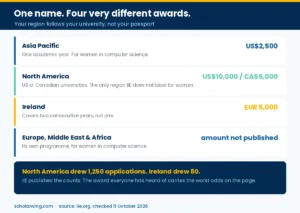
The Generation Google Scholarship runs as four separate programmes, and they do not pay the same money.
Asia Pacific awards US$2,500, once, for a single academic year. It runs for women in computer science.
North America awards US$10,000 for students at universities in the United States, or CA$5,000 for students at Canadian universities. Of the four, this is the only one IIE does not describe as being for women in computer science.
Ireland awards €5,000, and this one covers two consecutive years of undergraduate study rather than one.
Europe, the Middle East and Africa runs as its own programme for women in computer science.
So the same scholarship name can mean US$2,500 or US$10,000 depending on where you study. Any article quoting a single figure for “the Google scholarship” has looked at one region and ignored the rest.
The rule that decides your region
This catches people out, so read it carefully.
IIE states that your region depends on where your college or university sits, not on where you live and not on your citizenship.
A Pakistani student at a university in the United States applies to the North America programme. A Pakistani student at a university in Pakistan applies to Asia Pacific, provided the programme covers that country. Students at Irish universities may be considered for both the Ireland and the EMEA programmes.
Your passport does not place you. Your campus does.
What the scholarship asks of you
The Asia Pacific programme, which is the one most of our readers will look at, requires that you:
Be a woman, studying computer science, computer engineering or a closely related technical field.
Be a full-time second or third year undergraduate at an accredited university in the Asia Pacific region, and intend to continue your bachelor’s degree in the region the following year.
Demonstrate leadership, a strong academic record and financial need. IIE names all three, and the North America page repeats the same trio.
Not be the child of a Google employee. That exclusion appears on every regional page.
Note what is missing from that list. This funds undergraduates only. No master’s, no PhD, no research. If you reached this page hoping for postgraduate funding, this particular programme has nothing for you, and the alternatives further down will serve you better.
What the application involves
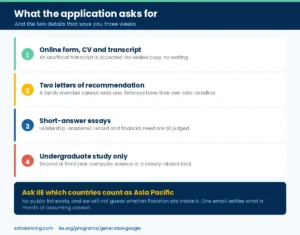
IIE asks for an online application with your background and your current and intended universities, a CV, your current or most recent transcript, two letters of recommendation, and answers to short-answer essay questions.
Two details save people trouble. An unofficial transcript is acceptable, which removes the usual three-week wait for a sealed copy. And a family member cannot write one of your references, which IIE states explicitly.
Your referees also work to their own deadline. In the 2025 round, applications closed in mid-August and recommendation letters were due on 18 August at 11:59pm US Pacific Time. Ask your referees early, and give them the actual date rather than “next week”.
The odds, which almost nobody publishes
IIE does something unusual and publishes how many applications each region received.
North America received 1,250 applications. Ireland received 80.
Sit with that second number. A scholarship worth €5,000 across two years, at a university in Ireland, drew eighty applicants. Smaller regional programmes routinely run at odds that larger ones never approach, and almost nobody looks for them because the headline amounts are smaller.
That is a lesson worth more than this scholarship. The award everyone has heard of has the worst odds on the page.
Who this is genuinely for
If you are a woman in your second or third year of a computer science degree, this is well worth an afternoon, especially if your university sits in a smaller region.
If you are applying for an undergraduate degree you have not started, note that the North America programme accepts high school seniors while the Asia Pacific one does not. Check your own region’s wording rather than ours.
If you want postgraduate funding, look elsewhere. For a funded master’s, Türkiye Bursları and the CSC scholarship both take applications without a prior admission letter. For a PhD, remember that across Europe a doctorate is salaried employment with no tuition fee our DTU Denmark post and ORFeus guide explain that market.
If you are a woman heading for a STEM PhD, the Faculty for the Future fellowship pays up to US$50,000 a year, though it runs its own strict country list.
What we could not confirm
Two things, and we would rather name them than smooth over them.
We could not retrieve the Asia Pacific programme page itself. It exists and IIE links to it, but it did not load for us on 11 October 2026. Everything above about the APAC terms comes from IIE’s own programme hub, its FAQ, and the regional pages for North America and Ireland that did load.
We could not find a published list of which countries count as Asia Pacific. IIE names the region without defining it. We will not guess whether Pakistan falls inside it, because guessing is how wrong information spreads.
So before you build an application, use the contact link on iie.org/programs/generationgoogle and ask one question: does a student at a university in my country fall within your Asia Pacific region? One reply settles it, and it costs you a day rather than a month.
What to do now
The 2025-2026 round has closed in every region. The next one has not been announced.
Past rounds opened around mid-year and closed in August, so check iie.org in June and again in July. Put it in your calendar rather than trusting a blog to tell you, since most of the blogs still carry the old name.
We checked every claim on this page on 11 October 2026, and we will say so on the page whenever we check again.