
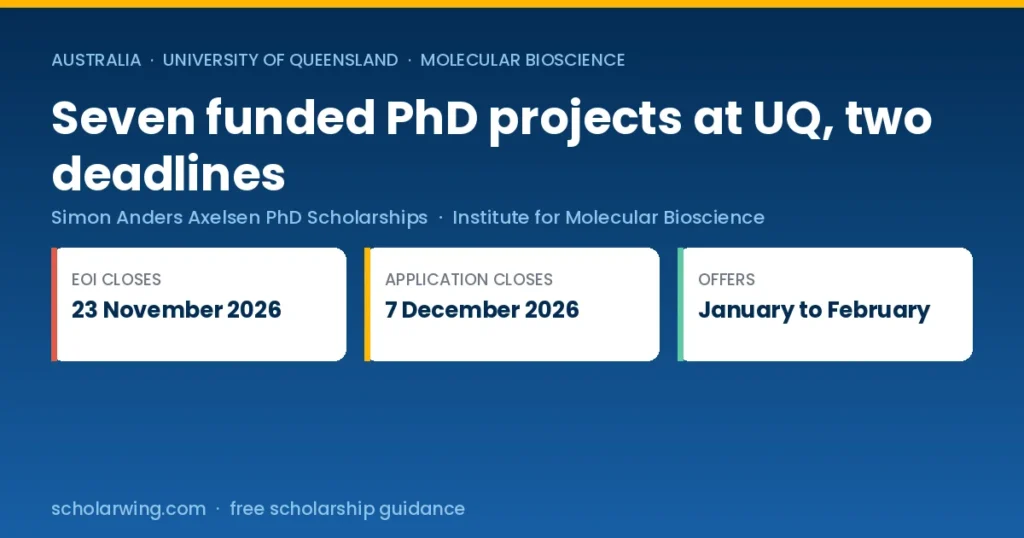
Seven Funded PhD Projects at UQ, and the Deadline Everyone Is Quoting Is the Wrong One
A single PhD project from the University of Queensland has been circulating this week — something on Salmonella lipases and gallbladder cancer — with 23 November 2026 attached to it as the deadline.
That project is real. The date is only half the story, and the project is one of seven.
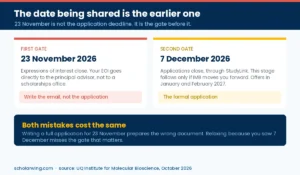
Two dates, and the one being shared is the earlier one
The project belongs to a round called the Simon Anders Axelsen PhD Scholarships, run by UQ’s Institute for Molecular Bioscience and funded from the Simon Anders Axelsen Memorial Fund.
The round runs on two deadlines:
- 23 November 2026 — expressions of interest close
- 7 December 2026 — applications close
- January to February 2027 — offers
So 23 November is not the application deadline. It is the date by which you must have made contact and submitted an expression of interest. The real application, through StudyLink, follows after that.
Anyone planning to write a full application for 23 November is preparing the wrong document. Anyone who saw 7 December somewhere and relaxed has already missed the gate that matters.
The seven projects
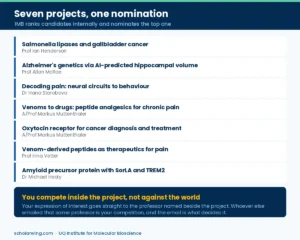
The round covers seven projects, each with a named principal advisor. If one circulating project did not fit you, another in this list may.
| Project | Principal advisor |
|---|---|
| Lipase–host lipid interactions in chronic Salmonella infection and gallbladder carcinogenesis | Prof Ian Henderson |
| Unlocking genetic insights into Alzheimer’s disease through AI-predicted hippocampal volume | Prof Allan McRae |
| Decoding pain: linking neural circuits to behaviour to transform treatment | Dr Hana Starobova |
| Venoms to drugs: peptide analgesics for severe chronic pain | A/Prof Markus Muttenthaler |
| Targeting the oxytocin receptor for cancer diagnosis and treatment | A/Prof Markus Muttenthaler |
| Venom-derived peptides as next-generation therapeutics for pain | Prof Irina Vetter |
| Amyloid precursor protein in the age of AlphaFold: APP interactions with SorLA and TREM2 | Dr Michael Healy |
Three of these sit in pain and venom pharmacology, two in Alzheimer’s biology, one in bacterial infection and cancer, one in receptor-targeted oncology. A background in biomedical science, biochemistry, molecular biology or pharmacology fits most of them.
Only one candidate gets nominated
Here is the mechanism, and it changes how you should spend the next six weeks.
Your expression of interest goes directly to the principal advisor, not to a central scholarships office. IMB then reviews and ranks the candidates internally, and nominates the top candidate for admission and scholarship consideration.
Read that again. The competition happens inside the project, between you and whoever else wrote to that same professor. The decision sits largely with the person whose name appears beside the project.
That makes the email the whole thing. Not the transcript, not the eventual StudyLink form. The email.
So write it as a researcher writing to a researcher. Three short paragraphs:
Who you are and what you have done with your hands. Name the organism, the assay, the instrument, the analysis. “I spent eighteen months doing bacterial genetics on Salmonella Typhimurium, including transposon library screens” beats a paragraph about your passion for microbiology.
One specific thing about their project. Read a recent paper from the group. Ask a real question about the work, or say which part you would want to extend.
What you are asking for. State plainly that you want to submit an EOI for that project in the Axelsen round, and ask whether they are taking candidates.
Then attach a two-page CV and nothing else.
For PhD and scholarship questions, IMB lists an HDR Liaison Officer at hdr.imb@enquire.uq.edu.au. Use that for process questions, and the advisor for research questions.
What this scholarship pays
We are not printing a figure, and here is why.
IMB’s own page does not publish the Axelsen stipend. It points to the UQ study site for amounts. A figure of A$39,220 has been circulating with the Salmonella project this week, and it may well be correct — the IMB page separately quotes A$32,192 as a 2023 rate for a different scheme, indexed annually, which makes a 2027 figure in that range plausible.
Plausible is not verified. Open UQ’s own scholarship listing and read the number attached to this round before you build a budget around it.
What UQ scholarships of this kind normally include: a tax-free living stipend, tuition fees, and single Overseas Student Health Cover, which the student visa requires.
That is the Australian model at its best. Note what it still is, though: a scholarship, not employment. In Sweden, Denmark and Germany a doctorate is a salaried job with a contract, a pension and social security — the difference is set out in our DTU Denmark post and our Örebro guide. And for most other Australian awards, “scholarship” means a tuition discount rather than funding at all, which we explain in our Australian scholarships post.
This round is the good kind. Most are not.
Your six weeks
This week. Pick one project. Read two recent papers from that group.
One practical problem: IMB’s page names the principal advisors but does not
publish their email addresses. Do not guess one, because an EOI that bounces is
an EOI that never existed. Find the correct address through UQ’s own staff
directory at contacts.uq.edu.au, or through the researcher’s profile at
about.uq.edu.au/experts. Several of these advisors also appear on their group
pages — Prof Irina Vetter, Dr Hana Starobova and A/Prof Markus Muttenthaler all
sit in IMB’s Centre for Pain Research, whose team page lists its members. If you
still cannot find the address, write to the HDR Liaison Officer at
hdr.imb@enquire.uq.edu.au and ask two things in the same message: the right way
to reach the advisor for your chosen project, and what the expression of interest
should contain. That one email answers both questions and puts your name on
record before 23 November.
By 20 October. Send the email to the principal advisor. Our email reviewer will tell you what a professor deletes in four seconds.
By early November. Get your CV and transcripts ready, and confirm with the advisor what their EOI should contain. The CV reviewer will tell you what to cut.
By 20 November. Submit the EOI, three days early.
23 November. EOI closes.
By 5 December. If IMB moves you forward, complete the StudyLink application.
7 December. Applications close.
Where to look: the Institute for Molecular Bioscience PhD scholarships page at UQ.
If this round is not yours
IMB also runs Earmarked Scholarships, attached to projects funded by recent ARC, NHMRC or Medical Research Future Fund grants. Those carry no closing date and appear on the PhD projects list as grants land, which makes them worth checking every month rather than once a year.
And the UQ Graduate School Scholarship funds most UQ PhD students, without being tied to any single project.
Three different routes, three different timetables. Most applicants only ever hear about the one somebody posted on Facebook.