
A Funded PhD in Sweden Building Human Heart Organoids, With Four Industry Partners
Örebro University in Sweden is recruiting a PhD student in Biomedicine, and applications close on 23 October 2026. The position starts in December 2026.
Before anything else, the money, because it decides whether most readers can even consider this.
There is no tuition fee, and you are paid
Swedish doctoral study is employment. You sign a contract, the university pays you, and no tuition exists to waive, win, or borrow for.
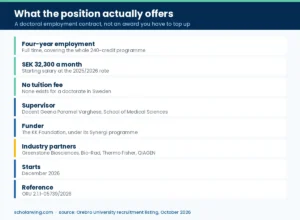
This position is a four-year, full-time doctoral employment covering the whole 240-credit programme, with a starting salary of SEK 32,300 a month at the 2025/2026 pay rate.
Your family contributes nothing. That single fact separates Sweden, Denmark and Germany from the British and Australian systems, where a “scholarship” usually means a fee reduction on a bill you still carry — we set out that arithmetic in our UK medical PhD funding guide and our Australia post.
The research, and why the partners matter
The project builds human cardiac organoids and multicellular 3D models — tiny laboratory hearts grown from human cells — to study how disease and environmental exposure change how a heart works.
In practice you would develop, optimise and characterise human cardiac spheroids and organoids using cardiomyocytes, cardiac fibroblasts, endothelial cells and iPSC-based models. The supervisor is Docent Geena Paramel Varghese, whose work sits in innate immunity and cardiovascular inflammation.
Now the detail nobody sharing this position has mentioned.
The project runs under the KK Foundation’s Synergi programme, with four industry partners: Greenstone Biosciences, Bio-Rad, Thermo Fisher Scientific and QIAGEN.
Read that as a career fact rather than a list of logos. A doctorate built inside an industry collaboration means your methods, your contacts and your reference letters all connect to companies that hire. Most PhD students spend four years inside one laboratory and then start learning how industry works. This one starts you there.
Who can apply
The advert states the subject requirement as at least 90 credits of passed coursework in a field relevant to biomedicine, including a C-level degree project, or equivalent knowledge. International qualifications count.
Swedish doctoral admission also carries a general eligibility requirement on top of the subject requirement, so confirm your own case against the advert before you assume either way. If your degree sits anywhere near the line, email and ask. It costs one message.
Particularly valued: documented practical experience with advanced cell culture and 3D models — spheroids and organoids, and heart models above all.
Also valued: work with human cardiac cells, iPSCs, stem cell differentiation, and the functional or molecular characterisation of heart models. Contractility, metabolism, mitochondrial function, imaging and molecular biology methods all count.
Nothing in the published eligibility restricts nationality.
What you submit, including the one people forget
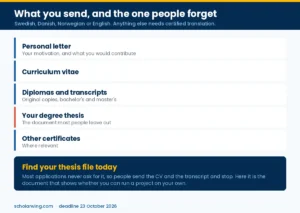
- A personal letter explaining your motivation and what you would contribute
- Your CV
- Original diploma copies and official transcripts for your bachelor’s and master’s degrees
- Your degree project — the thesis itself
- Any other relevant certificates or diplomas
That fourth item catches people. They send the CV and the transcript, and leave out the thesis, because most applications never ask for it. Here it is the document that shows whether you can actually run a project. Find your file now; if it only exists as a printed copy in a university office, you need these thirteen days.
Documents must be in Swedish, Danish, Norwegian or English. Credentials in any other language need a certified translation into Swedish or English, and that takes days you have not budgeted.
Applications go through the “Ansök” button on the university’s job page. The contacts listed are Simon Athlin, the unit head, and Geena Paramel Varghese, the supervisor.
Thirteen days
Today. Find your thesis file and your transcripts. Check whether anything needs certified translation, and start that immediately if it does.
Tomorrow. Email Dr Paramel Varghese. One paragraph: who you are, the one technique you share with the project — cell culture, iPSC work, imaging, whatever is genuinely yours — and one specific question about the organoid model. Our email reviewer will tell you what a supervisor deletes in four seconds.
By 18 October. Write the personal letter around the methods you have actually touched. Name the cell types, the assays, the equipment. A supervisor reading forty letters can tell in one paragraph whether you have done the work or only read about it. The SOP generator will structure it and the CV reviewer will clean up the CV beside it.
By 21 October. Submit, with two days spare.
Apply: the position is listed on Örebro University’s vacancies page under reference ORU 2.1.1-05739/2026.
If this project is not yours
Most readers will not have organoid experience, and that is fine. The mechanism behind this position is the thing worth keeping.
Sweden, Denmark, Norway, Germany and the Netherlands all run doctoral study as salaried employment with no tuition fee and, usually, no nationality bar. We have written up four live examples of the same model: the Karolinska positions, the DTU post in Denmark, the ORFeus doctoral network and the Urban Future group at Bonn.
Learn to read these as job adverts rather than scholarship announcements, and a funded doctorate stops being something you hope for and becomes something you apply to.