
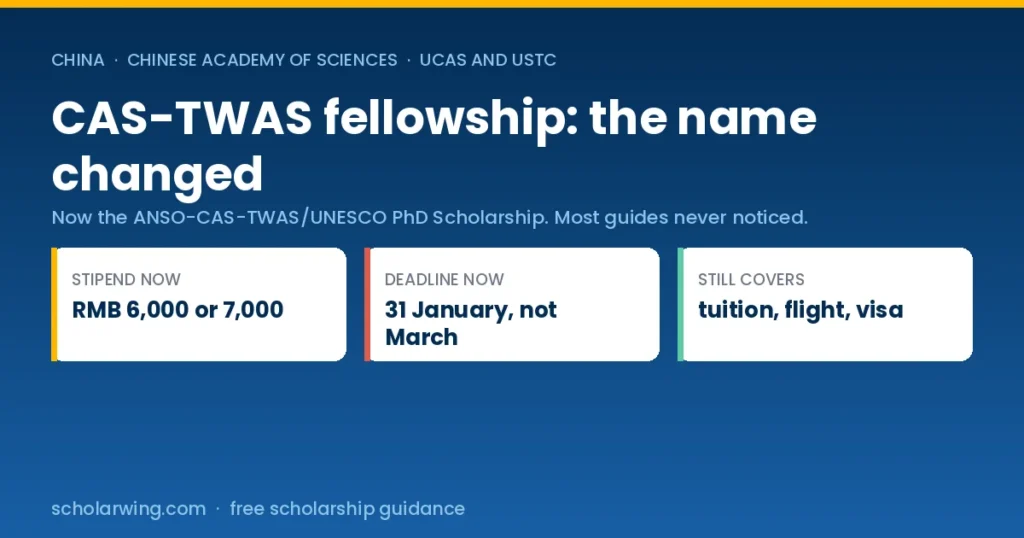
CAS-TWAS President’s Fellowship: The Name Changed, and Most Guides Never Noticed
Thousands of students across Pakistan, Nigeria, India and Bangladesh apply every year to something called the CAS-TWAS President’s Fellowship. The Chinese Academy of Sciences runs it, it pays for a PhD, and it has been one of the best routes into Chinese research for a decade.
Most of what circulates about it is now out of date, including the name you type into the application.
What it is called now
The programme runs as the ANSO-CAS-TWAS/UNESCO PhD Scholarship, a sub-category of the CAS-ANSO Scholarship. That scholarship launched in 2022, and it was itself previously called the ANSO Scholarship for Young Talents.
Three organizations share the work. ANSO and CAS manage the scholarship, with CAS as the major sponsor. TWAS and UNESCO fund part of it, specifically your travel and visa. UCAS and USTC admit you and manage your studies, the University of Chinese Academy of Sciences, and the University of Science and Technology of China.
This matters practically. When you reach the application system, you select the CAS-ANSO Scholarship, then tick the box for the ANSO-CAS-TWAS/UNESCO PhD Scholarship. A student searching the portal for “CAS-TWAS President’s Fellowship” finds nothing and assumes the programme ended.
Three numbers that changed
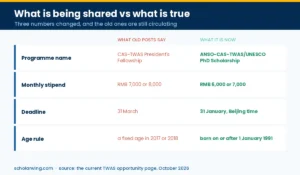
Compare what the shared posts say with what the current official page says.
The stipend. Old guides say RMB 7,000 or 8,000 a month. The current terms give RMB 6,000 or 7,000, depending on whether you pass the qualification test arranged by your university.
The deadline. Old guides say 31 March. The last cycle closed on 31 January, Beijing time.
The age limit. Old guides quote an age cut-off calculated from 2017 or 2018. The current rule works from a birth date: in the last cycle, applicants had to be born on or after 1 January 1991, with an age limit of 35.
A student planning around a March deadline and an 8,000 stipend has two months less than they think, and a different budget.
What the fellowship actually gives you
From CAS:
- A full tuition waiver
- A monthly stipend of RMB 6,000 or 7,000, for up to 48 months
- Health insurance
- The application fee waived
From TWAS and UNESCO, where you qualify:
- One international travel allowance, from your home country to China
- A one-time visa cost
Note the limit on that last pair. If you are already in China when you apply, you do not get the travel subsidy.
Who can apply
- A non-Chinese citizen
- A national of an eligible developing country in the South. Pakistan, Nigeria, Bangladesh and India all qualify
- Born on or after 1 January 1991 in the last cycle, with 35 as the age limit. Expect this date to move forward by one year each cycle, so check it rather than assuming
- Holding at least an MSc, since the minimum degree for the PhD route is a master’s
- Proficient in English or Chinese. You do not need Chinese
- Not already pursuing a doctorate in China
- Meeting the international admission criteria of UCAS or USTC
Two rules trip people up. You cannot apply to both USTC and UCAS. Pick one. And you cannot take other assignments or employment during the scholarship.
How the application works
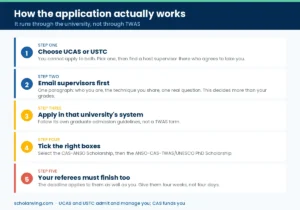
The application runs through the university, not through TWAS.
- Choose UCAS or USTC, and find a host supervisor there who agrees to take you. Do this first. Everything else depends on it.
- Apply through that university’s graduate admission system, following its own guidelines.
- Select the CAS-ANSO Scholarship, and tick the ANSO-CAS-TWAS/UNESCO PhD Scholarship box.
- Submit before the deadline.
And the detail that costs people the whole application:
Your referees must finish before the deadline too. The requirement names applicants and referees. A reference letter submitted on 1 February does not arrive late by a day, it arrives after the system has closed. Give your referees four weeks, not four days.
Documents follow the pattern these calls have used for years: a CV with your research experience, degree certificates and transcripts, proof of English or Chinese proficiency, a detailed research proposal, a passport copy, abstracts of any published papers, a physical examination form, and two reference letters from people other than your host supervisor. Confirm the exact list on the live call, because it is the one thing that varies.
The eight-week plan
Right now. Open the UCAS and USTC international admission pages and decide which one. Read the institutes and find two or three supervisors whose work matches yours.
This week. Email those supervisors. One short paragraph: who you are, the one technique or topic you share with their group, one specific question about their work. This is the single highest-value hour in the whole process. Our email reviewer will tell you what gets deleted in four seconds.
Within two weeks. Ask your two referees, and give each of them your CV, your draft proposal and a reminder of the work you did together. Tell them the deadline is theirs as well as yours. Our reference letter generator shows what a usable letter contains.
Weeks three to six. Write the research proposal. This is the document that decides it, far more than your grades. Name the problem, the method, what you would do in the first year, and why that institute rather than any other. The SOP generator will help you structure it, and the CV reviewer will clean up the CV beside it.
Week seven. Get the physical examination form done and your transcripts notarized. Both take longer than you expect.
Week eight. Submit, and check that both referees have submitted too.
If you do not fit this one
The age limit and the master’s requirement rule out many readers.
The Chinese Government Scholarship through CSC covers far more universities, takes bachelor’s graduates for master’s degrees, and carries a more generous age rule see our CSC China guide. For a funded master’s in Beijing with no research proposal at all, our Schwarzman Scholars guide and Yenching Academy guide cover two very different routes.
And one general habit, worth more than any single scholarship. Before you believe a scholarship post, check the programme’s own page. The CAS-TWAS fellowship kept its old name alive on a hundred websites for years after the official terms changed. The students who read the source applied to the right thing.