
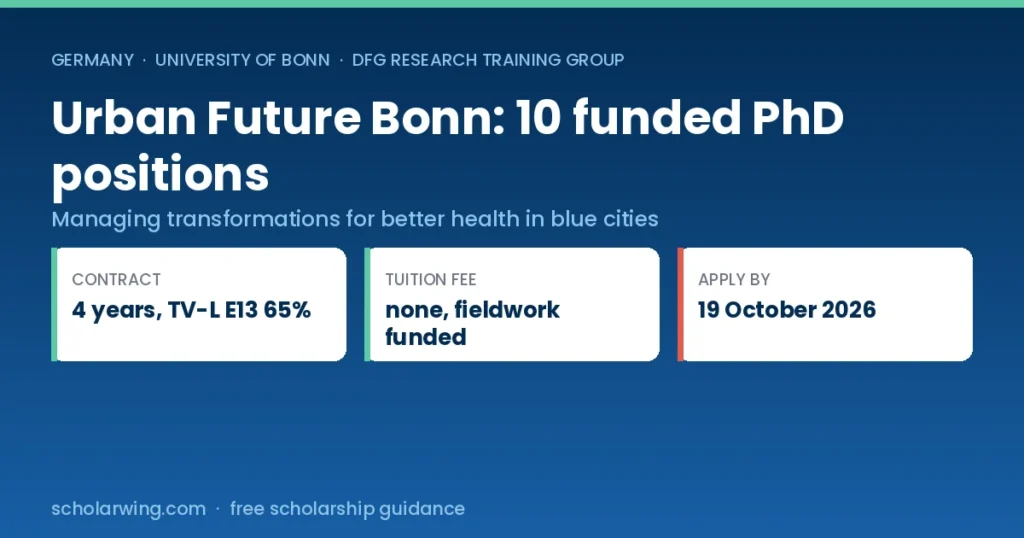
Urban Future Bonn: 10 Funded PhD Positions, and a Deadline You Should Not Trust
The University of Bonn has opened ten doctoral positions in a new research training group called Urban Future – managing transformations for a better health in blue cities. The German Research Foundation funds it as Graduiertenkolleg GRK 3204.
Start with the part that decides whether you can afford to go.
This is a four-year job
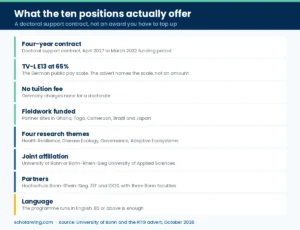
Germany does not charge PhD tuition, and this programme goes further than that. Each position carries a four-year doctoral support contract paid on TV-L E13 at 65%, the public pay scale that covers German state employees. Fieldwork costs come funded on top, which matters here because the research runs across partner sites in Ghana, Togo, Cameroon, Brazil and Japan.
So nobody asks you to find tuition, and nobody asks your family to fund a year abroad. You get a contract, a salary, and the social security that comes with German employment.
We keep returning to this difference because it decides more applications than grades do. A British research council pays tuition only at the home rate, so departments write “Home fee eligible” into the advert and the gap closes on you — the arithmetic sits in our UK medical PhD funding guide. In Australia the same word usually means a discount on a bill you still pay. In Germany, Denmark and Sweden a doctorate is paid work, exactly as in our DTU Denmark post, our Karolinska list and the ORFeus network guide.
What a “blue city” means
The programme studies cities built along rivers and coastlines, and what happens to the people in them.
Water shapes urban health in both directions. It supplies cities, and it carries disease, flooding and pollution into them. As climates shift and cities grow, the settlements most exposed to that double edge sit largely in the Global South. Urban Future asks how such places can stay healthy, ecologically sound and socially fair at the same time.
Four research themes organize the work:
- Urban Health Resilience
- Urban Disease Ecology
- Governance and Institutional Change
- Adaptive Urban Ecosystems
The consortium spans the University of Bonn’s faculties of Medicine, Mathematics and Natural Sciences, and Agricultural, Nutritional and Engineering Sciences, together with Hochschule Bonn-Rhein-Sieg, the Center for Development Research (ZEF), and the German Institute of Development and Sustainability (IDOS). Your doctorate carries a joint affiliation with the University of Bonn or Bonn-Rhein-Sieg University of Applied Sciences.
The first funding period runs April 2027 to March 2032, and the programme works in English.
Who can apply
A completed master’s degree, or an equivalent qualification, in a relevant field. The advert names a deliberately wide list:
- Agricultural or Food Systems
- Life or Environmental Sciences
- Social Sciences
- Economics
- Public Health
- Geography
- Engineering
Add an interdisciplinary turn of mind, because these themes cross faculties by design, and English at B2 or above.
That breadth is the opportunity here. Most funded PhD adverts want one narrow profile. This one wants ten people who can talk to each other across disciplines, which means a geographer, an economist and a public-health graduate all have a real route in.
Positions start on 1 April 2027.
The deadline problem, and what to do about it
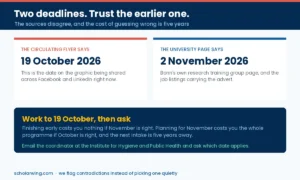
Read this carefully, because the sources contradict each other.
The circulating flyer states 19 October 2026. The University of Bonn’s own research-training-group page, and the job listings carrying the advert, state 2 November 2026.
We cannot resolve that from the outside, and you should not gamble on the later date. Work to 19 October. If 2 November turns out to be correct, you lose nothing by finishing early. If 19 October is correct and you planned around November, you lose the whole programme, and the next intake sits five years away.
Then send one short email and settle it. The programme coordinator is Dr. Julia Dannenberg at the Institute for Hygiene and Public Health, Venusberg-Campus 1, Bonn. One line is enough: “Could you confirm the application deadline for the Urban Future RTG? The flyer states 19 October and the university page states 2 November.”
Asking that question costs you nothing and marks you as somebody who reads carefully.
How to apply
Applications go through the University of Bonn master application portal, with the programme details on the Urban Future RTG page hosted by the University Hospital Bonn. The portal is the route, so set up your account early rather than on the final evening — German application systems ask for documents to be uploaded in specific formats and sizes, and that is not a discovery you want to make at 23:00.
Before you upload anything:
Pick your research theme. Four exist. Name the one you fit and explain why your master’s work leads there. A generic application across all four reads as an application to none.
Write to the interdisciplinary requirement. They are not hiring ten specialists. They are hiring ten people who can work beside specialists from other fields. Say what you have done outside your own discipline, even briefly.
Attach your grading scale with your transcripts. A German assessor cannot read a 3.4 CGPA or a 78% without the official key beside it. Request it from your university now; it often takes a few days.
Our SOP generator and CV reviewer will get those documents into shape, and the email reviewer will check the message to Dr. Dannenberg before you send it.
Programme page: ukbonn.de/ihph/bereiche/urban-future
If this one is not yours
Ten positions in one programme is unusual, and the eligible fields run unusually wide. Even so, most readers will not match it.
Keep the mechanism. Germany funds hundreds of structured doctoral programmes like this through the DFG, each with its own Graduiertenkolleg number, each paying on TV-L, each charging no tuition. They open throughout the year and they rarely restrict by nationality.
Stop looking for a scholarship in Germany. Start reading doctoral job adverts.