
A PhD in Denmark Is a Job. Here Is What the DTU Advert Actually Offers.
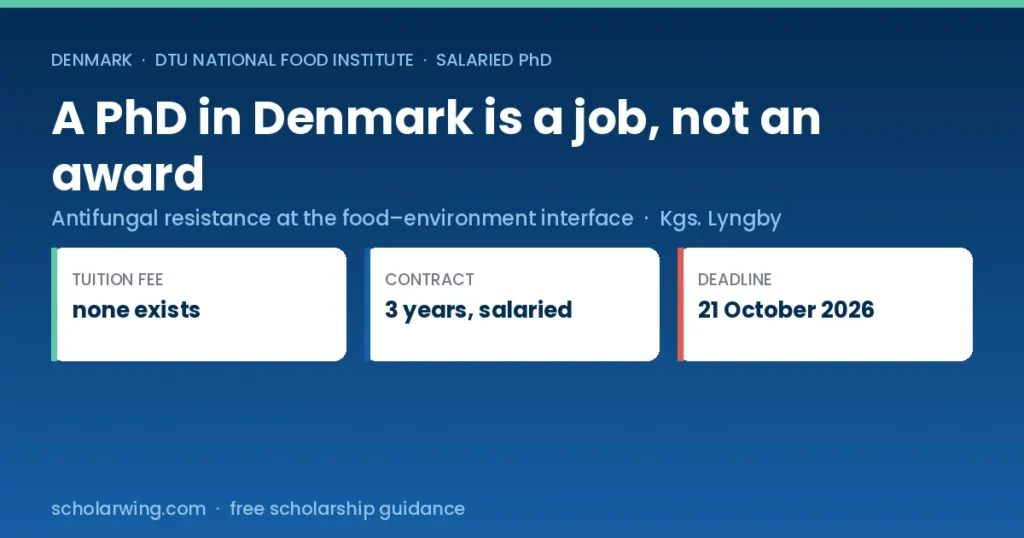
The Technical University of Denmark has opened a three-year PhD position at its National Food Institute, and applications close on 21 October 2026 at 23:59 Danish time. The title is PhD scholarship in Antifungal Resistance at the Food–Environment Interface.
The word “scholarship” in that title misleads almost every applicant who reads it from South Asia, so let me correct it before anything else.
This is employment, not an award
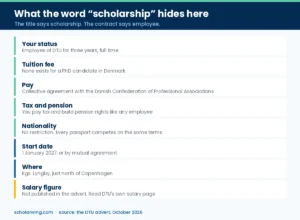
You do not pay tuition at DTU as a PhD candidate, and no fee waiver decides whether you can afford to come. The position runs as a job. DTU employs you for three years, full time, on the collective agreement held with the Danish Confederation of Professional Associations, the union body that covers university-qualified staff. You pay tax, you build pension rights, and the Danish labor system covers you like any other employee.
The advert does not print a salary figure, and we will not invent one. Danish university salaries follow published scales that depend on the agreement and on your seniority, so read the figure on DTU’s own salary page for scientific staff rather than trusting any number circulating in a Facebook group.
The eligibility carries no nationality restriction. A candidate from Pakistan, India, Nigeria or Bangladesh competes on the same terms as a Danish one.
This is the same mechanism we described in our Karolinska post and our ORFeus doctoral network guide: across much of continental Europe, a doctorate is paid work. Compare it with the British arrangement, where a research council covers tuition only at the home rate and departments write “Home fee eligible” into the advert to close the gap — we set out that arithmetic in our UK medical PhD funding guide. And compare it with Australia, where the same word usually means a discount on a bill you still pay.
One word. Three different financial worlds.
What the research is about
Antimicrobial resistance gets discussed almost entirely as a bacterial problem. Fungi resist drugs too, and the world has very few antifungal drug classes to lose.
Part of the pressure comes from outside hospitals. Agriculture uses azole fungicides on crops, and the same chemical family treats human fungal infection. Resistance that develops in a field can therefore show up in a patient. Tracking that path means following fungi through food and the environment, not only through clinics.
That is the gap this project works in. It sits with the Research Group for Global Capacity Building at DTU Food, in close collaboration with the Research Group for Risk-Benefit, and it combines microbiology, genomics, data science and risk assessment.
The supervision team: Joana Mourão as main supervisor, with Sara Monteiro Pires, Senior Researcher, and René S. Hendriksen, Professor, as co-supervisors. Those same three people assess the applications, which matters when you decide who to write to.
Who DTU actually wants
Read this part carefully, because the advert asks for a combination that most applicants have only half of.
They want someone who works at the bench and on the command line. Not a bioinformatician who has never held a pipette, and not a lab microbiologist who has never opened a terminal.
The stated requirements:
- A two-year master’s degree of 120 ECTS, or an equivalent academic level, in microbiology, molecular biology, biotechnology, bioinformatics, computational biology or a related field
- Experience with bioinformatics and sequence analysis
- Command-line computing, Linux for example
- Scripting or statistics in Python or R
- Hands-on microbiology laboratory experience, with an understanding of experimental design and basic statistics
- Good written and spoken English
Listed as advantages rather than requirements: fungal microbiology, antifungal susceptibility testing, whole-genome sequencing, metagenomics, machine learning, and quantitative risk assessment.
You may apply before you receive the master’s, but you cannot start before you hold it. The position begins on 1 January 2027, or by mutual agreement.
The work happens in Kgs. Lyngby, just north of Copenhagen.
How to apply, and the detail people get wrong
Everything goes in through the online system on the DTU advert, and this is the part that costs people:
All your material must arrive as one single PDF, in English. Not four attachments. One file.
What goes inside it:
- A cover letter that describes your laboratory experience, your computational experience, and your interest in combining the two
- Your CV
- Grade transcripts and your BSc and MSc diplomas, with the official description of your grading scale
- A publication list, if you have one
That grading-scale line trips up applicants from Pakistan and India every year. A Danish assessor cannot read a 3.4 CGPA or a 78% without the scale beside it. Get the official grading key from your university and put it in the PDF.
The advert also asks you to mention where you found the listing.
Two further conditions worth knowing. Your appointment depends on academic approval and enrolment in a DTU PhD programme. And because this field counts as critical technology, DTU may run open-source background checks on qualified candidates.
What to do with your eleven days
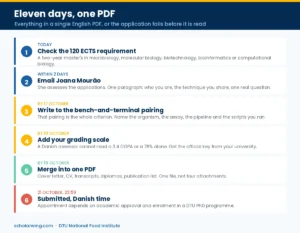
Today. Read the full advert on DTU’s own careers page and check your master’s against the 120 ECTS requirement.
Within two days. Email Joana Mourão. Keep it to a short paragraph: who you are, the one technique you share with the project, and one specific question about the work. She assesses the applications, so a thoughtless email costs you more than no email at all. Our email reviewer will tell you what gets deleted in four seconds.
By 17 October. Write the cover letter around the bench-and-terminal pairing, because that pairing is the whole selection criterion. Name the organism, the assay, the pipeline and the scripts you have actually run. The CV reviewer will catch what you have buried.
By 19 October. Merge everything into one PDF, including the grading scale, and read it once more before you submit. Leave the last two days for checking rather than writing.
Apply: DTU careers page
If this one is not yours
The project is narrow, and most readers will not match it. The mechanism behind it is not narrow at all.
Denmark, Sweden, Norway, Germany and the Netherlands all run doctoral study as salaried employment. No tuition fee exists, so no home rate and no international rate exist either, and nobody gets excluded by arithmetic. DTU advertises positions like this one throughout the year, and so does every university in that group.
Learn to read these adverts and you stop needing to find a scholarship at all. You start looking for a job.