
Why “Fully Funded” UK Medical PhDs Reject International Students
A student messages us some version of this most weeks.
She found a PhD studentship in cancer epidemiology at a serious British university. The advert said Fully Funded. It listed a tax-free stipend of £20,780 a year. She spent four days on the application, wrote to the supervisor, chased a reference — and then found one line, most of the way down the page: available to applicants eligible for Home tuition fees.
She was never eligible. The advert never said so in the title, and nobody had explained the rule to her.
This post explains that rule, because once you understand it you can read any British studentship advert in thirty seconds and know whether it is for you. It also shows where the genuinely open medical positions are, which is mostly not in Britain.
The rule, in one paragraph
International students can hold UK research council studentships. UKRI opened them up from the 2021/22 academic year, so the old blanket ban is gone and any site telling you otherwise is years out of date.
But UKRI attaches a condition that decides everything: “only the home fee level can be claimed from the UKRI training grant or other UKRI funding.” UKRI pays the stipend in full, and it pays tuition at the home rate. For an international student, the difference between the home fee and the international fee “must come from other sources, such as the institution, co-funders, or the student, or the institution may waive it.”
So the question is never whether you are allowed. The question is who pays the gap — and in most departments the honest answer is nobody.
The arithmetic that closes the door
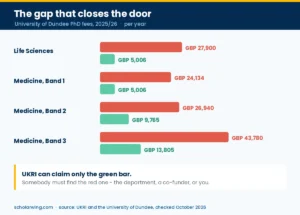
Look at one university’s published PhD fees for 2025/26. Dundee charges:
| Subject | Home rate | International rate |
|---|---|---|
| Life Sciences | £5,006 | £27,900 |
| Medicine, Band 1 | £5,006 | £24,134 |
| Medicine, Band 2 | £9,765 | £26,940 |
| Medicine, Band 3 | £13,805 | £34,062 to £43,780 |
| Biomedical Engineering, Band 3 | — | £41,800 |
A department holding a UKRI grant can claim £5,006. If it takes an international student in Medicine Band 3, somebody must find up to £38,000 more, every year, for three or four years. That is over £150,000 across one studentship.
A medical school with a fixed budget and a queue of excellent home applicants makes the obvious decision. It writes Home fee eligible into the advert and the problem disappears.
That is the whole mechanism. Not prejudice, not a visa rule, not anything you did wrong in your application. Arithmetic.
The second rule nobody mentions: the 30 per cent cap
Even where a department can cover the gap, it cannot do it freely.
UKRI normally limits international students to 30 per cent of appointments per doctoral training programme each year. The cap applies per cohort per training grant, rounded to the nearest whole number, and institutions cannot set their own.
In practice, a doctoral training programme taking ten students a year can fund three internationals at most. Those three places go to exceptional candidates whose supervisors fought for them, usually people already known to the group through a master’s or a research assistantship.
This is worth knowing for one reason. It tells you that contact with the supervisor matters more in Britain than almost anywhere else. A department will find the fee gap for somebody it already wants. It will not find it for a stranger who arrived through an online form.
How to read any UK studentship advert in thirty seconds
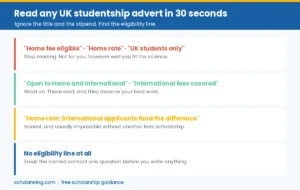
Ignore the title. Ignore the stipend. Scroll straight to eligibility or funding notes and look for these exact phrases.
“Home fee eligible” or “Home rate” or “UK students only”. Stop reading. This one is not for you, however well you fit the science.
“Open to Home and International applicants” or “International fees covered”. Read on. These exist and they are worth your best work.
“Fees at the home rate; international applicants must fund the difference”. Honest, and usually impossible unless you hold another scholarship that covers tuition.
Silence. Many adverts simply do not say. Email the named contact with one short question — is this studentship open to international applicants, and are international fees covered? — before you write anything. A supervisor answers that in a line, and the email reviewer will check your message before you send it.
One more habit worth building: check the closing date and whether the listing is still live. When we pulled a batch of medical studentships this week, one aggregated listing was already expired and still sitting there. Aggregators go stale; the university’s own page does not.
Where the open positions actually are
Here is the part that changes what you do on Monday.
In most of continental Europe, a PhD is a job. The student signs an employment contract, receives a salary with social security, and pays no tuition worth the name. There is no home fee and no international fee, so the arithmetic that closes British doors never arises. Nationality usually does not enter into it at all.
That is why a Pakistani, Nigerian or Indian applicant in a medical field frequently has better odds in Germany, the Netherlands, Belgium, Sweden, Denmark or Austria than in Britain — with no scholarship application anywhere in the process.
EURAXESS is the place to look. It is the European Commission’s own research jobs portal, the institutions post their vacancies there directly, and you can filter by research field and job type. Set the field to Medical Sciences and the job type to PhD positions.
A sample of what sits there in a normal month, across medical and biomedical fields:
- Life sciences and AI/ML — Medical University of Vienna, Austria
- Digital health and medical imaging — Eurecat, Spain
- Bioinformatics — Instituto Português de Oncologia Francisco Gentil, Portugal
- Cancer metabolism and translational control — IDIBELL, Spain
- Machine learning for medical diagnostics — University of Oldenburg, Germany
- Trustworthy AI for quantitative MRI in neuro-imaging — University of Antwerp, Belgium
- Neurosciences, movement science and rehabilitation medicine — Aix-Marseille Université, France
- Vascular cells in cardiac remodelling and heart failure — Heidelberg University, Germany
- Immune responses at the molecular level — University of Salzburg, Austria
- Neuroscience — Ruhr University Bochum, Germany
- Systems and computational neuroscience — Institute of Neurosciences, Spain
Germany’s Max Planck graduate schools run the same way. Their international research schools take students with a master’s in biology, biochemistry, medicine or pharmacy, teach entirely in English, and describe the positions as fully funded without a nationality restriction.
So should you give up on Britain?
No, but change how you approach it.
Target the adverts that say international applicants qualify, rather than applying to everything and hoping. There are fewer of them, and your effort per application goes much further.
Write to supervisors before the advert appears. Because of the 30 per cent cap and the fee gap, British departments fund internationals they already want. A good email in October about a group’s published work is worth more than ten applications in February.
Look at the scholarships that pay international fees outright, which solve the problem from the other side. Our guide to scholarships in the UK covers Commonwealth, Gates Cambridge, Clarendon and the rest, several of which cover full international fees and need no separate application.
Consider a funded master’s first. Many of the international students who do get British PhD funding were already in the department. That route is slower on paper and faster in practice.
What to do this week
Open EURAXESS, filter to medical sciences and PhD positions, and note everything closing in the next six weeks. That single search will show you more genuinely open medical positions than a month of UK studentship lists.
Then pick three research groups whose work you can speak about properly, and write to them. Our free tools cost nothing and need no account — the CV reviewer checks your academic CV line by line, and the email reviewer checks the message before a professor ever sees it.
And if an English test stands between you and an application, some universities accept a medium of instruction letter instead; our free MOI generator produces the request letter for your registrar.
Frequently asked questions
Can international students get UKRI-funded PhDs at all?
Yes. UKRI opened studentships to international students from the 2021/22 academic year. The limit is financial, not legal — UKRI pays tuition only at the home rate.
What does “home fee eligible” mean?
It means the funding covers tuition at the United Kingdom domestic rate only. Unless the department or another source covers the difference, international applicants cannot take the place.
How big is the difference?
At Dundee in 2025/26, £5,006 at the home rate against £24,134 to £43,780 for international medicine, depending on the band. Other universities differ, but the shape is the same.
Is there a limit on how many international students a programme can fund?
Yes. UKRI normally caps international students at 30 per cent of appointments per doctoral training programme per year, per cohort, and institutions cannot change it.
Does UKRI pay for my visa?
No. UKRI funding does not cover visas or the immigration health surcharge. Budget for both separately.
Are European PhD positions really open to any nationality?
In most cases yes, because they are employment contracts rather than scholarships. Always read the individual advert, but the fee barrier that closes British studentships does not exist there.
Should I email the supervisor before applying?
In Britain, yes, and earlier than you think. Because of the cap and the fee gap, departments find money for people they already want.
We checked every figure in this guide against UK Research and Innovation’s own guidance and the University of Dundee’s published fees in October 2026. Stipend rates change every October and fees change every year — confirm the current numbers on UKRI’s site and the university’s own fees page before you rely on them. If you find something here that no longer matches, write to us at scholarwingofficial@gmail.com and we will correct it.
Sources: UK Research and Innovation, Get a studentship to fund your doctorate · UKRI guidance on international eligibility for training grants · University of Dundee PhD fees · EURAXESS research jobs portal