
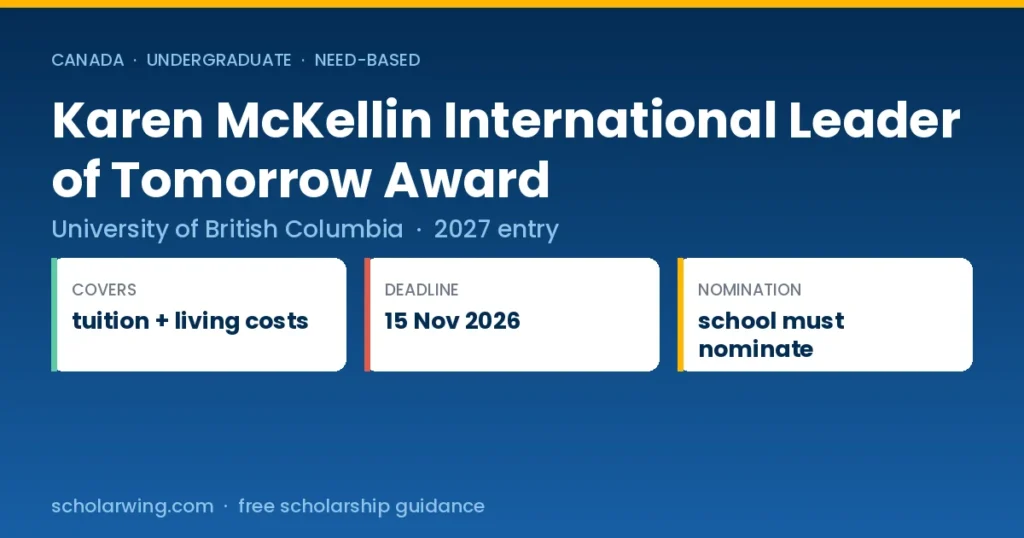
UBC International Leader of Tomorrow Award
Start with the two facts that most listings get wrong, because both of them end applications before they begin. If you’re applying for the UBC International Leader of Tomorrow Award, these facts are especially important to understand.
First, the name. UBC renamed this award the Karen McKellin International Leader of Tomorrow Award. Search for “International Leader of Tomorrow” and you land on a dozen pages still using the old name, several of them reprinting eligibility rules from 2019. The award itself continues, and it remains one of the few genuinely need-based undergraduate awards a non-Canadian can win at a top-50 world university.
Second, the deadline. Your UBC application and your award application are both due on 15 November 2026 for September 2027 entry. UBC’s general application deadline is 15 January 2027. Most sites print the January date, and a student who plans around it loses the award without ever learning why. You need your school nomination arranged in late September, your UBC application submitted in early October, and everything finished by mid-November.
Everything else in this guide follows from those two facts.
What the award actually pays
This award works differently from almost every scholarship ScholarWing covers. It carries no fixed amount. UBC assesses what your family can contribute, then funds the gap, tuition, student fees, textbooks, and living costs. UBC’s own nomination package describes the award as “commensurate with their financial need” and covers the full cost of attendance for students whose need reaches that far.
To understand the scale, look at what a year at UBC Vancouver costs an international undergraduate in 2026/27. Tuition alone runs between CAD 48,779 and CAD 66,678 for a full 30-credit load, depending on the faculty, Arts sits at CAD 51,530, while the most expensive programmes reach past CAD 66,000. Add housing, food, books, insurance and transport, and UBC’s nomination packages have put a full year near CAD 64,825 in recent cycles. An award that closes that gap is worth more over four years than most national scholarship programmes.
The award renews for up to three additional years. Renewal depends on two things: you keep satisfactory academic standing, and your financial need continues. UBC reassesses the need each year, so a family whose circumstances improve may see the award reduce.
Who can apply
Five conditions, and every one of them matters.
You are an international student. Canadian citizens and permanent residents apply to a different set of awards, the Presidential Scholars Awards, the Centennial Scholars Entrance Awards, or Beyond Tomorrow Scholars, all due 1 December. If you already study in Canada on a study permit, you remain eligible for this award.
You are entering your first undergraduate degree.
This rules out anyone who already holds a bachelor’s degree, and it rules out graduate applicants entirely. If you are looking for a master’s or PhD in Canada, read our guides to the Pierre Elliott Trudeau Foundation Scholarships and the Lester B. Pearson International Scholarship instead.
Your school nominates you. This is the condition that eliminates most applicants, and we treat it separately below.
You show significant financial need. UBC sets a high bar here and states it plainly: your circumstances must be such that pursuing a UBC degree would be impossible without meaningful financial help. This is not a top-up for a family that could manage with some strain. UBC asks for documentary proof, and the assessment compares what your family can genuinely contribute against a cost of attendance above CAD 60,000 a year.
Your programme qualifies. Several degrees sit outside this award: the Bachelor of Nursing, the Bachelor of Dental Science in Dental Hygiene, the Bachelor of Medical Laboratory Science, the combined Bachelor + Master of Management, and any dual or joint degree, whether between UBC’s two campuses or with another institution. Check your intended programme against that list before you spend a month on the application.
You also need to meet UBC’s English Language Admission Standard. The award page sets 31 January as the date for award documents; UBC’s own deadlines page gives 15 February 2027 as the date for English language documents. Treat the earlier date as yours and finish both by 31 January.
The nomination, and why it decides everything
You cannot apply to this award on your own. A school representative must nominate you, and the quotas are tight: a school may nominate up to two students for UBC Vancouver, including Vantage College, and one student for UBC Okanagan.
Read that again. Two students. Not two per programme, not two per year group two from your entire school.
This changes what you are doing in September. Before you write a single essay, you compete inside your own school for one of those places. A student who approaches their counsellor in December, having found this award on a listing site, discovers that the nomination went to somebody who asked in September.
So the first move is a conversation, not an application. Go to your guidance counsellor, principal or academic head in late September, tell them this award exists, and ask whether your school intends to nominate anyone. Many schools outside Canada have never heard of it. In that case you are not competing for a place; you are explaining an opportunity, and the school will often nominate you simply because you brought it to them.
You need two different people:
- A nominator: your guidance counsellor, principal, or a school administrator.
- A teacher referee: someone who has taught you.
These must be two separate individuals. One person cannot fill both roles.
If you are transferring from first year at another institution, the equivalent applies: an academic advisor or department head nominates you, and an instructor provides the academic reference.
The financial documents
UBC asks for two forms of documentation from this list:
- Recent income tax returns
- A salary statement from your parents’ employer
- A FAFSA report, for United States citizens
- Bank statements showing account balances
Anything not in English needs a certified translation. This defeats more applications than it should, purely through timing, a certified translation in Lahore, Lagos or Dhaka takes a week or two, and students start the process in the last week of January.
Two warnings worth more than they look.
Do not understate your family’s position, and do not overstate it either. Students sometimes think a smaller declared income improves their chances. It does not; it creates a contradiction with the documents, and a contradiction reads as dishonesty. Meanwhile other students hide real hardship out of pride, and the assessment then shows less need than they actually have.
Collect the documents in October. By the time you are writing essays in November, these should sit in a folder, translated and ready.
The timeline, month by month
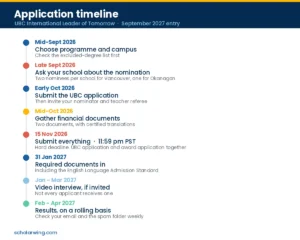
Mid-September 2026. Choose your programme and campus. This decision comes first because the nomination attaches to a specific application, and because the excluded-degree list might change your plan entirely.
Late September 2026. Speak to your school about the nomination. Earliest possible, and the single most important step.
Early October 2026. The UBC online application opens. Submit it. Then create your award application account and invite your nominator and referee both of them need time, and both will be slower than you expect.
Mid-October 2026. Gather the financial documents, arrange translations, and complete your own sections of the award application.
15 November 2026, 11:59 p.m. PST. Everything submitted UBC application and award application together. This is the hard deadline.
By 31 January 2027. Required documents in, including proof that you meet the English Language Admission Standard.
January to March 2027. Video interviews, for those UBC invites. Not everyone receives one.
February to April 2027. Results arrive on a rolling basis. Watch your email, and check the spam folder weekly.
Notice the shape of this. The decisive work happens in September and October. November is submission, not preparation.
What UBC is selecting for
The award honors three qualities together, and the committee looks for all three rather than a strong showing in one.
Superior academic achievement. Grades at the top of your cohort, not merely good grades.
Exemplary leadership. UBC’s wording points at impact through involvement in school and community service projects. They are reading for what changed because you were there, not for a list of positions you held.
Significant financial need. Documented, consistent, real.
The leadership criterion deserves care, because students misread it constantly. A captaincy or a society presidency means little on its own. What carries weight is a problem you noticed, something you did about it, and a result somebody else can confirm. A student who ran a free weekend math’s class for thirty children in their neighborhood, and can say how many sat the exam afterwards, is a stronger candidate than a head boy who lists five titles.
The application asks for up to five activities and three awards. Five is a ceiling, not a target. Three activities with real depth beat five thin ones.
The essays
The nomination package asks you to write about personal challenges, the values of your community, and your vision for the future. Three hard questions, and students answer all three badly in the same way: they write about themselves in the abstract.
On challenges, write the specific circumstance and what you did inside it. Not “I faced many difficulties growing up” but the actual difficulty, in plain terms, and the decision you made. A committee reading two hundred of these can tell the difference between a hardship narrative assembled for an application and an account of something that happened.
On your community’s values, resist the temptation to write a tourist’s description of your country. Write about the particular place you come from and something real about how people there behave. Specificity reads as honesty.
On your vision, connect it to the degree you are applying for and to the place you came from. UBC funds students they expect to do something; vague ambition to “make a difference” tells them nothing. Name the problem and the work.
One more thing, and it matters for every scholarship we cover. Write these essays yourself. ScholarWing builds free tools that help you structure a statement and check your own drafts, and they exist precisely so nobody needs to pay an agent. Use them as scaffolding and a second pair of eyes. The words and the substance must be yours, because a committee reading your file alongside your referee’s letter notices when the two describe different people.
The two awards you also get considered for
Your single application to the International Scholars Program puts you in front of three awards, not one. There is no separate form.
The Donald A. Wehrung International Student Award supports outstanding students from impoverished or war-torn areas who have shown academic excellence despite circumstances most applicants never face. If your region fits that description, this award may suit your situation better than the ILOT does.
The International Impact Award goes to students showing leadership and commitment in sustainability and climate change, social justice, equity and inclusion, or societal health and wellness. Students whose community work falls squarely in one of those areas should make that focus unmistakable in the application, because this award reads for it directly.
You do not choose between them. UBC assesses your file against all three.
The mistakes that end applications
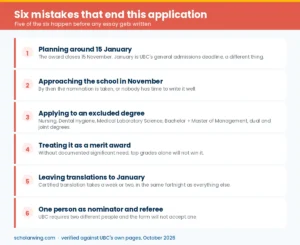
Planning around 15 January. The award closes on 15 November. Every listing printing the January date is describing UBC’s general admissions deadline, which is a different thing.
Approaching the school in November. By then the nomination is gone, or your counsellor has no time to write anything worth reading.
Applying to an excluded degree. Nursing, Dental Hygiene, Medical Laboratory Science, Bachelor + Master of Management, and any dual or joint degree. Students discover this after submission more often than you would think.
Treating it as a merit scholarship. Without documented significant need, academic brilliance alone does not win this award. Strong students with comfortable families should look at UBC’s International Major Entrance Scholarship instead, which runs on merit and needs no separate application.
Leaving translations to January. Certified translation takes a week or two, and the deadline falls in the same fortnight as everything else.
Naming one person as both nominator and referee. UBC requires two different people, and the application will not accept one.
Frequently asked questions
Is this award fully funded?
It covers what your assessed need requires, up to the full cost of attendance tuition, fees, books and living costs. For a student with no family contribution, it functions as full funding. The amount varies between recipients because the need does.
Can I apply without a school nomination?
No. The nomination is mandatory, and schools face quotas of two nominees for Vancouver and one for Okanagan.
Does it cover master’s or PhD study?
No. First undergraduate degree only.
I already study in Canada on a study permit. Am I eligible?
Yes. International students in Canada on a study permit remain eligible. Canadian citizens and permanent residents are not, and they should look at the 1 December awards for domestic students.
How many students win it?
UBC does not publish a fixed number, and the figures circulating on listing sites are guesses. What we can tell you is the structure: schools worldwide may nominate at most two students each for Vancouver, so the applicant pool is smaller and far stronger than an open competition.
Will everyone get an interview?
No. UBC invites some applicants to a video interview between January and March. An invitation is a good sign; its absence does not end your application.
Does the award renew?
Yes, for up to three additional years, provided you maintain satisfactory academic standing and your financial need continues. UBC reassesses need annually.
Do I need IELTS?
You need to meet UBC’s English Language Admission Standard, which several qualifications satisfy besides IELTS TOEFL, and in some cases your medium of instruction. Check UBC’s standard against your own qualifications, and if an MOI certificate applies to your situation, our free MOI generator produces the request letter for your registrar.
What if my school has never heard of this award?
That is common and it works in your favor. Send your counsellor UBC’s own award page, explain the nomination quota, and ask directly. A school with no competing nominee has every reason to put your name forward.
What to do this week
If you are applying for September 2027 entry, the deadline sits in November 2026 and the nomination conversation should happen now.
Three steps, in order. Confirm your programme does not appear on the excluded list. Ask your school this week whether anyone holds the nomination. Begin collecting the two financial documents and arrange any translations you need.
For other fully funded routes into Canada, read our guides to the Lester B. Pearson International Scholarship at the University of Toronto, which also runs on school nomination, and the Pierre Elliott Trudeau Foundation Scholarships for doctoral study. If you want help structuring your essays, our free tools cost nothing and never ask for an account.
We checked every fact in this guide against UBC’s own pages in October 2026. Scholarship terms change, and listing sites rarely update them, if you find something here that no longer matches UBC’s website, write to us at scholarwingofficial@gmail.com and we will correct it.
Sources: UBC International Scholars Program · UBC Dates and Deadlines · UBC Undergraduate Tuition Fees 2026/27 · UBC KMILOT Nomination Package