
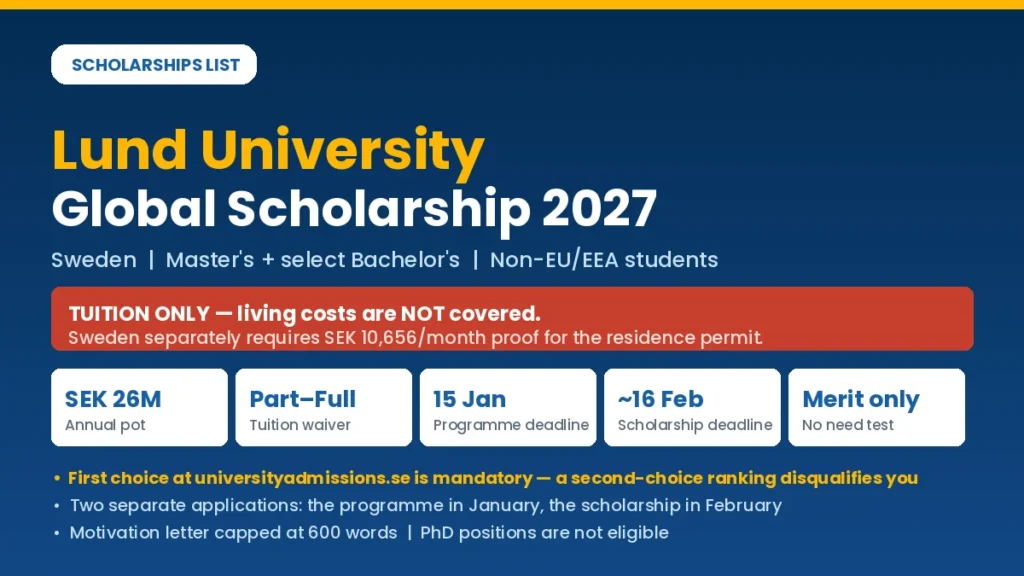
Lund University Global Scholarship
Swede charges international students nothing for the quality of its teaching and everything for the tuition.
A master’s programme at Lund University costs between SEK 135,000 and SEK 270,000 a year depending on the faculty, and that number stops most applicants from South Asia, Africa and Latin America before they read a single course description.
The Lund University Global Scholarship exists to remove that number. It is a tuition waiver, awarded on academic merit alone, to fee-paying students from outside the EU/EEA and Switzerland. Roughly SEK 26 million goes out through it each year.
This guide covers what the scholarship pays, what it does not pay, how the two-stage application actually works, why the 600-word motivation letter decides most outcomes, and where applicants from countries like Pakistan, Nigeria, India and Bangladesh lose their chances. We publish deadlines and figures as the university itself publishes them, and we tell you plainly where the university stays vague.
What the Lund University Global Scholarship Actually Covers
Start with the limits, because they matter more than the headline.
The scholarship reduces or removes tuition fees only. Living costs stay with you. Travel stays with you. The residence permit fee stays with you. Health insurance, books, housing deposit, the application fee at university admissions.se — all yours. Lund states this in plain language on its own scholarship page, and the Swedish Migration Agency enforces it separately when you apply for your permit.
Awards range from a partial waiver to the full tuition fee. Lund does not publish fixed percentage tiers, and it does not publish how many scholarships it grants each year. Several third-party sites list neat brackets of 25%, 50%, 75% and 100% — treat those as unofficial. What the university commits to is a total pot of around SEK 26 million distributed across faculties, with each faculty’s share shaping how many students it can support and at what level.
That vagueness is uncomfortable, and it is worth understanding rather than resenting. Faculty budgets differ. A programme that charges SEK 270,000 a year in architecture cannot fund as many full waivers from the same pot as a humanities programme charging SEK 135,000. So your odds depend partly on a variable nobody publishes: which programme you chose.
What a full waiver is worth
| Field | Annual tuition (SEK) | Two-year master’s total (SEK) | Approx. USD |
|---|---|---|---|
| Humanities and Languages | 135,000 | 270,000 | ~25,000 |
| Regional Studies | 135,000 | 270,000 | ~25,000 |
| Science | 145,000–185,000 | 290,000–370,000 | ~27,000–35,000 |
| Business, Economics and Management | 150,000–160,000 | 300,000–320,000 | ~28,000–30,000 |
| Environment and Sustainability | 150,000–180,000 | 300,000–360,000 | ~28,000–34,000 |
| Law | 155,000 | 310,000 | ~29,000 |
| Engineering and Technology | 185,000 | 370,000 | ~35,000 |
| Medicine and Health | 205,000 | 410,000 | ~39,000 |
| Architecture and Design | 270,000 | 540,000 | ~51,000 |
Figures from the Lund University International Student Prospectus 2026/27. Check the fee on your own programme page before you rely on any of this — faculties revise fees between intakes.
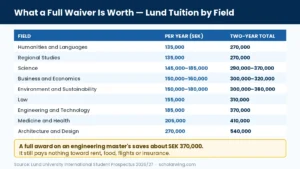
A full award on an engineering master’s therefore saves you roughly SEK 370,000. A partial award of half that still moves a programme from impossible to difficult. Neither one feeds you.
The Living Cost Problem Nobody Warns You About
This is the part that sinks applicants who win a scholarship and still cannot go, so read it twice.
The Swedish Migration Agency requires you to prove you can support yourself before it grants a residence permit. For 2026 applications the figure is SEK 10,656 per month, and you must show it for the entire period you are applying for. For a two-year master’s that means proving roughly SEK 255,744 in funds — around USD 24,000 — sitting in a bank account in your name.
A tuition waiver does not touch that requirement. The Migration Agency assesses maintenance separately from tuition, and a Lund scholarship letter does not substitute for the bank statement.
| Requirement | Amount (2026 rates) |
|---|---|
| Maintenance per month | SEK 10,656 |
| Reduction if housing is provided free | −SEK 4,736 per month |
| Reduction if food is provided free | −SEK 2,960 per month |
| Residence permit application fee (adult) | SEK 1,500 |
| Typical processing time | Around 3 months for 75% of decided cases |
Certain scholarship holders — Swedish Institute, Sida and some EU-funded awards — pay no residence permit fee. The Lund Global Scholarship does not appear on that exemption list, so budget the SEK 1,500.
So the honest arithmetic for a two-year master’s with a full tuition waiver looks like this: zero tuition, around SEK 256,000 to prove for maintenance, SEK 1,500 permit fee, SEK 900 application fee at university admissions.se, plus flights and insurance. If your family cannot assemble the maintenance figure, a full waiver still leaves you at home.
We say this early because too many guides do not. Plan the money before you plan the personal statement.
Ways applicants close the maintenance gap
Students who make it work usually combine several sources rather than finding one. A sponsor’s account with a documented relationship works, provided the funds sit there long enough to look real rather than borrowed for the screenshot. Education loans from banks in your home country count when the sanction letter names you and states the disbursement schedule. A second scholarship stacked on top of the Lund award covers the rest for some students — the Swedish Institute Scholarships for Global Professionals fund living costs and travel, and holding both changes everything, though SI runs its own separate and far more competitive process.
Part-time work exists in Sweden and student residence permits allow it, but never plan on it. The Migration Agency will not accept projected earnings as maintenance, and the Lund job market runs in Swedish for most student-level work.
Who Can Apply
The eligibility rules are narrow and mechanical. Either you meet them or you do not.
To qualify, all of these conditions must be true:
- You hold citizenship of a country outside the EU, the EEA and Switzerland, and you therefore pay tuition fees at Swedish universities
- You have applied to a master’s programme at Lund, or to one of the eligible bachelor’s programmes — Development Studies, Mathematics, Physics and Physical Geography
- You listed your Lund programme as your first choice at university admissions.se
- You paid the application fee and completed the programme application by the deadline
- Your academic record is strong
You are not eligible if:
- You are an EU/EEA or Swiss citizen, since you pay no tuition in the first place
- You hold permanent residence in Sweden
- You applied to a Lund programme as a second or third choice
- You applied only to exchange studies, single courses or a PhD position
That first-choice rule removes more applicants than any other. Lund states it explicitly. Ranking Lund second while hedging toward another Swedish university disqualifies your scholarship application entirely, no matter how strong your grades are. Decide before you submit.
Music and Fine Arts programmes run under different conditions, and applicants in the March–April round receive separate instructions. Check your own programme page rather than assuming the standard timeline applies to you.
One more point that reassures many applicants: Lund does not assess financial need. The selection is academic merit only. You do not submit proof of income, you do not explain your family’s circumstances, and you gain nothing by describing hardship. Save that energy for the academic case.
The Two-Stage Timeline
The single most common failure is treating this as one application. It is two, in a fixed order, and missing the first kills the second.
Stage one — the programme application. Opens around mid-October and closes 15 January for programmes starting the following August. You apply through university admissions.se, rank your choices, upload documents and pay the SEK 900 application fee.
Stage two — the scholarship application. The separate scholarship portal opens in early February, after the programme application has closed. The 2026 round closed on 16 February 2026. You cannot reach this portal until stage one is complete and your fee is paid.
| Stage | Window | Where | What can go wrong |
|---|---|---|---|
| Programme application opens | Mid-October | university admissions.se | People wait and then rush documents |
| Programme application closes | 15 January | university admissions.se | Missing this ends everything |
| Document deadline | Usually early February | university admissions.se | Transcripts arriving late |
| Scholarship portal opens | Early February | Lund’s own portal | Applicants never hear it opened |
| Scholarship deadline | Mid-February (16 February in 2026) | Lund’s own portal | A two-week window, easily missed |
| Admission results | Late March | university admissions.se | — |
| Scholarship results | Usually late March to April | Email from Lund | — |
| Residence permit application | Immediately after acceptance | migrations verket.se | Three-month processing |
| Studies begin | Late August | Lund | — |
Dates shift by a few days each year. The 2027 intake will follow this shape, but confirm every date on Lund’s official scholarship page before you act on it.
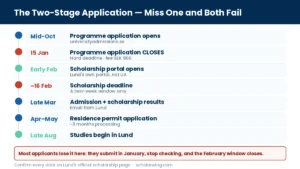
The gap between stage one closing and stage two opening traps people. They submit in January, feel finished, stop checking email, and discover the scholarship round in March when it has already closed. Put both dates in your calendar the day you start.
The 600-Word Motivation Letter: Where the Decision Happens
Grades get you into the pile. The scholarship motivation letter decides where you sit inside it.
Six hundred words is short. It is roughly a page and a quarter, which means every sentence has to carry information. The committee reads hundreds of these, and the ones that succeed share a shape.
What the letter must establish
That you belong in this specific programme. Not in “your prestigious university” — in the MSc in Water Resources Engineering, because of the coursework in that programme and the research group attached to it. Name modules,name a research centre,name a supervisor whose published work overlaps yours. Committees can tell within two sentences whether you read the programme page or the university homepage.
That your record supports the claim. State your CGPA, your class rank if it flatters you, your thesis topic and its finding. A sentence like “my final-year thesis measured nitrate at 96 hand-pump sites across Kasur District and found 41 above the WHO limit” does more work than a paragraph about passion for the environment.
That you have done relevant things outside your coursework. Research assistance, a publication, a conference presentation, fieldwork, an internship with real responsibility, a tool you built. Concrete, dated, quantified.
That Lund specifically enables what you want to do next. This is the fit paragraph, and weak applications skip it. Lund has a Centre for Sustainability Studies, MAX IV and ESS on its doorstep for materials and neutron science, a strong development studies tradition, and specific labs in each faculty. Find the one that matters for your work and say why it matters.
That you will use the degree. Short-term and long-term, stated concretely. Where you will work, on what problem, in which country.
What wastes the 600 words
Childhood anecdotes. Praise for Sweden. Praise for Lund. Descriptions of financial hardship, which the committee does not assess. Generic statements about globalisation, innovation or making a difference. Lists of adjectives about yourself. Restating your CV chronologically.
Weak versus strong, same applicant
Weak: “I have always been passionate about sustainable development and believe that Lund University’s prestigious reputation and world-class faculty make it the ideal place for me to pursue my dreams and contribute to making the world a better place.”
Strong: “I intend to study how municipal waste-to-energy systems perform under the fuel-quality variation found in South Asian cities, extending the mass-burn efficiency work published by the Environmental and Energy Systems Studies division at LTH. My undergraduate thesis measured calorific value across 38 waste samples from three Lahore collection zones and found a 41% spread the standard design assumptions ignore.”
The second version names a division, a method, a number and a gap. It also says nothing about passion, and loses nothing by it.
If you want a structured starting point, our free personal statement generator and SOP generator build a first draft from your own details. Rewrite what they produce in your own words before you submit anything — committees screen for AI text, and a generic letter reads as generic whoever wrote it.
Building the Rest of the Application
Documents through university admissions.se
Sweden runs a centralized admissions system, and it is strict about documentation. Upload certified copies of your degree certificate and full transcripts, with official English translations where the originals are in another language. Some countries have specific instructions — India, Pakistan, Nigeria, Iran and China among them — listed on university admissions.se under country-specific requirements. Read your own country’s page. Documents that ignore it get rejected without review.
English proficiency comes next. Lund requires English 6 in Swedish terms, which maps to roughly IELTS 6.5 overall with no band under 5.5, or TOEFL iBT 90 with at least 20 in writing. Some programmes ask for more. A degree taught fully in English can sometimes exempt you, but only when your university’s medium of instruction is documented properly — our free MOI certificate generator produces the wording most institutions accept, though your university must issue and stamp the final version.
The CV and supporting material
Some Lund programmes ask for a CV, a summary of previous studies or a short statement alongside the standard documents. Requirements vary by programme, so check yours rather than preparing a generic bundle. Where a CV is required, keep it academic: education, research, publications, relevant employment, technical skills, languages. Leave out photographs, date of birth, marital status and national ID numbers — Swedish institutions neither need nor want them. Our free CV builder follows that convention.
Contacting a supervisor
For taught master’s programmes, you do not need to. Lund admits to the programme, not to a supervisor, and unsolicited emails rarely change an admission decision.
For research-heavy programmes where a thesis supervisor matters later, a short and specific email can still help you write a sharper motivation letter, because it tells you which projects are actually running. Keep it under 250 words, reference a specific paper, attach a CV, and expect most messages to go unanswered. Our free cover letter generator drafts that first email.
How Lund Compares With Sweden’s Other Fee Waivers
Almost every Swedish university runs its own tuition waiver on the same national calendar, because they all recruit through university admissions.se. Applying to one and ignoring the rest wastes the effort you already spent on documents.
| University | Scheme | Covers | Separate application? |
|---|---|---|---|
| Lund | Global Scholarship | Part or all of tuition | Yes, February portal |
| Uppsala | IPK Scholarships | Full tuition | Yes, separate round |
| KTH | KTH Scholarship | Full tuition, some with living costs | Yes |
| Chalmers | Chalmers IPOET | Full tuition | Automatic for eligible applicants |
| Stockholm University | Tuition waivers | Full tuition | Yes |
| Swedish Institute | SISGP | Tuition, living costs, travel, insurance | Yes, separate national scheme |
Two things follow from that table. First, the Swedish Institute award is the only one on it that solves the living-cost problem, which is why it is worth a serious application even though it is the hardest to win. Second, your transcripts, English test and academic CV serve every row. The marginal cost of a second or third application is one more motivation letter, rewritten for a different programme.
Rank honestly, though. The first-choice rule at Lund means you can only give one Swedish university your top slot, and a half-hearted first choice reads exactly like what it is.
What Studying at Lund Is Actually Like
Lund is a university town of roughly 90,000 people in the far south of Sweden, and the university has been there since 1666. Malmö sits 15 minutes away by train and Copenhagen about 40, so the airport question answers itself.
Three practical things matter to international students. Housing is the first: Lund’s student nations and AF Bostäder run a large share of it, queues are real, and you register the day you accept your place rather than the week before you fly. The second is the nations themselves — student societies that run cheap meals, clubs and events, and which shape social life far more than the departments do. The third is the language: your programme runs in English and daily life mostly accommodates that, but Swedish matters for part-time work and for staying after graduation.
On research, Lund’s pull for many applicants comes from what sits around the campus rather than in it. MAX IV, the synchrotron light facility, and the European Spallation Source draw materials scientists, chemists and physicists specifically. The Centre for Sustainability Studies and the long tradition in development studies do the same for social scientists. If one of those is your reason for applying, say so in the motivation letter — that is precisely the kind of specificity the committee is looking for.
Sweden also allows graduates to apply for a residence permit to look for work after finishing a degree, which changes the arithmetic on a two-year investment. Check the current rules on the Migration Agency site, since post-study permit conditions have shifted more than once.
Seven Mistakes That Cost Applicants the Scholarship
1. Ranking Lund second. The first-choice rule is absolute. A hedged application ranks you out of the scholarship entirely.
2. Missing the February window. The scholarship round runs about two weeks, months after the programme deadline, in a different portal. Calendar it in October.
3. Writing about need instead of merit. Selection is academic. A letter built around family circumstances spends its 600 words on a criterion nobody scores.
4. A motivation letter that could go to any university. Swap “Lund” for another name and if the letter still works, it will not win anything.
5. Ignoring country-specific document rules. university admissions.se rejects incorrectly documented applications mechanically, before anyone reads your file.
6. Assuming a waiver covers living costs. Students win the scholarship, fail the maintenance requirement at the Migration Agency, and lose the place. Plan the SEK 10,656 per month from day one.
7. Applying to the most expensive programme without thinking. Architecture at SEK 270,000 a year draws from the same faculty pot as everything else in its faculty. Choosing a programme you genuinely fit beats choosing the one with the biggest sticker price.
Realistic Odds and How to Improve Them
Lund publishes neither the number of applicants nor the number of awards, so anyone quoting a precise success rate is guessing. What the university does publish — SEK 26 million spread across all faculties, against tuition fees of SEK 135,000 to 270,000 per student per year — tells you enough. The pot funds a few hundred partial awards or far fewer full ones. Competition is severe.
That said, several things sit inside your control.
Apply early in the programme window, with complete documents, so no part of your file waits on a missing transcript. Choose a programme you can argue for in a paragraph rather than the one with the strongest brand. Write a motivation letter that names things — divisions, modules, papers, numbers. Apply in parallel to the Swedish Institute Scholarships for Global Professionals, which cover living costs, travel and insurance, and which change the maintenance problem entirely if you win one. Treat Uppsala, KTH, Chalmers and Stockholm as genuine parallel applications rather than backups — each runs its own scholarship scheme on a similar calendar.
And apply again if it does not work. Nothing bars a second attempt in a later intake, and an applicant with an extra year of research or publication behind them is a materially stronger candidate than they were the year before.
Frequently Asked Questions
Is the Lund University Global Scholarship fully funded?
No. It covers tuition, partially or fully. Living costs, travel, insurance and permit fees stay with you, and Sweden requires proof of SEK 10,656 per month before it issues a residence permit.
Do I need a separate application for the scholarship?
Yes. You first apply to the programme at university admissions.se by 15 January, then apply through Lund’s own scholarship portal when it opens in February.
Can I apply if Lund is my second choice?
No. Lund requires the programme to sit first in your ranking.
Does Lund consider financial need?
No. Selection rests on academic merit.
How long is the motivation letter?
A maximum of 600 words.
When do results arrive?
Admission decisions come in late March, with scholarship decisions usually following in late March or April by email.
Can I combine this with the Swedish Institute scholarship?
The two run separately, and holding both solves the living-cost problem. SI is considerably more competitive and has its own deadlines, so apply to each on its own terms.
Are PhD students eligible?
No. Doctoral positions in Sweden are salaried employment with no tuition fee, so this scholarship does not apply.
Which bachelor’s programmes are eligible?
Development Studies, Mathematics, Physics and Physical Geography. Other bachelor’s programmes are not.
Is IELTS required?
You need to demonstrate English 6, usually through IELTS 6.5 or TOEFL iBT 90. Certain English-taught degrees qualify for exemption when properly documented.