
Swiss Government Excellence Scholarships
Most websites call this scholarship “fully funded.” It is not.
The Swiss Government Excellence Scholarship pays CHF 2,450 a month and leaves your tuition fees to you between CHF 600 and CHF 2,000 every semester. It also refuses almost every Master’s applicant on the planet, because outside the arts this award does not fund taught Master’s degrees at all.
That sounds discouraging. It should not be. For the right candidate a PhD student, a doctoral researcher, or an artist heading to a Swiss conservatory,this remains one of the strongest research awards in Europe, and it sits at a Swiss university system that charges a fraction of what the UK or the US charges. The problem is that thousands of students apply every year without meeting the one requirement that decides everything, and they find out in January.
This guide covers what the award actually pays, who genuinely qualifies, the supervisor letter that blocks most applicants, and the timeline that starts far earlier than the deadline suggests.
Quick Facts
| Item | Detail |
|---|---|
| Funder | Federal Commission for Scholarships for Foreign Students (FCS), Switzerland |
| Official name | Swiss Government Excellence Scholarships (ESKAS) |
| Monthly stipend | CHF 2,450 |
| Tuition | NOT covered, you pay CHF 600–2,000 per semester |
| Who qualifies | PhD candidates, doctoral researchers, and arts Master’s students |
| Who does NOT | Taught Master’s applicants (outside the arts), Bachelor’s applicants |
| Age limit | Born after 31 December 1991 |
| Countries | 183 for research; far fewer for the arts track |
| Applications open | 20 August 2026 |
| Deadline | Varies by country set by your Swiss embassy |
| Apply through | The GO ESKAS online system, via your home country |
What the Scholarship Actually Pays
Read this section closely, because the gap between what the award covers and what students assume it covers causes real financial trouble.
What you receive
| Benefit | Amount | Notes |
|---|---|---|
| Monthly stipend | CHF 2,450 | For one person only no family supplement |
| Rental deposit grant | CHF 600, once | Helps you sign a lease on arrival |
| Health insurance | Premiums paid | Non-EU/EFTA nationals only |
| Half-Fare Travelcard | Included | Halves your train and bus fares across Switzerland |
| Return flight | Allowance | Non-EU/EFTA nationals only |
What you pay yourself
| Cost | Typical amount |
|---|---|
| Tuition and semester fees | CHF 600–2,000 per semester |
| Conference travel | Your own budget |
| Field research costs | Your own budget |
| Flights (EU/EFTA nationals) | Your own budget |
| Family costs | Entirely your own |
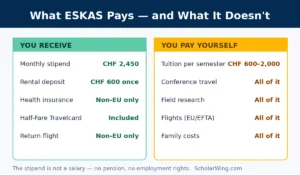
The stipend is not a salary. The FCS states this explicitly, and it matters more than it sounds. You hold a scholarship, not employment, so you accrue no Swiss pension contributions, no unemployment entitlement, and no employment-based residence rights from this money.
Does CHF 2,450 stretch in Switzerland?
Honestly, it stretches to a careful student life and nothing more. Rough monthly figures for 2026:
| Expense | Zurich / Geneva | Bern / Basel / Lausanne |
|---|---|---|
| Room in shared flat | CHF 700–1,100 | CHF 550–850 |
| Food | CHF 400–500 | CHF 350–450 |
| Transport (with Half-Fare) | CHF 50–80 | CHF 40–70 |
| Phone, internet, sundries | CHF 100–150 | CHF 100–150 |
| Total | CHF 1,250–1,830 | CHF 1,040–1,520 |
So a researcher in Bern lives comfortably and saves a little. A researcher in Zurich who cannot find a room under CHF 900 will feel the squeeze every month, and will need the semester tuition instalment sitting in a separate account before it falls due.
Who Actually Qualifies
This is where most applications end before they begin.
The three tracks
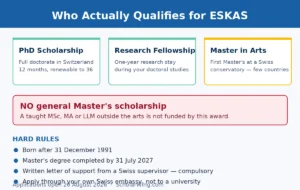
1. Research Fellowship: a one-year research stay in Switzerland during your doctoral studies, or for postdoctoral researchers. You remain enrolled at your home university and conduct a defined project at a Swiss institution.
2. PhD Scholarship: a full doctorate at a Swiss university. Funded for 12 months and renewable up to 36 months, subject to satisfactory progress.
3. Master in Arts: a first Master’s degree at a Swiss art school or conservatory. This track alone accepts Master’s applicants, and only from a limited list of countries.
The rule that ends most applications
There is no general Master’s scholarship. If you want a taught MSc in engineering, an MA in economics or an LLM in Switzerland, this award does not fund it. Every listing that advertises “Swiss Government Scholarship for Masters 2027” without saying “in the arts” is either careless or deliberately misleading, and students lose whole application cycles to those posts.
Hard eligibility rules
- Date of birth after 31 December 1991. A firm cut-off, not a preference.
- Master’s degree completed by 31 July 2027 for research and PhD tracks. A Bachelor’s suffices for the arts track.
- A letter of support from a Swiss academic supervisor. Compulsory. More on this below, because it decides everything.
- A detailed research plan with a timeline and milestones.
- If you already live in Switzerland, your entry date must not precede 1 August 2026. This rule quietly excludes people already settled there.
Who the FCS turns away
- Anyone applying for a taught Master’s outside the arts
- Anyone born on or before 31 December 1991
- Anyone without a named Swiss supervisor who has agreed in writing
- Anyone applying from a country the programme does not cover that year
- Anyone who applies directly to a Swiss university expecting ESKAS to follow
The Supervisor Letter: the Real Barrier
Ask anyone who has won this scholarship what the hardest part was, and they will not say the essays. They will say finding a professor in Switzerland willing to sign a letter of support.
Why it exists
The FCS funds research, not enrolment. A Swiss professor’s signature confirms that a laboratory or research group has space, relevance and willingness to host your specific project. Without it, the committee has no way to judge whether your work can actually happen.
What the letter must show
A usable letter names you, names your project, confirms the supervisor’s willingness to host you for the stated period, and states that the institution can provide the facilities your research needs. A two-line “I have no objection” note rarely survives review.
How to secure one
Start in March or April 2026, five months before applications even open. The professors who host international researchers receive dozens of requests each cycle, and they answer the ones that show genuine preparation.
Read three or four of the professor’s recent papers properly. Then write a short email under 250 words ,that states who you are, what you propose, why their group specifically, and what you bring. Attach your CV and a one-page project summary. Never send the same email to twelve professors at once; they talk to each other, and a mass email reads like a mass email.
Expect silence from most. A response rate of one in six counts as normal. Write to fifteen or twenty relevant researchers over several weeks, and follow up once after ten days.
One practical note: target the professor whose published work overlaps your proposal, not the most famous name in the department. A mid-career researcher with two funded projects has more capacity and more reason to say yes than a department head with forty commitments.
The Research Plan
After the supervisor letter, the research plan carries the most weight. The FCS asks for a detailed plan with a timeline and milestones, and reviewers read it to judge whether twelve months in Switzerland would produce something real.
Cover these six things:
The question. State it in one or two sentences, early. Reviewers who reach paragraph three without finding your research question stop reading.
The gap. What the literature has not settled, and why it matters. Cite the work you build on, including your prospective supervisor’s where it fits honestly.
The method. The section that sinks weak proposals. Name your approach, your data sources, your sample, your instruments, your analysis. “I will conduct a comprehensive study” tells a committee nothing.
Why Switzerland. Specifically why this group, this laboratory, this equipment or this dataset. If your project could run anywhere, the committee will wonder why it should run on Swiss money.
The timeline. Month by month across your funded period, with milestones a reviewer can check: literature review by month two, fieldwork by month five, first draft by month nine.
The outcome. What exists at the end, a paper submitted, a dataset published, a chapter completed, a method validated.
Free Tools for This Application
Every document ESKAS asks for, we build free. No account, no payment.
| You need | Use this | Why it matters here |
|---|---|---|
| Research plan with timeline and milestones | Research Proposal Generator | The FCS weighs this second only to the supervisor letter |
| Academic CV | CV Builder | Puts publications above employment, and strips the photo and date of birth that Swiss committees do not want |
| Motivation statement | SOP Generator | Builds the academic-plan essay several embassies request alongside the research plan |
| Letter to your supervisor | Cover Letter Generator | For the first email to a Swiss professor keep it under 250 words |
| References | Reference Letter Generator | Drafts a letter your professor can review, edit and sign |
| English proof | MOI Generator | Requests the certificate that replaces IELTS at several Swiss institutions |
| Deadline tracking | Deadline Tracker | Counts down to every major award while you wait for your embassy’s date |
| A reality check | Eligibility Checker | Shows which awards your profile actually clears, in about a minute |
Deadlines and How to Apply
The route runs through your own country
You do not apply to a Swiss university and you do not apply to Bern directly. The Swiss embassy or consulate in your home country runs the process, sets your deadline, and conducts the first round of selection.
Key dates for 2027–2028
| Stage | Date |
|---|---|
| Country deadlines published | August 2026 |
| Applications open (GO ESKAS) | 20 August 2026 |
| Country deadlines | Vary typically between October and December 2026 |
| Embassy pre-selection | Winter 2026–27 |
| FCS final selection | Spring 2027 |
| Results | By May 2027 |
| Studies begin | September 2027 |
Deadlines differ by country and they differ sharply. Some embassies close in early October, others in December. Check your own embassy’s page the week applications open, and never rely on a date you read on a scholarship aggregator.
The application itself
You apply through the GO ESKAS online system. Expect to submit your research plan, your academic record, your supervisor’s letter of support, references, a CV, and identity documents. The exact list comes from your embassy, because national requirements vary.
For anything the published material does not answer, the FCS answers email at sgs@sbfi.admin.ch.
Your Timeline, Working Backwards
| When | What you do |
|---|---|
| March–April 2026 | Identify Swiss research groups. Read their recent work. |
| April–June 2026 | Email professors. Follow up. Secure a supervisor. |
| June–July 2026 | Draft the research plan. Send it to your supervisor for comment. |
| August 2026 | Check your embassy’s deadline the day it appears. |
| Aug–Oct 2026 | Assemble documents, request references, prepare translations. |
| Your deadline | Submit through GO ESKAS, a week early. |
| Winter 2026–27 | Embassy pre-selection; some countries interview. |
| Spring 2027 | FCS decides. |
| By May 2027 | Results. |
| Summer 2027 | Visa, housing, insurance, travel. |
| September 2027 | Arrive. |
Notice that the real work starts eighteen months before you set foot in Switzerland. Students who first hear about ESKAS in October have already missed the supervisor stage, which is exactly why so many applications arrive incomplete.
Is Switzerland Worth It?
The case for
Swiss universities charge remarkably little by international standards. ETH Zurich, EPFL, the University of Zurich and the University of Geneva all sit in the global top 150, and their semester fees run between CHF 600 and CHF 2,000, where a comparable UK PhD charges £20,000 or more a year in overseas fees. Research funding per student is among the highest anywhere, laboratories are well equipped, and Swiss institutions collaborate heavily across Europe.
English serves as the working language in most doctoral programmes and research groups, particularly in the sciences.
The case against
Switzerland is expensive, and CHF 2,450 buys a student life rather than a comfortable one. The award funds one person, so a researcher with a partner or children needs another income. Housing in Zurich and Geneva is genuinely difficult, and arriving without a confirmed room causes real stress.
The award also carries no path to settlement of its own. It funds a research period, after which you return or find other status.
Frequently Asked Questions
Is the Swiss Government Excellence Scholarship fully funded?
No, and the phrase misleads people. It pays CHF 2,450 a month, insurance for non-EU nationals, a CHF 600 rental deposit and a travel card. Tuition of CHF 600–2,000 per semester stays with you, as do conference and research costs.
Can I apply for a Master’s degree?
Only in the arts, and only from a limited list of countries. No general Master’s track exists.
What is the age limit?
Your date of birth must fall after 31 December 1991 for the 2027–28 cycle. The cut-off shifts each year.
Do I need a supervisor before applying?
Yes. A letter of support from a Swiss academic supervisor is compulsory, and securing one takes months. Start in spring.
Can I bring my family?
The scholarship covers one person. Family members need separate financial provision and separate permits, and CHF 2,450 will not stretch to cover them.
What English level do I need?
Requirements vary by institution and programme. Most doctoral research runs in English; some universities ask for a test, others accept your supervisor’s confirmation. Check with the host institution, and read our MOI certificate guide if your degree ran in English.
Are flights covered?
For non-EU/EFTA nationals, yes, as an allowance. EU and EFTA applicants pay their own way.
Can I work alongside the scholarship?
Swiss permit rules limit employment for scholarship holders, and the FCS expects your research to occupy you fully. Ask your host institution before assuming any side income.
What if my country is not on the list?
Eligible countries change year to year. Check the list your embassy publishes in August, and look at other fully funded research awards in the meantime.
Before You Apply — a Short Checklist
- Born after 31 December 1991
- Master’s degree finished by 31 July 2027 (or Bachelor’s for arts)
- Applying for a PhD, a research stay, or an arts Master’s not a taught Master’s
- A named Swiss supervisor who has agreed in writing
- A research plan with a month-by-month timeline
- Your embassy’s exact deadline, checked on its own website
- A plan for the tuition the scholarship does not cover
- Documents translated and certified where your embassy requires it