
Rosa Luxemburg Stiftung Scholarship
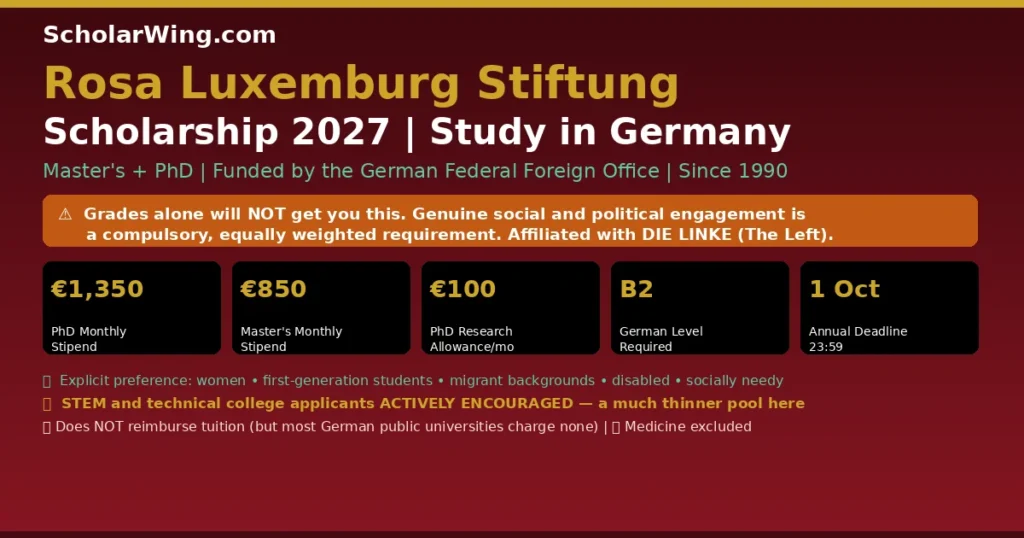
Grades Alone Will Not Get You This — Political and Social Engagement Is Compulsory
The Rosa Luxemburg Stiftung (RLS) is one of Germany’s six major political foundation scholarships, and it is the most ideologically specific of them all.
The Scholarship Department of the Rosa-Luxemburg-Stiftung awards financial grants to highly-qualified undergraduate and doctoral students from Germany and abroad who evidence high levels of social and political engagement.
High scholarly and professional qualifications (proof of above-average academic achievement at school and/or university). Political and social engagement in line with the aims of the Rosa-Luxemburg-Stiftung.
Two requirements, both mandatory. Excellent academic results, and demonstrated political and social engagement that genuinely aligns with the foundation’s aims.
⚠️ Know What You Are Applying To
The RLF is a political educational organization closely affiliated with DIE LINKE (The Left Party) which awards scholarships to foreigners who come to Germany for their dissertation or in order to conduct research.
The RLS is affiliated with DIE LINKE, Germany’s left party. It is named after Rosa Luxemburg, the Polish-German Marxist theorist and revolutionary murdered in Berlin in 1919.
The Rosa Luxemburg Stiftung scholarship is unique because it explicitly targets students who demonstrate the following: A commitment to social transformation and political activism. Academic excellence combined with real-world engagement. Solidarity with workers, migrants, women, and oppressed communities. Critical and interdisciplinary academic approaches.
This is not a neutral academic award. If your convictions and record do not authentically align with those commitments, this is the wrong foundation and Germany has five others with different political traditions (Konrad Adenauer for the center-right, Friedrich Ebert for social democracy, Heinrich Böll for the Greens, and others already covered on ScholarWing).
Apply where you genuinely fit. Assessors read a great many applications and manufactured activism is transparent.
The Funding
For a Master’s: The monthly basic scholarship consists of 850€ along with a lump sum of 20€. Additional subsidies for health and nursing insurance of no more than 86€ are also available. For PhD: The doctoral scholarship is largely independent of one’s income and consists of 1,350€ per month. Additional lump sum payments of 100€ to cover research costs and further health care subsidies are also available. Scholarship holders can also receive funding to cover stays abroad (for research, attending conferences, etc.).
Master’s
| Component | Amount |
|---|---|
| Basic monthly scholarship | €850/month |
| Lump sum | €20/month |
| Health and nursing insurance subsidy | Up to €86/month |
| Approximate total | ~€956/month |
PhD / Doctoral
| Component | Amount |
|---|---|
| Monthly scholarship | €1,350/month |
| Research cost lump sum | €100/month |
| Health care subsidies | Additional |
| Stays abroad, conferences | ⭐ Funding available |
€1,400/month doctoral grant is also reported figures shift between cycles. Verify the current rate at rosalux.de.
⭐ The doctoral award is largely income-independent, and the separate €100 monthly research allowance plus conference and research-travel funding make it genuinely workable for fieldwork-based research.
Funded by the German Foreign Office
The funds for this program are provided by the Federal Foreign Office (Auswärtiges Amt).
For international students, the money comes from the German Federal Foreign Office the same source behind many DAAD programmes.
⚠️ It Does NOT Pay Tuition Fees
Several sites claim this scholarship “covers full tuition fees.” That is wrong.
Does the Rosa Luxemburg Stiftung scholarship reimburse university tuition fees (for paid programmes)? No. For international students, the RLS scholarship is primarily a living-expenses stipend. It does not reimburse tuition fees charged by universities.
It is a living stipend, not a tuition award.
⭐ Why This Matters Much Less in Germany
Here is the nuance most guides miss: most German public universities charge no tuition fees to international students. You typically pay only a semester contribution (Semesterbeitrag) of roughly €150–€350, which usually includes a public transport pass.
So for the overwhelming majority of RLS scholars at public universities, a living stipend is full funding in practice.
⚠️ But check your specific programme. Some Master’s courses particularly at private institutions, business schools, or certain specialized international programmes do charge substantial fees. RLS will not cover those.
⭐ Explicit Preference for Underrepresented Applicants
This is one of the most genuinely inclusive selection statements of any scholarship in this series.
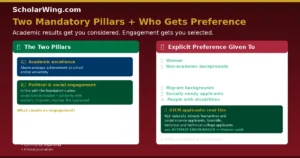
In granting scholarships, the Stiftung seeks to counteract the social, political and gender discrimination prevalent in our society, and therefore gives preference to applications from women, students of non-academic and migrant backgrounds, the socially needy, and people with disabilities who demonstrate comparable achievements and commitment.
| Priority Group | Status |
|---|---|
| Women | ⭐ Preference |
| Students of non-academic backgrounds | ⭐ Preference, first-generation students |
| Students of migrant backgrounds | ⭐ Preference |
| Socially needy applicants | ⭐ Preference |
| People with disabilities | ⭐ Preference |
“Non-academic background” means first-generation university students, those whose parents did not attend university. If you are the first in your family to reach higher education, say so explicitly in your application. It counts in your favor here.
⭐ STEM Applicants Are Actively Encouraged
Applications from undergraduate and doctoral students from scientific and technical disciplines are actively encouraged, as well as from graduates of technical colleges.
RLS naturally attracts humanities and social science applicants. Scientific and technical applicants face a shallower pool and the foundation says so directly. Engineers, computer scientists, environmental scientists and technical college graduates with genuine activist records should take this seriously.
⚠️ Medical fields are excluded from the programme at doctoral level.
Eligibility
Hold an excellent academic record. Demonstrate proficiency in the German language at B2 level. Be enrolled, or planning to enroll, in a master’s or doctoral programme at a state-recognized university in Germany. Show active involvement in social, political, or community engagement aligned with the foundation’s values. Present a strong research proposal, particularly for doctoral studies.
| Requirement | Detail |
|---|---|
| Academic record | Above-average achievement at school and/or university |
| German language | ⚠️ B2 level or above |
| Institution | State-recognised university in Germany |
| Level | Master’s or Doctoral (undergraduate also supported for some cohorts) |
| Engagement | ✅ Active social/political/community involvement |
| Research proposal | Required, especially for doctoral applicants |
| Nationality | German and international students |
| Medicine | ❌ Excluded (doctoral) |
⚠️ German B2 Is a Real Barrier
Unlike DAAD programmes with English-taught tracks, RLS requires German at B2 upper-intermediate. You must be able to study, argue and engage politically in German.
If you do not have B2 German, this is a two-year preparation project, not a next-cycle application. Start now: Goethe-Institut courses, university language canters, or structured self-study toward the Goethe-Zertifikat B2 or TestDaF.
Master’s Timing Rules
Master’s degree: Funding possible if studies begin in the winter semester. If you are already in your second semester of a Master’s program by the application deadline of October 1st, you can apply to us if it is a four-semester Master’s program.
You have not yet started your studies and your studies will only begin in the semester after the application deadline.
| Situation | Eligible? |
|---|---|
| Not yet started; beginning the semester after the deadline | ✅ Yes |
| Master’s beginning in winter semester | ✅ Yes |
| Already in 2nd semester of a 4-semester Master’s | ✅ Yes |
| Late into a short Master’s | ❌ Generally no |
Duration
The maximum time period of the scholarship is based on the average time or number of semesters of your studies (Regelstudienzeit). The scholarship will initially be granted for one year and then extended until the completion of your studies, provided you fulfil the prerequisites.
| Element | Detail |
|---|---|
| Initial grant | One year |
| Extension | To completion of studies, subject to conditions |
| Maximum | Bound by Regelstudienzeit (standard study duration) |
Regelstudienzeit is the official expected length of your programme, typically four semesters for a German Master’s. Funding does not extend indefinitely if you fall behind.
How to Apply
Step 1: You can apply for this scholarship through the online application portal. Step 2: Create an account and fill out the application form. Also, upload the required documents. Step 3: Submit the application.
Step by Step
1: Read the foundation’s aims properly Go to rosalux.de and read what the RLS actually stands for. Your application must speak to it credibly.
2: Confirm your German level B2 or above. Get certified if you are not already.
3: Secure or plan your German university place State-recognized institution, Master’s or doctoral.
4: Gather your documents
Typically including academic transcripts, proof of university admission, approved international student travel insurance, language certificates, CV, and evidence of social engagement.
| Document | Notes |
|---|---|
| ✅ Academic transcripts | All previous study |
| ✅ Proof of university admission | Or planned enrolment |
| ✅ Language certificate | German B2+ |
| ✅ CV | Academic and activist record |
| ✅ Evidence of social engagement | ⭐ The decisive element |
| ✅ Research proposal | Especially doctoral |
| ✅ Insurance documentation | As specified |
5: Apply online and submit before 1 October
Submit before the 1 October deadline late applications will not be considered.
Deadline
The application deadline is October 1, 2026, at 11:59 PM.
The application deadline for the Rosa Luxemburg Stiftung Scholarships is October 1, 2026, for grants beginning in the summer semester (April 1, 2027).
| Stage | Date |
|---|---|
| Annual deadline | 1 October, 23:59 |
| For grants beginning | Summer semester — 1 April |
| Late applications | ❌ Not considered |
⚠️ 1 October is the annual deadline every year. Confirm the current cycle’s details at rosalux.de.
Documenting Your Engagement — The Decisive Part
Your activism evidence is what separates successful applications from rejected ones. Academic results get you considered; engagement gets you selected.
What Counts
- Trade union or labour organising
- Student political organisation and campaigning
- Migrant, refugee or minority rights work
- Women’s rights and gender equality organising
- Anti-racism and anti-discrimination work
- Environmental and climate justice activism
- Community organising in disadvantaged areas
- Critical journalism or political writing
- NGO work on social justice issues
How to Evidence It
Weak: “I am passionate about social justice and have volunteered with several organisations.”
Strong: “Since 2023 I have coordinated a student collective at my university that organised three campaigns on campus contract-worker pay. We collected 1,400 signatures, secured a meeting with the administration, and the cleaning staff’s contract was renegotiated. I attach a letter from the workers’ representative and press coverage from [publication].”
Provide names, dates, outcomes, and third-party confirmation letters from organisations you worked with, press coverage, campaign materials.
Connect It to Your Studies
The strongest applications show your academic work and your political commitment are the same project that you study what you study because of your convictions, and will use the degree in service of them.
RLS vs Germany’s Other Political Foundations
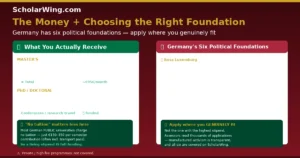
Germany funds six major party-affiliated foundation scholarships. Choose by genuine alignment.
| Foundation | Political Tradition |
|---|---|
| Rosa Luxemburg Stiftung | DIE LINKE — democratic socialism, left |
| Friedrich Ebert Stiftung | SPD, social democracy |
| Heinrich Böll Stiftung | Greens, ecology, democracy |
| Konrad Adenauer Stiftung | CDU, Christian democracy, Centre-right |
| Friedrich Naumann Stiftung | FDP, liberalism |
| Hanns Seidel Stiftung | CSU, Bavarian conservatism |
All six are covered or being covered on ScholarWing. Apply to the one whose values you actually hold not the one with the highest stipend.
Who This Suits
✅ Strong fit if you:
- Have a genuine, documented record of left political or social activism
- Hold German at B2 or above
- Are a woman, first-generation student, from a migrant background, socially disadvantaged, or have a disability
- Work in the humanities, social sciences, law, politics, economics or STEM, where competition is thinner
- Can connect your academic work to your political commitments
❌ Poor fit if you:
- Have strong grades but no activist record
- Do not have B2 German
- Do not genuinely share the foundation’s politics
- Are applying for a medical doctorate
- Need tuition fees covered at a high-fee private programme
Quick Reference
| Element | Detail |
|---|---|
| Foundation | Rosa-Luxemburg-Stiftung (RLS) |
| Founded | 1990 |
| Affiliation | DIE LINKE (The Left Party) |
| Funded by (international) | German Federal Foreign Office |
| Levels | Master’s + Doctoral (undergraduate in some cohorts) |
| Master’s stipend | €850/month + €20 lump sum + up to €86 insurance |
| PhD stipend | €1,350/month + €100/month research allowance |
| Conference / research travel | ⭐ Funding available |
| Tuition fees | ❌ Not reimbursed (most German public unis charge none) |
| German language | ⚠️ B2 minimum |
| Nationality | German and international |
| Institution | State-recognised German university |
| Medicine | ❌ Excluded (doctoral) |
| Engagement | ✅ Mandatory, social and political |
| Priority groups | ⭐ Women • non-academic backgrounds • migrant backgrounds • socially needy • disabled |
| STEM applicants | ⭐ Actively encouraged |
| Duration | 1 year initially, extended to completion within Regelstudienzeit |
| Deadline | 1 October, 23:59, annually |
| Grants begin | Summer semester, 1 April |
| Application | Online portal |
| Official site | rosalux.de/en/foundation/studienwerk |
FAQ
Does this scholarship cover tuition fees?
No. For international students, the RLS scholarship is primarily a living-expenses stipend. It does not reimburse tuition fees charged by universities. Most German public universities charge no tuition anyway.
How much is the monthly stipend?
Master’s: €850 per month plus a €20 lump sum and up to €86 insurance subsidy. PhD: €1,350 per month plus €100 for research costs.
Do I need to speak German?
Yes, proficiency at B2 level.
Is political engagement really required?
Yes, political and social engagement in line with the aims of the Rosa-Luxemburg-Stiftung is a stated requirement alongside academic achievement.
Who gets preference?
Women, students of non-academic and migrant backgrounds, the socially needy, and people with disabilities who demonstrate comparable achievements and commitment.
Are STEM students eligible?
Yes, applications from scientific and technical disciplines are actively encouraged, as are those from graduates of technical colleges.
Is medicine eligible?
No, medical fields are excluded.
When is the deadline?
1 October at 11:59 PM, annually.
How long does funding last?
Initially one year, then extended until completion of your studies, within the standard study duration (Regelstudienzeit).
Free Application Tools
- Motivation Letter: Motivation Letter Generator
- SOP / Study Plan: SOP Generator
- CV: Free CV Builder
- Reference Letter: Reference Letter Generator
- MOI Certificate (if needed): MOI Generator
- Research Proposal (PhD): Research Proposal Generator