
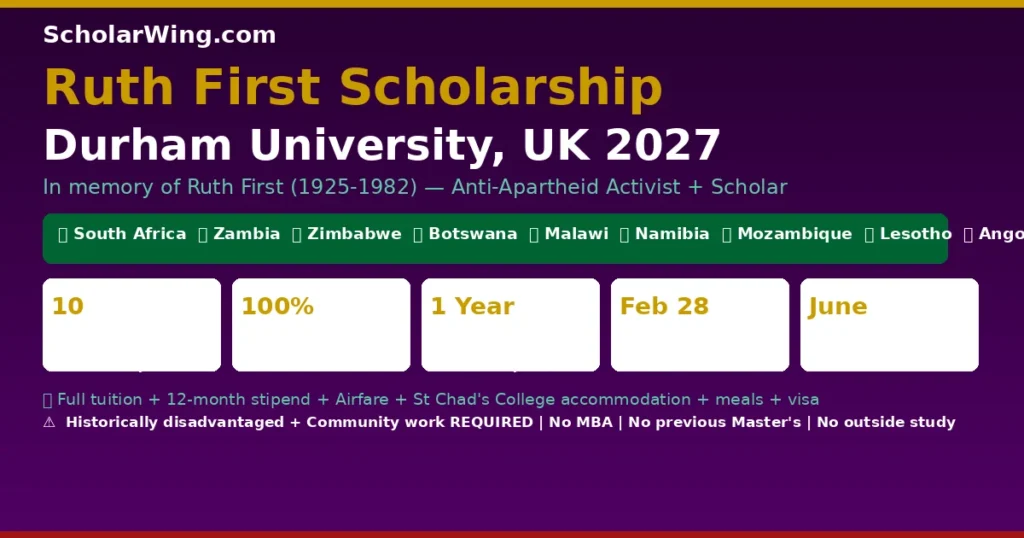
Ruth First Scholarship
The Ruth First Scholarship Has Three Requirements That Most Guides Miss
Every scholarship guide correctly identifies the Ruth First Scholarship at Durham University as a fully funded opportunity for southern African postgraduate students. Three specific eligibility requirements appear in almost no guides:
First: The scholarship is for students from historically disadvantaged backgrounds not simply for any talented southern African student. Financial and social disadvantage is an explicit requirement.
Second: Applicants must not hold a Master’s degree, nor have earlier studies at a university outside Southern Africa. If you have previously studied for any degree outside the region even briefly, you are not eligible.
Third: Applicants must show evidence of active involvement in and commitment to voluntary work for causes such as urban or rural community development, young people, education, health, AIDS awareness, charitable organizations, student welfare, the promotion of equal opportunities, social justice, or the defense of human rights.
Academic excellence alone is not sufficient. The Ruth First Scholarship selects scholars who are already giving back to their communities and who will become leaders that serve southern Africa’s development.
The Ruth First Educational Trust aims to enable southern African students from historically disadvantaged backgrounds to undertake postgraduate study at Durham University. Southern Africa is defined for this purpose as comprising: Angola, Botswana, Lesotho, Malawi, Mozambique, Namibia, Republic of South Africa, Swaziland, Zambia and Zimbabwe.
Who Was Ruth First — The Person Behind the Scholarship
Ruth First (1925-1982) was one of southern Africa’s most significant anti-apartheid activists, journalists, and academics, and one of the most courageous intellectuals of the 20th century.
Born in Johannesburg to Lithuanian Jewish immigrant parents, First became politically active as a young woman, joining the Communist Party of South Africa and becoming deeply embedded in the anti-apartheid struggle. She was a journalist, editor, and campaigner whose work exposed the brutality of apartheid in print at a time when doing so required extraordinary courage.
She was arrested in 1963 under South Africa’s 90-day detention law a law that allowed indefinite detention without trial, and she spent 117 days in solitary confinement in Johannesburg’s Marshall Square prison. Her account of that experience, “117 Days,” remains one of the most powerful testimonies of apartheid-era political imprisonment.
After her release, First went into exile first in London, then in Tanzania, and finally in Mozambique, where she joined the Eduardo Mondlane University in Maputo as a researcher and professor, building one of southern Africa’s most important centers for radical scholarship and social science research.
On August 17, 1982, Ruth First opened a letter in her Maputo office. The letter contained a bomb. She was killed instantly. The bomb had been sent by the apartheid South African security apparatus, the Bureau of State Security (BOSS) in a targeted assassination of one of the regime’s most formidable intellectual opponents.
She was 57 years old.
Ruth First House in Durham bears a mural dedicated to Ruth First, restored by the original artist Lotte Shankland. The scholarship bearing her name at Durham University is a continuation of her conviction that education, justice, and social transformation are inseparable.
Eligible Countries — Southern Africa Only
Southern Africa is defined for the purpose of this scholarship as comprising the following countries:
| Country | ✅ |
|---|---|
| Angola | ✅ |
| Botswana | ✅ |
| Lesotho | ✅ |
| Malawi | ✅ |
| Mozambique | ✅ |
| Namibia | ✅ |
| Republic of South Africa | ✅ |
| Eswatini (formerly Swaziland) | ✅ |
| Zambia | ✅ |
| Zimbabwe | ✅ |
These are the only ten countries eligible. No exceptions.
Full Financial Package — What Durham Covers
The scholarship covers: full payment of tuition fees, stipend for living expenses paid in 12 monthly payments, one return air ticket from the home country to the UK and the cost of return travel between the UK airport and Durham City, fully funded accommodation and meals at St Chad’s College, a settlement allowance, a contribution towards the cost of a UK visa and the UK Health Surcharge, and a contribution towards the cost of sending belongings home before departure.
Complete Coverage:
| Benefit | Detail |
|---|---|
| Tuition fees | 100% — full payment |
| Living stipend | 12 monthly payments |
| Return airfare | Home country → UK + return |
| Airport → Durham transfer | Return travel from UK airport to Durham City |
| Accommodation | Fully funded at St Chad’s College |
| Meals | Fully funded at St Chad’s College |
| Settlement allowance | On arrival in Durham |
| UK visa contribution | Partial contribution |
| IHS (UK Health Surcharge) | Contribution covered |
| Sending belongings home | Contribution on departure |
St Chad’s College:
St Chad’s College is one of Durham University’s historic residential colleges, a collegiate community providing both accommodation and a structured social and academic environment. Being fully housed and fed at St Chad’s College means scholars have an established home base with a college community around them, rather than navigating Durham’s private rental market independently.
What Can You Study — Eligible Programs
The scholarship is open to all taught Master’s degree programs at Durham University, except the MBA.
What Is Eligible:
- Any taught Master’s degree (MA, MSc, MRes — if primarily taught) at Durham
- Full-time mode of study only
- Programs starting in September/October
What Is NOT Eligible:
- MBA — explicitly excluded
- PhD or research degrees
- Part-time programs
- Research-only programs (MPhil by research)
Durham University is one of England’s oldest universities (est. 1832), consistently ranked in the QS top 100-150 globally. Its strong departments include social sciences, humanities, law, environmental sciences, economics, education, and others.
Popular Master’s programs for Ruth First Scholars historically include: Development Economics, International Relations, African Studies, Law, Environmental Sciences, Education, Politics, Social Policy.
Eligibility — All Requirements
1. National of One of 10 Southern African Countries
Must hold citizenship of Angola, Botswana, Lesotho, Malawi, Mozambique, Namibia, South Africa, Eswatini, Zambia, or Zimbabwe.
2. Historically Disadvantaged Background
The scholarship is explicitly for students from disadvantaged backgrounds economic, social, or educational disadvantage under apartheid and its legacy systems. This is not a merit-only scholarship for any talented student from these countries; it specifically targets those for whom financial barriers would otherwise prevent postgraduate education.
3. Honors Degree of Sufficient Standard
Hold a relevant honors degree of sufficient standard to be admitted to their chosen Master’s course. Academic quality matters, you must meet Durham’s standard for admission to your chosen program.
4. NOT Currently Holding a Master’s Degree
Must not hold a Master’s degree. If you already have a postgraduate qualification at Master’s level, you are not eligible.
5. NOT Previously Studied Outside Southern Africa
Must not have earlier studies at a university outside Southern Africa. If you previously completed any university studies in the UK, USA, Europe, or elsewhere outside the 10 eligible countries, you are not eligible.
6. Active Community and Voluntary Work — Essential
Show evidence of active involvement in and commitment to voluntary work for causes such as urban or rural community development, young people, education, health, AIDS awareness, charitable organizations, student welfare, the promotion of equal opportunities, social justice, or the defense of human rights.
This requirement reflects Ruth First’s own life. She did not separate intellectual work from political and community action. The scholarship seeks students who share that commitment, people who are already giving back to their communities and who will lead with social purpose.
Application Process — Two Simultaneous Applications
Submit an academic application to Durham University for one of the eligible programs by 28 February. Submit an online scholarship application form by 28 February.
Step 1: Choose your Durham Master’s program
Research eligible taught Master’s programs at Durham that align with your background and career goals. Remember: There is no programme for MBA applicants.
Step 2: Submit Durham University academic application
Apply for your chosen program through the Durham University Applicant Portal (apply.durham.ac.uk). In the application, provide evidence that you are also applying for the Ruth First Scholarship.
Step 3: Submit Ruth First Scholarship application
Complete the online Ruth First Scholarship application form simultaneously. This is a separate form from the Durham academic application.
Step 4: Both submissions by February 28, 2027
The academic application AND the scholarship form must both be received by February 28, 2027.
Step 5: Await results
The outcome of the applications will be announced by the end of June.
For inquiries: ruthfirsttrust.webspace.durham.ac.uk | Ruth First Educational Trust
What the Ruth First Trust Looks For — Selection Philosophy
The scholarship panel selects based on:
Academic potential: You must be strong enough academically to succeed at Durham. A relevant honors degree at sufficient standard is required but the trust also evaluates your potential for growth and leadership.
Disadvantaged background: Your personal history of overcoming financial, social, or educational barriers. The scholarship specifically seeks students for whom this opportunity would be genuinely transformative.
Community commitment: Not peripheral involvement, but genuine, sustained engagement with causes that matter to your community. Ruth First spent her life in service of justice. The scholarship seeks students who demonstrate a similar orientation.
Leadership capacity: Evidence that you will return to southern Africa and contribute to its development in government, civil society, education, health, or other critical sectors.
Many former Ruth First Scholars now hold important positions in the public and private sectors in southern Africa and have become inspirational role models for young people.
Quick Reference
| Element | Detail |
|---|---|
| Scholarship | Ruth First Scholarship |
| Trust | Ruth First Educational Trust |
| University | Durham University, UK |
| Countries | Angola, Botswana, Lesotho, Malawi, Mozambique, Namibia, South Africa, Eswatini, Zambia, Zimbabwe |
| Level | Taught Master’s only — 1 year full-time |
| NOT for | MBA |
| Coverage | Tuition + 12mo stipend + airfare + St Chad’s accommodation + meals + visa contribution |
| Disadvantaged background | REQUIRED |
| Community work | REQUIRED — must be demonstrated |
| No previous Master’s | Cannot already hold Master’s degree |
| No outside study | Cannot have previously studied outside Southern Africa |
| Annual deadline | February 28 |
| 2027-28 deadline | February 28, 2027 |
| Results | End of June annually |
| Accommodation | St Chad’s College, Durham |
| Named after | Ruth First (1925-1982) — anti-apartheid activist, assassinated by apartheid |
FAQ
Which countries are eligible?
Angola, Botswana, Lesotho, Malawi, Mozambique, Namibia, Republic of South Africa, Swaziland, Zambia and Zimbabwe.
What does the scholarship cover?
Full tuition fees, 12-month living stipend, return airfare, fully funded accommodation and meals at St Chad’s College, settlement allowance, visa contribution, and contribution to sending belongings home.
Can I apply if I already have a Master’s degree?
No, applicants must not hold a Master’s degree.
Can I apply if I studied abroad before?
No, applicants must not have earlier studies at a university outside Southern Africa.
When is the deadline?
February 28 annually, both the Durham academic application and the Ruth First scholarship form.
Is MBA eligible?
No, all taught Master’s programs are eligible except the MBA.