
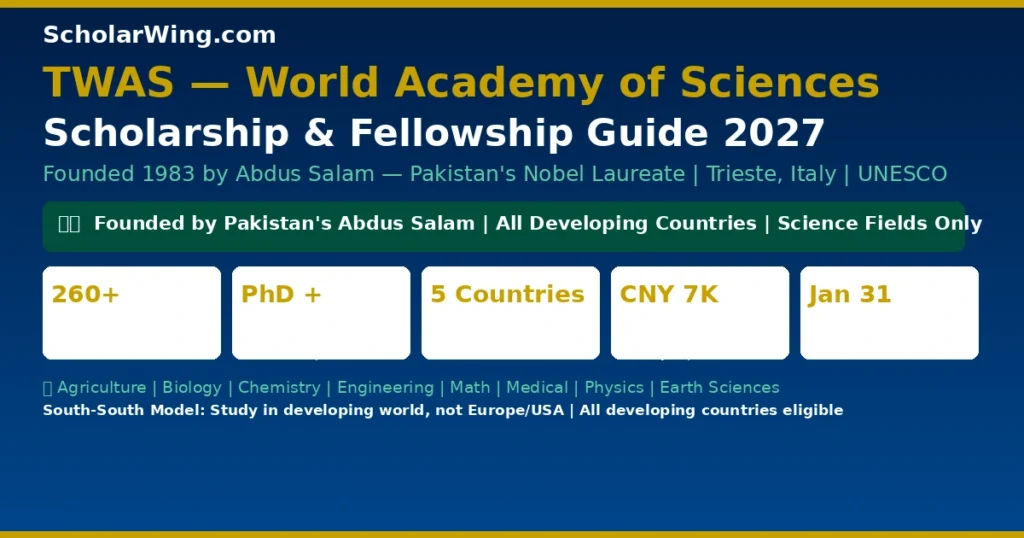
TWAS Is Not One Scholarship — It Is the World’s Largest Science Fellowship Portfolio for Developing Countries
When scholars from developing countries search for TWAS, most expect to find a single scholarship application page. What they find instead is something far more significant: the world’s most comprehensive portfolio of science fellowships, grants, and research programs specifically designed for scientists from developing countries.
The World Academy of Sciences (TWAS):
TWAS — The World Academy of Sciences for the advancement of science in developing countries offers between 100 and 160 PhD fellowships a year at some of the most respected institutions in the developing world. These fellowships are hosted in Brazil, China, India, Pakistan, and South Africa.
Additionally, TWAS runs the largest South-South fellowship program, offering approximately 160 PhD fellowships in collaboration with 8 partners in 6 countries, and approximately 100 postdoctoral fellowships with 9 partners in 5 countries.
This means TWAS offers between 260-360 fellowships per year far more than most individual scholarship programs.
The defining philosophy of TWAS is “South-South cooperation.” Rather than sending developing country scientists to the UK, USA, or Europe, TWAS funds them to study in the more scientifically advanced developing countries, China, India, Brazil, Pakistan, South Africa. The argument is practical: these institutions train scientists in contexts relevant to developing country challenges, in environments more similar to home, often with lower costs and less cultural distance.
TWAS was founded in 1983 by a distinguished group of scientists from the developing world, under the leadership of Abdus Salam, the Pakistani physicist and Nobel laureate. They shared a belief that developing nations, by building strength in science and engineering, could build the knowledge and skill to address such challenges as hunger, disease and poverty.
Who Was Abdus Salam — Pakistan’s Nobel Laureate Founded TWAS
TWAS was founded under the leadership of Abdus Salam, the Pakistani physicist and Nobel laureate.
Muhammad Abdus Salam (1926-1996) was a Pakistani theoretical physicist born in Jhang, Punjab at the time British India, now Pakistan. He is Pakistan’s only Nobel Prize laureate in science, sharing the 1979 Nobel Prize in Physics with Sheldon Glashow and Steven Weinberg for their work on the electroweak theory, one of the fundamental theories of particle physics.
Salam spent most of his career in Italy at the International Centre for Theoretical Physics (ICTP) in Trieste, an institution he founded specifically to support scientists from developing countries. He was a Muslim, a Pakistani, and a member of the Ahmadiyya community. His dedication to science in the developing world was inseparable from his faith that knowledge and scientific capacity were among the greatest tools for human dignity.
TWAS was built at ICTP, in Trieste, the same city and same institution that Salam had dedicated his life to. It remains headquartered there, operating as part of the UNESCO system. Every TWAS fellowship carries the legacy of a Pakistani Nobel laureate who believed that developing world science could be world-class.
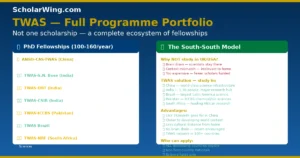
The TWAS Program Portfolio — All Available Opportunities
TWAS is not one program. These are the main fellowship opportunities available:
Program 1: ANSO-CAS-TWAS/UNESCO PhD Scholarship (China) — Most Applied-For
The ANSO-CAS-TWAS/UNESCO PhD Scholarship offers talented students from developing countries a chance to pursue their doctoral degrees in China, sponsored by the Alliance of International Science Organizations (ANSO) in collaboration with the Chinese Academy of Sciences (CAS) and The World Academy of Sciences (TWAS/UNESCO).
| Element | Detail |
|---|---|
| Partner | ANSO + CAS + TWAS + UNESCO |
| Study in | China — USTC or UCAS (University of Chinese Academy of Sciences) |
| Awards/year | Up to 40-50 PhD scholarships |
| Duration | Up to 48 months (4 years) |
| Monthly stipend | CNY 6,000 or CNY 7,000/month (~$825-965) |
| Tuition | Full waiver |
| Health insurance | Covered |
| Travel allowance | One-time return travel (if not already in China) |
| Visa/residence | Support provided |
| Deadline | January 31 annually |
| Application | Through USTC or UCAS — choose ONE only |
⚠️ Critical warning: You are NOT allowed to apply for the ANSO Scholarship in both USTC and UCAS simultaneously, otherwise you will be disqualified from admission.
Eligibility for ANSO-CAS-TWAS:
- National of a developing country (non-Chinese)
- Hold a Master’s degree (MSc)
- Proficient in English or Chinese
- Born after January 1, 1990 (for PhD applicants)
- NOT currently pursuing a PhD in China
- NOT currently residing in China (affects travel allowance eligibility)
- Meet USTC/UCAS international student admission criteria
Program 2: TWAS PhD Fellowships — South-South (General)
TWAS offers between 100 and 160 PhD fellowships a year at some of the most respected institutions in the developing world, hosted in Brazil, China, India, Pakistan, and South Africa.
Beyond the China-specific ANSO-CAS-TWAS program, TWAS runs direct PhD fellowships at partner institutions across five countries:
Partner Institutions (PhD Level):
| Country | Institution | Fields |
|---|---|---|
| China | Chinese Academy of Sciences (CAS) | All TWAS science fields |
| India | S.N. Bose Centre for Basic Sciences, Kolkata | Physical sciences |
| India | CSIR (Council of Scientific & Industrial Research) | Sciences and technology |
| India | DBT (Department of Biotechnology) | Biotechnology and life sciences |
| Brazil | Multiple Brazilian institutions | All TWAS science fields |
| Pakistan | ICCBS, Karachi (for non-Pakistanis) | Chemical and biological sciences |
| South Africa | NRF — National Research Foundation | Sciences |
General eligibility for TWAS PhD Fellowships:
- National of a developing country (not the host country for most programs)
- Bachelor’s or Master’s in relevant science field
- Strong academic record
- Research proposal
- Maximum age varies by partner (typically 35-40)
Program 3: TWAS Postdoctoral Fellowships
TWAS runs approximately 100 postdoctoral fellowships with 9 partners in 5 countries. These are for early-career scientists from developing countries seeking advanced training at top research institutions.
Postdoctoral fellows are researchers who have already completed their PhD and want to conduct advanced research at a partner institution. Duration: typically 3-10 months.
Partner countries: Brazil, China, India, Pakistan, South Africa.
Program 4: TWAS-UNESCO Associateship Scheme
For established researchers (not students) who want to make regular research visits to selected centers of excellence in the South. Allows researchers from developing countries to maintain active research connections with top institutions over several years.
Program 5: TWAS Research Professors in LDCs
A number of TWAS Fellows and TWAS Young Affiliates will be offered appointments as TWAS Research Professors for one year, during which they will visit the host institution in a Least Developed Country for a period of two to four weeks. TWAS provides travel support while living expenses are covered by the host.
For TWAS Fellows themselves not for scholarship applicants.
Program 6: TWAS Awards ($10,000 each)
TWAS offers nine awards of USD 10,000 each to individual scientists from developing countries who have made outstanding contributions to scientific knowledge in nine fields of science. TWAS Award candidates must be scientists who have worked and lived in a developing country for at least ten years prior to their nomination.
Not a scholarship recognition awards for established scientists.
Eligible Fields — All TWAS Science Programs
TWAS fellowship fields include: Agricultural Sciences, Structural Cell and Molecular Biology, Biological Systems and Organisms, Medical and Health Sciences including Neurosciences, Chemical Sciences, Engineering Sciences, Astronomy Space and Earth Sciences, Mathematical Sciences, Physics, Social and Economic Sciences.
| Field Number | Field |
|---|---|
| 01 | Agricultural Sciences |
| 02 | Structural, Cell and Molecular Biology |
| 03 | Biological Systems and Organisms |
| 04 | Medical and Health Sciences incl. Neurosciences |
| 05 | Chemical Sciences |
| 06 | Engineering Sciences |
| 07 | Astronomy, Space and Earth Sciences |
| 08 | Mathematical Sciences |
| 09 | Physics |
| 10 | Social and Economic Sciences (select programs) |
Important: TWAS is a science academy. Humanities, arts, law, and business are generally NOT in TWAS. If your field is one of the above science and technology disciplines, you are eligible.
Eligible Countries — All Developing Countries
TWAS serves the entire developing world any country classified as “developing” in the South is generally eligible. The eligible countries list includes virtually all of Africa, all of South and Southeast Asia, all of Latin America, and all of the Middle East essentially any non-OECD developing nation.
TWAS programs target early-career scientists from developing countries seeking advanced training at top research institutions.
Confirmed eligible include: Pakistan ✅, Bangladesh ✅, India (for non-India programs) ✅, Afghanistan ✅, Nigeria ✅, Kenya ✅, Ghana ✅, Ethiopia ✅, Tanzania ✅, Uganda ✅, Egypt ✅, Morocco ✅, Algeria ✅, Syria ✅, Indonesia ✅, Vietnam ✅, Philippines ✅, Brazil (for non-Brazil programs) ✅, Colombia ✅, Peru ✅ and many more.
Not eligible: China (for China-based programs as host country). Host countries are generally not eligible for the programs they host.
The ANSO-CAS-TWAS Application — Step by Step
This is the most accessible and most applied-for TWAS program.
Step 1: Choose USTC or UCAS — not both: You are NOT allowed to apply for the ANSO Scholarship in both USTC and UCAS simultaneously. Research which institution’s research groups better match your proposed PhD topic. USTC (University of Science and Technology of China) and UCAS (University of Chinese Academy of Sciences) are both world-class institutions.
2: Contact potential PhD supervisor: Before applying, email professors at your chosen institution whose research aligns with your interests. Informal acceptance from a supervisor significantly strengthens your application. Include your CV, research proposal outline, and academic background.
Step 3: Prepare research proposal: A detailed research proposal is required explaining what you plan to study, why this institution, and how your research connects to developing country challenges.
4: Gather documents:
- Master’s degree certificate and transcripts
- Bachelor’s degree certificate and transcripts
- Passport (valid, non-Chinese)
- Research proposal
- CV
- Two recommendation letters (academic)
- English proficiency proof (IELTS/TOEFL or equivalent)
- Supervisor recommendation/agreement (if obtained)
Step 5: Submit by January 31: Apply through the official ANSO/TWAS portal. The next cycle opens approximately October-November and closes January 31.
Step 6: Qualification test: After admission, CNY 6,000/month if you pass the university’s qualification test; CNY 7,000/month if you achieve higher results. This affects your stipend amount.
The South-South Philosophy — Why It Matters
Most scholarship guides present TWAS as simply “another scholarship for developing country students.” This misses the point.
TWAS was founded on a specific argument: the development of science in developing countries cannot be achieved by sending all talented scientists to the UK, USA, or Europe. Several problems arise from that model:
Brain drain: Scientists who train in wealthy countries often stay there, providing a net transfer of human capital FROM developing to developed nations.
Context mismatch: Scientists trained in European lab environments may not have the knowledge, tools, or networks to address developing country challenges when they return.
Cost: Studying in the UK or USA is vastly more expensive than studying in China, India, or Brazil reducing the total number of developing country scientists who can be supported per dollar invested.
TWAS’s solution: train developing country scientists at world-class institutions IN the developing world. China’s science infrastructure, India’s research capacity, and Brazil’s academic system are all genuinely world-class in multiple fields and training in these environments keeps scientists closer to developing country contexts.
The CNY 7,000/month stipend (~$965) goes much further in China than the equivalent amount would go in London or New York. A student can live comfortably, focus on research, and return home with a world-class PhD debt-free.
Practical Tips for TWAS Applicants
1. Start with the ANSO-CAS-TWAS program The China program is the most accessible entry point. It has the clearest eligibility criteria, the most consistent annual timeline, and the most detailed application guidance.
2. Contact a potential supervisor before applying Unlike many scholarships where you apply and are then matched, TWAS PhD programs benefit enormously from pre-arranged supervisor support. Email Chinese Academy of Sciences professors whose work matches yours. An email response expressing interest is a significant advantage.
3. Your research proposal must connect to development TWAS’s mission is development in the Global South. Your research proposal should articulate, specifically how your proposed PhD research connects to challenges in your home country or developing world generally.
4. Apply to relevant India programs simultaneously TWAS-CSIR, TWAS-DBT, and TWAS-S.N. Bose are separate programs with separate applications. If you are eligible and interested in studying in India, apply simultaneously with the China program.
5. For Pakistan applicants TWAS-ICCBS is hosted at the International Centre for Chemical and Biological Sciences in Karachi but it is for applicants from OTHER developing countries, not Pakistan. Pakistani students should apply for the China, India, Brazil, or South Africa programs.
6. English OR Chinese is accepted For the China program, you can conduct your PhD in English at most CAS institutions. Chinese language is not mandatory, though basic Chinese proficiency improves daily life significantly.
Quick Reference — TWAS Programs Overview
| Program | Partner | Location | Level | Awards/year | Stipend | Deadline |
|---|---|---|---|---|---|---|
| ANSO-CAS-TWAS | ANSO+CAS+UNESCO | China | PhD (4yr) | 40-50 | CNY 6-7K/mo | Jan 31 |
| TWAS PhD (general) | Various | Brazil/China/India/Pakistan/SA | PhD | 100-160 total | Varies | Varies |
| TWAS Postdoc | Various | 5 countries | Postdoc | ~100 | Varies | Varies |
| TWAS-S.N. Bose | India | Kolkata | PhD | Limited | Varies | Varies |
| TWAS-DBT | India | India | PG/PhD | Limited | Varies | Varies |
| TWAS-CSIR | India | India | PG/PhD | Limited | Varies | Varies |
| TWAS-ICCBS | Pakistan | Karachi | PG | Limited | Varies | Varies |
| TWAS Associateship | UNESCO | Centers in South | Research visits | Limited | Travel | Varies |
FAQ
What does TWAS stand for?
The World Academy of Sciences for the Advancement of Science in Developing Countries.
How many fellowships does TWAS offer?
Approximately 160 PhD fellowships with 8 partners in 6 countries, and approximately 100 postdoctoral fellowships with 9 partners in 5 countries, 260+ total annually.
What is the ANSO-CAS-TWAS stipend?
Monthly stipend of CNY 6,000 or CNY 7,000 depending on qualification test results, for up to 48 months.
Which fields are in TWAS?
Agricultural Sciences, Biology, Chemistry, Earth Sciences, Engineering, ICT, Mathematics, Medical Sciences including Neurosciences, Physics, Social and Economic Sciences.
What is the ANSO-CAS-TWAS deadline?
The annual application deadline is January 31.