
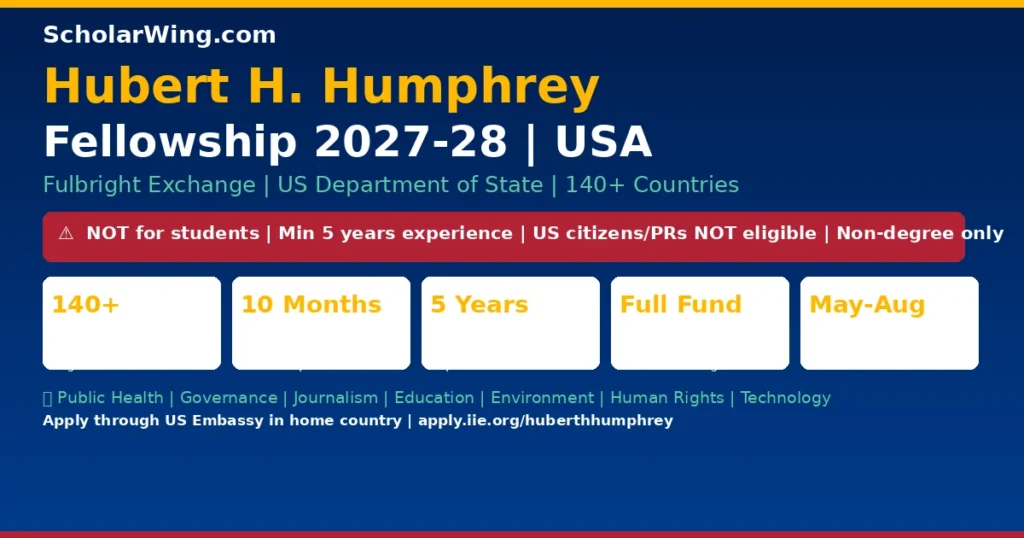
The Hubert Humphrey Fellowship Is a Fulbright Program — And That Changes Everything
When professionals from 140+ countries search for ways to spend a transformative year in the United States developing their leadership, building networks, and deepening expertise in their field, the Hubert H. Humphrey Fellowship is the most prestigious pathway available to mid-career professionals who are not pursuing an academic degree.
The Humphrey Fellowship Program, a Fulbright Exchange, builds connections between U.S. and international professionals to advance solutions to the most pressing global challenges, from developing technology policy, to protecting human rights, and strengthening global health security.
The Fulbright association is not decorative. The Humphrey Fellowship sits under the same US State Department umbrella as the Fulbright Foreign Student Program, one of the world’s most recognized academic exchange brands. Humphrey Fellows carry Fulbright designation, access Fulbright’s US network, and are selected through the same rigorous US Embassy and IIE (Institute of International Education) process.
But before anything else, one critical fact:
The Humphrey Fellowship is not a degree program. Fellows participate in academic study, professional collaboration, leadership training, and networking, but they do not receive a formal academic degree. The program is intended for experienced mid-career professionals recent graduates are not eligible. Applicants must have at least five years of full-time professional experience.
If you are a student or recent graduate, this fellowship is not available to you yet. It is designed for working professionals with a track record five years minimum who want to accelerate their leadership and expand their international network through a fully funded year in the United States.
The Humphrey Fellowship Program was founded in 1978 to honor the late Senator and Vice President Hubert H. Humphrey. President Jimmy Carter announced the establishment of the program to create opportunities embodying American values: democracy, public service, and a desire to assist the world’s developing nations.
Who Was Hubert Humphrey — The Person Behind the Fellowship
Hubert Horatio Humphrey (1911-1978) was one of America’s most consequential 20th-century political figures. He served as Mayor of Minneapolis, US Senator from Minnesota for 24 years, 38th Vice President of the United States (1965-1969 under President Lyndon Johnson), and was the 1968 Democratic presidential nominee.
Humphrey was known as “The Happy Warrior” a lifelong champion of civil rights (his 1948 speech at the Democratic National Convention on civil rights was a defining moment in American political history), healthcare access, international development, and public service. He co-authored the Peace Corps Act and authored legislation that became the foundation of Medicare.
The fellowship named after him specifically reflects his values: it targets professionals in public service, governance, health, education, and development, the fields Humphrey devoted his political career to advancing. A Humphrey Fellowship is not just a program, it is an honor bearing the name of a man who spent his life trying to reduce inequality and strengthen democratic institutions.
What the Fellowship Is — 10 Months in the USA
The Hubert H. Humphrey Fellowship Program brings accomplished mid-career professionals with demonstrated leadership potential to the United States for an academic year of non-degree graduate-level study, leadership development, and substantive professional collaboration with U.S. counterparts. By providing future leaders and policy makers with experience in U.S. society, culture, and professional fields, the program provides a basis for lasting, productive ties between Americans and their professional counterparts overseas.
The Fellowship Structure (10 months):
1. Graduate-Level Academic Study Fellows are placed at US universities in programs relevant to their field. This is graduate-level coursework challenging, rigorous, and academically substantive but without the pressure of grades and degree completion. Fellows attend classes, engage with faculty, and participate in seminars.
2. Professional Development Site visits to relevant US organizations, agencies, companies, and institutions. A journalist fellow might visit major news organizations. A public health fellow might visit the CDC or major health institutions. An agricultural development fellow might visit USDA and agricultural research centers.
3. Leadership Training Structured leadership development programming workshops, seminars, mentoring specifically designed to build the management and policy leadership capacities that fellows will apply when they return home.
4. Professional Collaboration with US Counterparts A distinctive feature of Humphrey: fellows work alongside US professionals in their field not just study about them. This peer exchange is where lasting professional relationships are built.
5. Cultural Exchange Integration into American professional and social life, understanding how US institutions function, how US professionals approach problems, and how American society works from the inside.
Eligible Fields — Where Humphrey Fellows Come From
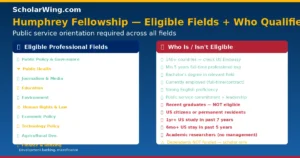
Participants spend approximately ten months at U.S. host universities, gaining knowledge, practical experience, and professional connections in fields such as public policy, public health, education, environmental management, human rights, journalism, and economic development.
Confirmed Eligible Fields:
| Field | Sub-areas |
|---|---|
| Public Policy & Governance | Democracy, rule of law, public administration, decentralization |
| Public Health | Global health security, epidemiology, health systems, HIV/AIDS policy |
| Journalism & Communications | Investigative journalism, digital media, public relations, strategic communications |
| Education | Educational administration, curriculum development, higher education leadership |
| Environmental Management | Natural resources, climate policy, conservation, environmental governance |
| Human Rights & Law | International law, rule of law, judicial reform, human rights advocacy |
| Economic Policy | Development finance, trade policy, economic reform |
| Technology Policy | Digital governance, telecommunications, technology regulation |
| Finance & Banking | Development banking, microfinance, financial regulation |
| Agricultural Development | Food security, rural development, agricultural policy |
| Substance Abuse | Drug policy, treatment, prevention, rehabilitation |
| Trafficking in Persons | Anti-trafficking policy, survivor support, law enforcement |
The common thread across all eligible fields: public service orientation. Humphrey is for professionals working to improve systems, institutions, and communities not for commercial sector career advancement.
Full Financial Package:
The fellowship covers tuition, university fees, monthly allowance, health coverage, books, international airfare, and eligible professional development activities.
Coverage Breakdown:
| Benefit | Detail |
|---|---|
| Full tuition | All university and academic fees at host institution |
| Monthly allowance | Living stipend covering accommodation and daily expenses |
| Health insurance | Medical coverage throughout the 10-month fellowship |
| Books and materials | All required academic and professional reading materials |
| International airfare | Round-trip flights from home country to USA and return |
| Professional development | Site visits, conferences, professional activities |
What Is NOT Covered:
The programme does not provide financial support for accompanying dependents.
The monthly allowance supports the fellow not a spouse, children, or family. If you plan to bring family to the USA, you bear those costs independently. This is a significant practical consideration given US living costs.
Eligibility — Full Requirements
1. Citizenship in an Eligible Country: The Hubert H. Humphrey Fellowship is open to applicants from over 140 eligible countries across Africa, Asia, Australia and Oceania, Europe, Latin America and the Caribbean, and the Middle East and North Africa.
2. Minimum 5 Years Professional Experience: Applicants must have at least five years of full-time professional experience. This is the primary filter, the Humphrey Fellowship is not for recent graduates. Your five years must be in or clearly connected to one of the eligible fields.
3. Bachelor’s-Equivalent Degree: A qualifying university degree (pre-Bologna 4-year undergraduate degree) or a Bologna Master level degree (5-year degree).
4. Currently Employed: Employment in an eligible country full-time or contract-based. You must be an active working professional, not between jobs.
5. Strong English Proficiency: Applicants must demonstrate strong English language proficiency. Proof of English proficiency (IELTS, TOEFL, or equivalent) required.
6. Leadership Potential and Public Service Commitment: Competitive applicants are mid-career professionals with leadership experience, a commitment to public service, and strong potential for professional advancement.
Who Is NOT Eligible — Critical Disqualifiers
The following are not eligible: Academic researchers or university teachers without management responsibilities (except in eligible teaching fields). Individuals who studied in the U.S. for one academic year or longer within the seven years prior to August 2026. Individuals with more than six months of U.S. experience within the five years prior to August 2026. Dual U.S. citizens or permanent residents.
Breaking these down:
Academic researchers without management: Pure researchers and university teachers are not the target. University administrators, deans, department heads with management responsibilities may qualify. A lab researcher without administrative duties does not.
Recent US study experience: If you spent a year or more studying in the USA within the past 7 years, you are not eligible. The program is for professionals who have NOT had extensive US experience, it is an introduction to US professional culture, not a supplement to existing US experience.
Recent US presence: If you have lived or worked in the USA for more than 6 months in the past 5 years, you are not eligible.
US citizens and permanent residents: The program is for international professionals, American citizens and green card holders cannot apply regardless of their country of residence.
Application Process — Through US Embassy Only
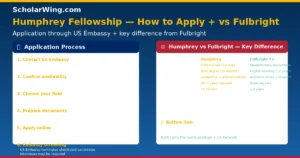
Applicants should contact the U.S. Embassy or Fulbright Commission in their country for detailed application instructions and deadlines.
The online application is available at: apply.iie.org/huberthhumphrey
Step-by-Step:
Step 1: Contact US Embassy or Fulbright Commission Every country has a US Embassy and most have a Fulbright Commission or Fulbright contact. This is your entry point. Contact them to confirm:
- Whether Humphrey is available in your country for the current cycle
- Your country’s specific application deadline
- Any country-specific requirements beyond the standard ones
Step 2: Confirm your field The Humphrey Fellowship matches you to a US host university based on your professional field. Before applying, identify which eligible field your work falls under and articulate how the fellowship will advance your specific professional goals.
Step 3: Prepare application materials
Standard requirements include:
- Curriculum Vitae (CV), detailed professional and academic history
- Personal statement, your leadership journey, professional goals, and what you will contribute upon return
- Study/affiliation objectives, what you want to study and with which US institution or professor
- Three recommendation letters, from supervisors and/or professional peers
- English proficiency test scores (TOEFL/IELTS or equivalent)
- Academic transcripts
Step 4: Submit by your country’s deadline
Deadlines are country-specific. Confirmed deadlines for 2027-28 cycle:
- Croatia: July 31, 2026
- Madagascar/Comoros: Varies
- Ethiopia: July 31 (for 2026-27 cycle)
- General range: May-August 2026
Check with your US Embassy for your country’s exact date.
Step 5: Embassy screening and interview Shortlisted candidates may be invited for interviews. The US Embassy or Fulbright Commission conducts initial screening. Strong candidates are nominated to IIE for US-based review.
Step 6: IIE and US panel review Candidates are screened and nominated by the U.S. Embassy, reviewed by U.S. selection panels, and approved through the official U.S. government fellowship process.
What the Selection Committee Looks For
Competitive applicants are mid-career professionals with leadership experience, a commitment to public service, and strong potential for professional advancement. Candidates should clearly explain how the program will benefit their professional development, institution, and community.
The strongest Humphrey applications demonstrate:
Specific Professional Impact: Not “I work in public health” but “I manage a district health system serving 340,000 people and have introduced data-driven disease surveillance that reduced response time to outbreaks by 40%.” The program selects professionals who have already demonstrated impact, not those who hope to demonstrate it someday.
Clear US Affiliation Goals: Which US university, which department, which professor, which US institution (hospital, agency, NGO, media organization) do you want to affiliate with? Vague applications fail. Specific, researched US affiliation plans succeed.
Return Commitment: Participants are expected to apply their learning to advance development in their home countries. The fellowship is explicitly designed to send professionals back to their home countries to apply what they learn. Your post-fellowship plan, specific, credible, institution-based is central to selection.
Leadership Evidence: Have you led people, managed institutions, influenced policy? The Humphrey selects people who are already leading not people who aspire to lead.
Humphrey vs Fulbright — What Is the Difference?
Both are US State Department programs administered by IIE. The distinction matters:
| Feature | Humphrey Fellowship | Fulbright Foreign Student |
|---|---|---|
| For | Mid-career professionals | Students/early-career researchers |
| Degree | NON-degree (10 months) | Degree-seeking (Master’s/PhD/Research) |
| Experience required | Minimum 5 years | None (students) |
| Duration | 10 months | 1-2 years |
| Focus | Leadership + professional development | Academic study + research |
| Application | Through US Embassy | Through US Embassy/Fulbright Commission |
Both carry the Fulbright name and prestige. They serve different career stages. The Humphrey is for established professionals. The Fulbright Foreign Student is for students and early-career academics.
Country-Specific Notes
🇵🇰 Pakistan
Pakistan has an active Fulbright Commission, the United States Educational Foundation in Pakistan (USEFP) which administers both Fulbright and Humphrey programs. Contact USEFP Islamabad for current Humphrey deadlines and requirements.
🇧🇩 Bangladesh
Bangladesh has an active US Embassy Dhaka Fulbright program. Public health, governance, environmental management, and education professionals from Bangladesh have historically been strong Humphrey applicants given Bangladesh’s development context.
🇳🇬 Nigeria
Nigeria has active US Embassy Lagos and Abuja Fulbright contacts. Nigeria’s professionals in journalism, public health, economic policy, and governance have been well-represented in Humphrey cohorts.
🇰🇪 Kenya
Kenya has one of Africa’s strongest Fulbright networks. US Embassy Nairobi administers Humphrey for Kenya.
🌍 Africa (broadly)
The fellowship is open to applicants across Africa, contact the US Embassy in your country for country-specific availability and deadlines.
Quick Reference
| Element | Detail |
|---|---|
| Full name | Hubert H. Humphrey Fellowship Program |
| Part of | Fulbright Exchange (US Department of State) |
| Founded | 1978 |
| Administered by | IIE (Institute of International Education) |
| Duration | 10 months — non-degree |
| Countries eligible | 140+ |
| Experience required | Minimum 5 years full-time professional |
| Coverage | Tuition + monthly allowance + health + airfare + books |
| Dependents | NOT covered |
| Apply through | US Embassy / Fulbright Commission in home country |
| Online application | apply.iie.org/huberthhumphrey |
| Deadlines | Country-specific — May-August 2026 |
| US citizens/PRs | NOT eligible |
| Recent US study | 1yr+ in past 7 years = NOT eligible |
| Recent US stay | 6mo+ in past 5 years = NOT eligible |
FAQ
What does the Humphrey Fellowship cover?
The fellowship covers tuition, university fees, monthly allowance, health coverage, books, international airfare, and eligible professional development activities.
Is the fellowship a degree program?
No, the programme does not result in a formal academic degree. Fellows participate in academic study, professional collaboration, leadership training, and networking.
How many years of experience are required?
At least five years of full-time professional experience.
Who is NOT eligible?
Academic researchers or university teachers without management responsibilities; individuals who studied in the U.S. for one academic year or longer within the past seven years; those with more than six months of U.S. experience within the past five years; dual U.S. citizens or permanent residents.
How do I apply?
Contact the U.S. Embassy or Fulbright Commission in your country for detailed application instructions and deadlines. Apply online at apply.iie.org/huberthhumphrey.
Are dependents funded?
No, the programme does not provide financial support for accompanying dependents.
What is the fellowship deadline?
Deadlines are country-specific, typically May-August 2026 for the 2027-28 cycle. Check with your US Embassy.
Free Application Tools
- Motivation Letter: Motivation Letter Generator
- SOP / Study Plan: SOP Generator
- CV: Free CV Builder
- Reference Letter: Reference Letter Generator
- MOI Certificate (if needed): MOI Generator
- Research Proposal (PhD): Research Proposal Generator