
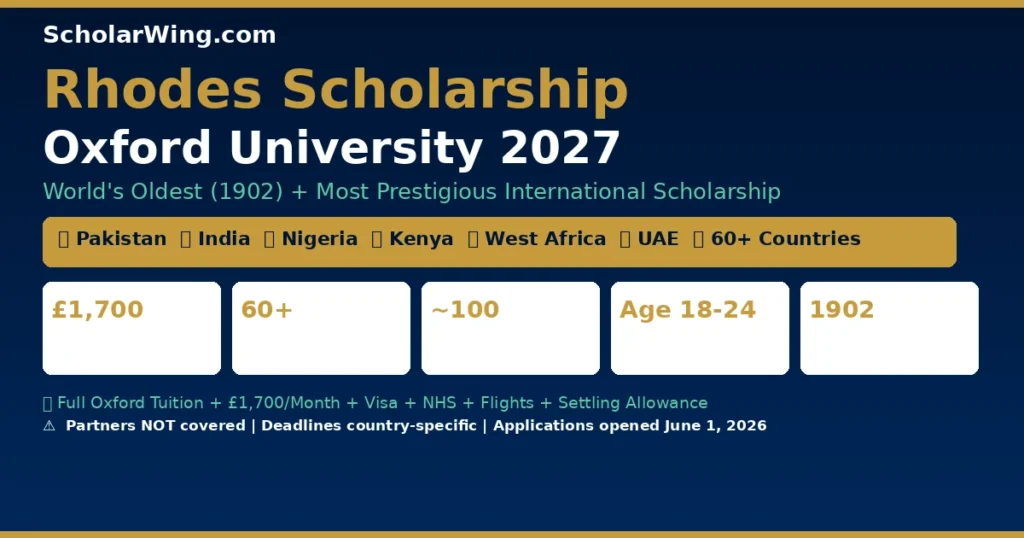
The World’s Oldest and Most Prestigious Scholarship Asks Four Questions About You — Not One
Most scholarship guides open with the amount. For the Rhodes Scholarship, the amount matters £20,400 per year (£1,700 per month), full tuition and college fees, visa costs, International Health Surcharge, and two economy class return flights, but the amount is almost beside the point. The Rhodes Scholarship is not primarily a financial award. It is a character and leadership selection.
The Rhodes Scholarship is the oldest and most celebrated international scholarship programme in the world. Founded in 1902, it funds full-time postgraduate study at the University of Oxford, fully covered, with no tuition costs, a monthly stipend, flights, visa fees, and health insurance all included. Approximately 100 scholars are selected each year globally from over 64 countries. These are not just academically outstanding students — they are people who have demonstrated leadership, commitment to service, and the potential to make a genuine difference in the world.
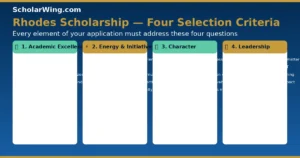
The selection process evaluates four criteria. Every element of your application, the personal statement, the endorsement letters, and the interview, addresses some version of these four questions:
- How excellent is your academic and scholarly record?
- How much energy do you bring to using your talents fully?
- What is the quality of your character, truth, courage, kindness, unselfishness, fellowship?
- What is your capacity for moral leadership, do people follow you?
A student with a 4.0 GPA who has never contributed to anything beyond their grades will not win the Rhodes. A student with a 3.8 GPA who has led genuine community transformation, demonstrated intellectual curiosity beyond their coursework, and shown moral courage in difficult situations will compete.
Applications for the Rhodes Scholarship 2027 are now open, meaning applications submitted now are for entry to Oxford in October 2027.
Deadlines are country-specific. Most fall between July and October 2026. Do not miss yours.
What Is the Rhodes Scholarship — The Full Picture
| Detail | Information |
|---|---|
| Founded | 1902 — world’s oldest international scholarship |
| Named after | Cecil Rhodes (1853-1902) — British colonial magnate |
| Study at | University of Oxford, United Kingdom |
| Level | Master’s, MPhil, DPhil (PhD) — most full-time postgraduate courses |
| Duration | 2 years (basic tenure), renewable on satisfactory academic performance |
| Scholarships/year | ~100-102 globally |
| Stipend | £20,400/year (£1,700/month) |
| Countries | 60+ via constituency system + Global Rhodes for uncovered countries |
| Application | Through your country’s constituency portal |
| 2027 deadline | Country-specific — most July-October 2026 |
| Official site | rhodeshouse.ox.ac.uk |
Full Financial Package — What the Rhodes Covers
The Rhodes Scholarship covers all Oxford tuition and college fees, a living stipend of £20,400 per annum, a settling-in allowance, full health insurance, visa costs, and two economy-class return flights.
Detailed Breakdown:
| Benefit | Detail |
|---|---|
| Full Oxford tuition | All university and college fees — 100% |
| Monthly stipend | £1,700/month (£20,400/year) — for living expenses including accommodation |
| Settling-in allowance | £225 on arrival |
| Student visa fees | Covered by Rhodes Trust |
| International Health Surcharge (IHS) | Covered — gives access to UK National Health Service (NHS) |
| Two economy flights | To Oxford at start + return at end of studies |
| Oxford application fee | Covered by Rhodes Trust AFTER selection |
What Is NOT Covered:
Important note: The stipend is not sufficient to cover partners or dependents.
The Rhodes Scholarship funds the scholar — not a family. If you plan to bring a spouse or children to Oxford, the scholarship does not provide for them. Oxford’s cost of living is significant, £1,700/month is adequate for a single scholar living carefully, but it is not a family income.
Additionally, the following are NOT funded:
- Part-time courses
- PGCert and PGDip programs
- Graduate-entry medicine
- DClinPsych (Clinical Psychology doctorate)
The Four Selection Criteria — What Rhodes Actually Looks For
These criteria were established by Cecil Rhodes in his 1902 will and remain the foundation of selection 120+ years later:
Criterion 1: Literary and Scholastic Attainments
Academic excellence not just grades, but intellectual depth, curiosity, and demonstrated scholarly achievement. First-class undergraduate performance is the baseline. Outstanding, typically first-class undergraduate degree or equivalent GPA of 3.7+ in the US/Canada system.
But “scholastic attainments” extends beyond GPA. Published research, academic prizes, faculty recognition, performance in demanding courses, and intellectual engagement beyond curriculum all count. A student who has pushed the boundaries of their field, not just performed well within them is what Rhodes selects.
Criterion 2: Energy to Use One’s Talents to the Full
This criterion catches applicants who stop at academic excellence. Rhodes is not looking for high-performing students who then go home. The question is: what have you done with your abilities beyond the classroom? Sports at a high level, music, art, entrepreneurship, research, community engagement, all count, provided they reflect genuine exertion of talent rather than casual participation.
Criterion 3: Truth, Courage, Devotion to Duty, Sympathy, Kindness, Unselfishness, Fellowship
This is the character criterion — the most personal and the hardest to fake. Your endorsement letters will speak most directly to this. The question is: are you the kind of person others trust? Have you shown moral courage — spoken truth when it was uncomfortable, stood for something when it was costly? Have you been genuinely kind, not performatively kind?
Criterion 4: Moral Force of Character and Instincts to Lead
Leadership at Rhodes is not hierarchical position-holding. It is the ability to move people toward goals that matter. Have you organized something? Built something? Influenced a community? Changed something that needed changing? The instinct to lead means you identify what is wrong and you act, you do not wait for someone else to act first.
Eligible Countries — The Constituency System
Approximately 100 scholars are selected each year globally from over 64 countries.
The Rhodes operates through a constituency system, each country or regional grouping has its own selection committee, its own application portal, its own deadline, and its own number of allocated scholarships.
Individual Country Constituencies:
| Country | Annual Scholarships |
|---|---|
| USA | 32 (across 16 districts) |
| Australia | 9 |
| Canada | 11 |
| South Africa | 11 |
| India | 6 |
| Pakistan | Constituency active ✅ |
| Kenya | Constituency active ✅ |
| China | Constituency active ✅ |
| Germany | 2 |
| New Zealand | Constituency active ✅ |
| Malaysia | Constituency active ✅ |
| Singapore | Constituency active ✅ |
| Saudi Arabia | Constituency active ✅ |
| UAE | Constituency active ✅ |
| Israel | Constituency active ✅ |
| Hong Kong SAR | Constituency active ✅ |
| Jamaica | Constituency active ✅ |
| Zambia | Constituency active ✅ |
| Zimbabwe | Constituency active ✅ |
Regional Constituencies:
West Africa (covers 20 countries): Benin, Burkina Faso, Cape Verde, Gambia, Ghana, Guinea, Guinea-Bissau, Ivory Coast, Liberia, Mali, Mauritania, Niger, Nigeria, Saint Helena, Senegal, Sierra Leone, São Tomé and Príncipe, and Togo.
East Africa (covers 5 countries): Uganda, Tanzania, Rwanda, South Sudan, and Burundi.
Southern Africa (covers 6 countries): South Africa, Botswana, Lesotho, Malawi, Namibia, and eSwatini.
Commonwealth Caribbean (covers 15+ territories): Anguilla, Antigua, the Bahamas, Barbados, Belize, the British Virgin Islands, the Cayman Islands, Dominica, Grenada, Guyana, Montserrat, St Lucia, St. Kitts and Nevis, St. Vincent, Trinidad and Tobago, and the Turks and Caicos Islands.
Syria, Jordan, Lebanon, Palestine — constituency active ✅
Global Rhodes Scholarship:
Two additional scholarships are awarded annually to candidates from any country not already served by an existing constituency. This is the entry point for students from nations including most of Latin America, Central Asia, much of Africa beyond the named countries, and other regions.
If your country is not listed in any constituency above, you may still apply through the Global Rhodes. Two places are available annually. Competition is intense but the pathway exists.
Eligibility — Core Requirements
While each country has slightly different rules, the core eligibility criteria are consistent across all Rhodes constituencies.
1. Citizenship in an Eligible Constituency You must be a citizen of one of the countries or regions above. Dual citizens should check the Rhodes Trust website for which constituency applies.
2. Age Requirement Age: Generally between 18 and 24 years old on October 1, 2026. Extended to 27 for students in medicine, dentistry, pharmacy, law, or engineering who needed extra time to complete professional training.
Both conditions must be met relative to your constituency’s rules. Check your specific country’s age requirements on rhodeshouse.ox.ac.uk — some constituencies set slightly different ranges (18-28 in some cases).
3. Outstanding Academic Record A first-class undergraduate degree or equivalent. No minimum GPA is globally published, each constituency sets its own threshold. In practice, successful applicants have demonstrated clearly distinguished academic performance.
4. Accepted to or Completing an Oxford-Eligible Postgraduate Course Rhodes Scholars can apply to study most full-time postgraduate courses offered by Oxford, across almost any field. There is no subject restriction.
Note: You apply for the Rhodes Scholarship first. Oxford University application comes AFTER being selected, December 2026 – March 2027: University of Oxford application (for selected scholars only).
Application Process — Step by Step
Step 1: Confirm your constituency Visit rhodeshouse.ox.ac.uk → find your country’s constituency page → confirm you are eligible.
Step 2: Check your exact deadline There’s no single global deadline, each constituency sets its own date. Applications opened June 1, 2026. Most deadlines fall July-October 2026. Missing your constituency deadline means waiting a full year.
Step 3: Prepare your endorsement letters Most country constituencies require 4-8 references. These are called endorsement letters and are more personal than standard academic references. They should address the four criteria specifically. Give endorsers at least 6 weeks and provide them with your personal statement, CV, and the four criteria to address.
This is where Rhodes differs from most scholarships. 4-8 endorsers is a high bar. Choose people who know you well across different dimensions, academic, professional, community, leadership. Brief them thoroughly on the four criteria.
Step 4: Write the personal statement The personal statement must address the four criteria with specific examples. Generic statements about wanting to contribute to the world will not succeed. Specific, honest, evidence-backed engagement with each criterion is required.
Step 5: Submit through constituency portal Apply through your country’s specific application system, not a single global portal. Each constituency manages its own process.
Step 6: Shortlisting and interview Shortlisted candidates are invited for interview, typically a panel interview with multiple selectors probing all four criteria.
Step 7 (for selected scholars only): Oxford University application December 2026 – March 2027: University of Oxford application (for selected scholars only). October 2027: Scholars begin their studies at Oxford.
Documents Required (Typical — Varies by Constituency)
| Document | Detail |
|---|---|
| ✅ Personal statement | Addressing all four criteria with specific examples |
| ✅ Academic transcripts | All degrees — official |
| ✅ Degree certificate | Undergraduate (or enrollment proof if completing) |
| ✅ CV | Full academic and extracurricular record |
| ✅ Passport | Valid, from eligible constituency country |
| ✅ 4-8 endorsement letters | Submitted by endorsers — cover all four criteria |
| ✅ Proposed course of study | Which Oxford program and why Oxford specifically |
Country-Specific Notes
🇵🇰 Pakistan
For students from Pakistan and India: Both constituencies are highly competitive with outstanding academic pools. Leadership activities and clear post-Oxford plans matter enormously. Do not apply without a specific Oxford course in mind and a specific reason why that course.
Pakistan has an active Rhodes constituency. The competition pool is strong, Pakistani applicants must demonstrate leadership and community impact that genuinely distinguishes them, not just academic excellence.
🇮🇳 India
India has 6 allocated scholarships annually, one of the larger constituencies. Same guidance as Pakistan: academic excellence alone is insufficient. The endorsement letters and interview are where Indian applicants most often succeed or fail.
🇳🇬 Nigeria / West Africa
For students from Nigeria and West Africa: The West Africa constituency covers more than 15 countries, meaning competition is regional. Candidates who demonstrate pan-African impact or ambitions tend to be stronger in interview.
The West Africa constituency is regional — Nigeria competes alongside Ghana, Senegal, Côte d’Ivoire, and 15+ other countries. Pan-African ambition and demonstrated cross-country impact strengthens West African applications.
🇿🇦 Southern Africa
For students from South Africa and Southern Africa: The Southern Africa constituency has deep roots and a large alumni base. Connecting with Rhodes South Africa alumni before your interview is genuinely useful.
South Africa has 11 allocated scholarships, the largest single-country allocation outside the USA and Canada.
Cecil Rhodes — Who He Was and Why the Naming Is Controversial
Cecil Rhodes (1853-1902) was a British businessman and colonial politician who accumulated extraordinary wealth through De Beers diamonds, became Prime Minister of Cape Colony (now South Africa), and founded Rhodesia (now Zimbabwe and Zambia). He was a driving force of British imperial expansion in southern Africa.
Rhodes was also a white supremacist whose views are deeply antithetical to the values of 21st-century Oxford and the Rhodes Trust itself. The “Rhodes Must Fall” movement began at the University of Cape Town in 2015 and spread to Oxford in 2016, demanding the removal of the Rhodes statue from Oriel College and a reckoning with his legacy.
The Rhodes Trust has acknowledged this tension directly. The scholarship named after Rhodes now selects scholars specifically from the African nations whose people Rhodes’s empire subjugated and has deliberately expanded to include constituencies in the Middle East, Asia, and beyond. The scholarship has become something significantly different from what its founder intended.
For applicants, understanding this history is not required for the application but it reflects the complexity of the institution you are applying to, and it can be relevant in the interview.
Why Oxford Specifically — Not Just “Prestige”
A common mistake in Rhodes applications is giving vague answers about Oxford’s reputation. The selection committee sees through this immediately.
Selectors want to understand why Oxford specifically not just because it is prestigious, but because there is a professor, a research group, a programme, or an intellectual community that connects directly to your work. Vague answers about Oxford’s reputation are not compelling.
Your application must identify:
- A specific Oxford program or course
- A specific Oxford professor whose work connects to yours (if research-focused)
- A specific intellectual community at Oxford that you want to engage with
- A clear post-Oxford plan that requires this specific Oxford experience
Generic admiration for Oxford is not a competitive application. Specific intellectual connection is.
The Rhodes Alumni Network
Becoming a Rhodes Scholar makes you a lifetime member of one of the world’s most influential alumni networks. Past Rhodes Scholars include former presidents, prime ministers, Nobel Prize laureates, Supreme Court justices, senior UN officials, and leaders across science, medicine, arts, and civil society.
This network is not decorative, Rhodes alumni actively mentor, support, and open doors for each other across decades and across fields. The scholarship is a two-year investment in an Oxford degree. The alumni community is a lifetime asset.
Quick Reference
| Element | Detail |
|---|---|
| Founded | 1902 — world’s oldest international scholarship |
| Study at | University of Oxford, UK |
| Level | Master’s, MPhil, DPhil (PhD) |
| Duration | 2 years (renewable) |
| Annual stipend | £20,400 (£1,700/month) |
| Tuition | 100% covered |
| Visa + IHS | Covered |
| Flights | Two economy class return |
| Settling allowance | £225 |
| Partners | NOT covered |
| Countries | 60+ via constituencies |
| Pakistan | ✅ Eligible |
| Nigeria | ✅ West Africa constituency |
| India | ✅ 6 scholarships/year |
| Kenya | ✅ Eligible |
| Age | 18-24 (27 for medicine/law/pharmacy/engineering) |
| Applications opened | June 1, 2026 |
| Deadlines | Country-specific — July-October 2026 |
| Official site | rhodeshouse.ox.ac.uk |
| Endorsers required | 4-8 (varies by constituency) |
| Four criteria | Academic + Energy + Character + Leadership |
FAQ
What does the Rhodes Scholarship cover?
Full Oxford tuition and college fees, a living stipend of £20,400 per annum, a settling-in allowance, full health insurance, visa costs, and two economy-class return flights.
Is Pakistan eligible?
Yes, Pakistan has an active Rhodes constituency. Apply through the Pakistan-specific portal at rhodeshouse.ox.ac.uk.
What is the age limit?
Generally between 18 and 24 years old on October 1, 2026. Extended to 27 for students in medicine, dentistry, pharmacy, law, or engineering.
When is the deadline?
There is no single global deadline — each constituency sets its own date. Applications opened June 1, 2026. Most deadlines fall between July and October 2026. Check rhodeshouse.ox.ac.uk for your country’s exact date.
Can I apply if my country has no constituency?
Yes, two Global Rhodes Scholarships are awarded annually to candidates from any country not served by an existing constituency.
What subjects can I study?
Rhodes Scholars can apply to study most full-time postgraduate courses offered by Oxford, across almost any field. There is no subject restriction.
Are partners/dependents funded?
No, the stipend is not sufficient to cover partners or dependents.
How many endorsement letters are needed?
Most country constituencies require 4-8 references (endorsement letters). Check your specific constituency requirements.
Related Guides:
- Fully Funded Scholarships for Mali Students 2026-27 — IsDB-France | Chevening | DAAD | Francophone Advantage
- Fully Funded Scholarships for Zambia Students 2026 — Beit Trust, Chevening, Commonwealth Guide
- Fully Funded Scholarships for Sierra Leone Students 2026-27 — Chevening | ALN Fund $50K | DAAD | Commonwealth