
Albert Einstein Was a Refugee. DAFI Was Named After Him.
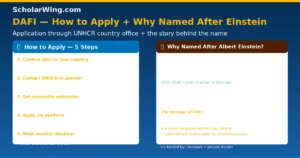
In 1933, Albert Einstein, the world’s most famous physicist, winner of the Nobel Prize, developer of the theory of relativity fled Nazi Germany and sought asylum in the United States. He took a position at the Institute for Advanced Study in Princeton, New Jersey, and spent the rest of his life there, never returning to Germany.
Einstein’s displacement was a loss for Germany and a gain for the world. But the premise of DAFI, the scholarship program named in his honor is that millions of refugees globally possess talent and intellectual potential equal to Einstein’s that is being wasted because displacement has severed their access to education.
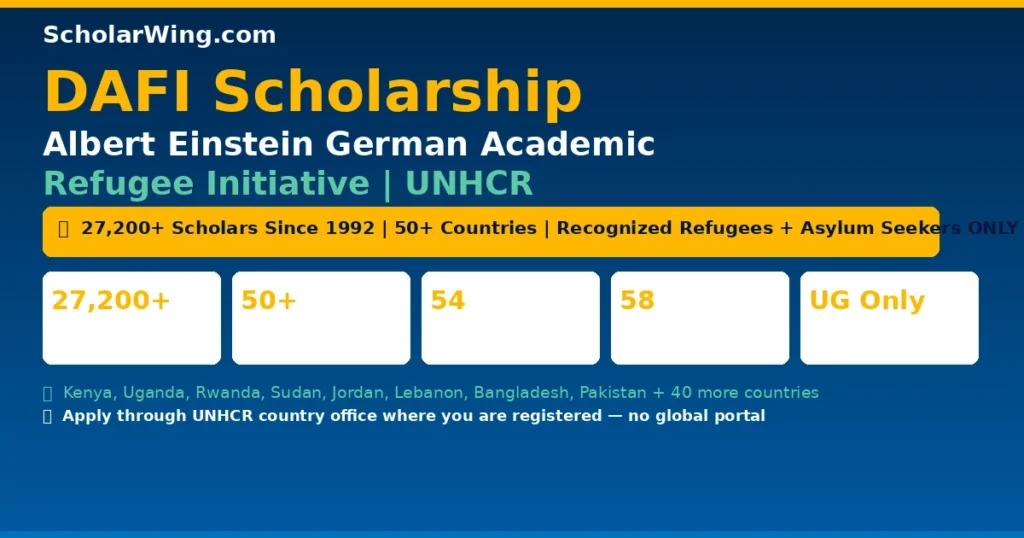
DAFI is short for “Deutsche Akademische Flüchtlings Initiative Albert Einstein”, translated from German as the “Albert Einstein German Academic Refugee Initiative.” It is a higher education scholarship program that provides refugee students with the financial and academic support they need to complete an undergraduate degree. The program is implemented by UNHCR with funding from the German government, along with support from other donors and private sector partners.
Since its launch in 1992, DAFI has empowered over 27,200 refugee students to pursue undergraduate degrees unlocking opportunity, dignity and long-term self-reliance. In 2024, DAFI recipients were from 54 countries of origin and studied in 58 different countries of asylum.
This is not a scholarship for everyone. It is a scholarship specifically for people who have been forced to flee their home countries recognized refugees and asylum seekers living in a country that is not their own, who have a secondary school diploma and the ability and desire to pursue university education despite the obstacles of displacement.
If that describes you or someone you know, this guide explains exactly how DAFI works and how to access it.
What Is DAFI — The Full Picture
| Detail | Information |
|---|---|
| Full name | Deutsche Akademische Flüchtlings Initiative Albert Einstein |
| English translation | Albert Einstein German Academic Refugee Initiative |
| Established | 1992 |
| Primary funder | German Federal Foreign Office |
| Additional funders | Government of Denmark + private donors + UNHCR partners |
| Implemented by | UNHCR (United Nations High Commissioner for Refugees) + local partners |
| For | Recognized refugees and asylum seekers |
| Study location | Country of asylum (where you currently live as a refugee) |
| Level | Undergraduate (Bachelor’s degree, ISCED Level 6) + TVET (some countries) |
| NOT covered | Master’s degrees |
| Countries active | 50+ countries globally |
| Total scholars | 27,200+ since 1992 |
| Apply via | UNHCR country office in your country of asylum |
| Platform | unhcr-dafi-tertiary.scholarshipsplatform.com (country-specific) |
Who Is Eligible — The Core Requirement
UNHCR’s Tertiary Refugee Scholarship Program (DAFI) offers qualified refugee and returnee students the possibility to earn an undergraduate degree in their country of asylum or home country. The applicant must be a recognized refugee or asylum seeker.
Applicants may be citizens of any country, but must be planning to study in an eligible country of asylum.
The Three Core Requirements:
1. Recognized Refugee or Asylum Seeker Status You must hold formal refugee status recognized by UNHCR or the host government, OR be a registered asylum seeker whose claim is pending. Undocumented migrants or economic migrants without formal refugee status are not eligible.
What counts as refugee documentation:
- UNHCR refugee registration certificate
- Government-issued refugee identity card (in countries where the host government registers refugees)
- Asylum seeker certificate (while claim is being processed)
2. Living in Your Country of Asylum DAFI is a scholarship for study IN the country of asylum, the country where you are currently registered as a refugee. It is not a study abroad scholarship. A Somali refugee registered in Kenya studies at a Kenyan university through DAFI. A Congolese refugee registered in Rwanda studies at a Rwandan university. A Syrian refugee registered in Jordan studies at a Jordanian university.
3. Secondary Education Diploma You must have completed secondary school (high school) and hold a leaving certificate or equivalent qualification.
Additional Common Requirements (vary by country):
- Good academic performance in secondary school
- Not already enrolled in a university program
- Proof of admission or enrollment at an accredited institution in the country of asylum
- Financial need (DAFI specifically targets students who cannot afford university without support)
What DAFI Covers — Variable by Country
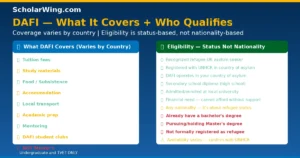
The scholarship package varies from country to country and covers a range of costs including tuition and study materials, food, transportation, and accommodation.
The scholarship provides comprehensive financial support covering tuition fees, academic expenses, a subsistence allowance, and other essential needs such as textbooks, accommodation, and local transportation.
Core components typically covered:
| Benefit | Detail |
|---|---|
| Tuition fees | University enrollment and academic fees |
| Study materials | Books, stationery, course materials |
| Subsistence allowance | Food/living expenses stipend |
| Accommodation | Housing support or contribution |
| Local transportation | Getting to/from university |
| Textbooks | Required course readings |
Beyond financial support:
To amplify academic achievement and skills development, DAFI scholars receive additional support through close monitoring, academic preparatory and language classes based on students’ needs, as well as mentoring and networking opportunities. DAFI student clubs and alumni groups are active in many countries.
- Academic preparatory classes — for students who need support before or during their university studies
- Language classes — many refugees study in their second or third language; DAFI provides language support
- Mentoring — individual mentorship from educators, professionals, and alumni
- Networking — connections to other DAFI scholars and alumni
- DAFI student clubs — active community within the program
- Close monitoring of academic progress and well-being — regular engagement from UNHCR and partners
Where DAFI Operates — Countries of Asylum
DAFI scholarships are offered in over 50 countries.
DAFI operates wherever UNHCR has a country office and refugee populations have access to local universities. Confirmed active countries include:
Africa (confirmed active): Kenya, Uganda, Rwanda, Ethiopia, Tanzania, Sudan, South Sudan, DRC (Congo), Zimbabwe, Zambia, Mozambique, Angola, Cameroon, Nigeria, Ghana, South Africa, Malawi, Burundi, Egypt, and others
Middle East: Jordan, Lebanon, Turkey, Iraq, Yemen, Egypt
Asia: Bangladesh, Nepal, Malaysia, Pakistan, India, Myanmar (in some contexts)
Latin America: Ecuador, Colombia, Peru, Costa Rica, Brazil, Venezuela
How to confirm if DAFI is in your country: Confirm availability of DAFI in your country of asylum via your local UNHCR office.
The definitive answer comes from contacting the UNHCR country office where you are registered. The list of active DAFI countries changes as new programs are established and funding levels change.
Where DAFI Does NOT Apply — Critical Clarification
DAFI is specifically for study in the country of asylum. This means:
DAFI is NOT:
- A study abroad scholarship
- A scholarship to study in Germany (despite the “German” in the name)
- A scholarship to return to your home country (in most cases)
- A Master’s degree scholarship
- Available in every country — only where UNHCR has established the program
DAFI IS:
- A scholarship to study at a university in the country where you are currently registered as a refugee
- For undergraduate (bachelor’s) level study
- Administered locally through UNHCR country offices and partners
Study Levels — Undergraduate and TVET Only
DAFI covers programs at ISCED level 6, bachelor’s degrees or equivalent level qualifications. The scholarship is designed to provide students with academic and/or professional knowledge, skills, and competencies, leading to a first degree or equivalent qualification. DAFI can also cover short-cycle tertiary education (ISCED level 5 courses).
What DAFI covers:
- Bachelor’s degree (4-year undergraduate) — primary focus
- Associate degrees and diplomas (ISCED Level 5) — some countries
- TVET (Technical and Vocational Education and Training) — confirmed in some countries including Sudan
What DAFI does NOT cover: The scholarship does not cover master’s degree programs.
If you are a refugee seeking Master’s degree support, other programs may be relevant some universities have specific refugee scholarships for graduate study. Discuss with your UNHCR country office about other tertiary education pathways.
How to Apply — UNHCR Country Office Is Your Entry Point
If you are an eligible candidate and DAFI exists in your country, you can request a DAFI application form from your UNHCR country office. All applications need to be directed to the respective UNHCR country offices.
Step-by-Step Process:
Step 1: Confirm DAFI is active in your country of asylum Contact the UNHCR office where you are registered. Ask specifically whether the DAFI program is available for the current academic year. Do not assume availability can change based on annual funding cycles.
Step 2: Contact the UNHCR office or implementing partner UNHCR often works with implementing partners who administer DAFI locally:
- Kenya and Uganda: Windle Trust Kenya / Windle Trust Uganda
- Sudan: Windle Trust International (in partnership with UNHCR Sudan)
- Rwanda: UNHCR Rwanda directly
- Other countries: Country-specific partners — ask the UNHCR office
Step 3: Apply through the country-specific process Many countries now use the DAFI Program Management Platform: unhcr-dafi-tertiary.scholarshipsplatform.com
Upload required documentation:
- Proof of refugee status (UNHCR certificate or government-issued ID)
- Admission letter or enrollment confirmation from university
- Secondary school leaving certificate and transcripts
- Any other country-specific documents required
Step 4: Meet your country’s specific deadline Deadlines vary by country. Confirmed current cycles:
- Rwanda 2026/2027: Applications open, deadline August 7, 2026
- Sudan 2026: Deadline was April 30, 2026 (administered by Windle Trust International)
Other countries have their own deadlines. Contact the UNHCR office in your country for the current application window.
Country-Specific Notes
🇷🇼 Rwanda
In Rwanda, over 600 refugee students have benefited from the DAFI Scholarship. Applications are now open for the 2026/2027 academic year, and eligible refugees and asylum-seekers are invited to apply by August 7, 2026.
The applicant must be a recognized refugee or asylum seeker living in Rwanda.
🇸🇩 Sudan
Windle Trust International, in partnership with UNHCR, administers DAFI in Sudan. The scholarship provides access to tertiary education for refugees, supporting study at universities, colleges, and Technical and Vocational Education and Training (TVET) institutions across Sudan. Deadline was April 30, 2026.
🇰🇪 Kenya
Windle Trust Kenya implements DAFI in Kenya for East African refugees including Somali, South Sudanese, Ethiopian, and other refugees hosted in Kenya. Contact Windle Trust Kenya or UNHCR Kenya for current application cycles.
🇺🇬 Uganda
Uganda hosts one of Africa’s largest refugee populations. Windle Trust Uganda implements DAFI for refugees in Uganda including South Sudanese, Congolese, Somali, and Rwandan refugees. Contact UNHCR Uganda or Windle Trust Uganda.
🇯🇴 Jordan / 🇱🇧 Lebanon
DAFI is active in both Jordan and Lebanon for Syrian, Palestinian, Iraqi, and other refugees. Given the large refugee populations, competition is high. Contact UNHCR Jordan or UNHCR Lebanon directly.
🇧🇩 Bangladesh
DAFI operates in Bangladesh for Rohingya refugees. Access has been complex given Bangladesh’s policy on Rohingya education access. Contact UNHCR Bangladesh for current program status.
🇵🇰 Pakistan
DAFI has operated in Pakistan for Afghan refugees. Contact UNHCR Pakistan for current availability.
The Six Strategic Objectives of DAFI
The six strategic objectives of the program are to: 1. Promote self-reliance and pathways to solutions resulting from the completion of undergraduate qualification. 2. Empower young women and men equally to contribute knowledge, skills and leadership to their communities. 3. Strengthen the protective impact of education by encouraging lifelong learning for refugees. 4. Provide role models for refugee children and youth to demonstrate the impact of education on individuals, communities and societies.
These objectives explain why DAFI exists beyond the immediate benefit to individual scholars. A DAFI graduate becomes a role model for younger refugees in the same camp or community demonstrating that education and professional achievement are possible despite displacement. They become the doctors, teachers, engineers, and civil servants that refugee host communities and eventual return communities need.
The Albert Einstein Naming — Why It Matters
Albert Einstein (1879-1955) was born in Ulm, Germany, and became the world’s most celebrated scientist. In 1933, when the Nazi Party came to power in Germany, Einstein who was Jewish was in the United States. He never returned to Germany, formally renouncing his German citizenship and becoming an American citizen in 1940.
Einstein’s experience embodies what DAFI addresses: a person of exceptional intellectual capacity displaced by political violence, who found refuge and continued to contribute to human knowledge. DAFI’s implicit message is that every refugee may be carrying within them the equivalent of Einstein’s potential and that the global community has a responsibility to create conditions for that potential to develop.
Naming the scholarship after Einstein a German Jew who fled the German government that now funds the scholarship is also an act of historical reckoning and moral commitment.
Practical Guidance for DAFI Applicants
1. Your first action: Contact UNHCR Do not search for a DAFI application form online. The form, the process, and the deadline are all specific to your country. Your UNHCR registration office is your only entry point.
2. Have your refugee documentation in order Your UNHCR registration certificate or equivalent government documentation is mandatory. If your documentation has expired or is in process, address that before applying for DAFI.
3. Apply for university admission simultaneously DAFI generally requires either an admission letter or enrollment confirmation. Apply to eligible universities in your country of asylum and secure admission before or simultaneously with your DAFI application.
4. Be honest about financial need DAFI specifically targets students who cannot afford university without support. Misrepresenting financial circumstances can affect other deserving refugees who need the scholarship more.
5. DAFI is country-specific — check every year DAFI funding levels change year to year. A program that was active in your country last year may have reduced capacity this year. Always verify with the UNHCR office before each application cycle.
6. Engage with DAFI student clubs and alumni In countries where DAFI is active, student clubs and alumni networks exist. Connecting with current and former DAFI scholars can provide information, guidance, and community that navigating the application independently cannot.
For Organizations Supporting Refugees
If you work with refugees and are not sure whether DAFI is available in your context:
- Contact your national UNHCR office
- Contact Windle Trust International (windle.org.uk) for East/Central Africa contexts
- Check unhcr.org for the DAFI program page and regional contacts
- Contact the DAFI Program Management Platform at unhcr-dafi-tertiary.scholarshipsplatform.com
FAQ
What does DAFI stand for?
DAFI is short for “Deutsche Akademische Flüchtlings Initiative Albert Einstein” translated as the “Albert Einstein German Academic Refugee Initiative.”
How many students has DAFI supported?
Since its launch in 1992, DAFI has empowered over 27,200 refugee students to pursue undergraduate degrees.
Who is eligible for DAFI?
Recognized refugees or asylum seekers studying in their country of asylum with a secondary school diploma, seeking to pursue undergraduate study at an accredited institution in that country.
Does DAFI cover Master’s degrees?
No, the scholarship does not cover master’s degree programs. It is for undergraduate (Bachelor’s) and short-cycle tertiary/TVET programs only.
How do I apply?
Contact your UNHCR country office. All applications need to be directed to the respective UNHCR country offices. Application may also go through implementing partners like Windle Trust in East African contexts.
What does DAFI cover?
The scholarship covers a range of costs, including tuition, fees, study materials, food, transportation, accommodation and other expenses. The exact package varies by country.
What is the Rwanda 2026/2027 deadline?
Applications are open for the 2026/2027 academic year, and eligible refugees and asylum-seekers are invited to apply by August 7, 2026.
Who funds DAFI?
DAFI is primarily funded by the German Federal Foreign Office, but relies on a growing network of partners including UNHCR, host country governments, NGOs and private donors.
If You Are in Crisis or Need Immediate Support
If you are a refugee experiencing difficulty accessing basic needs, housing, or safety, scholarship applications can wait. Contact your nearest UNHCR office for immediate protection and assistance before pursuing DAFI.
UNHCR Global website: unhcr.org Find your UNHCR country office: unhcr.org/get-help/report-concerns/asylum-seekers
Related Guides:
- 10 Fully Funded Scholarships for Libyan Students 2026-27 — Amounts, Deadlines & Arabic Speaker Advantage
- TWAS Scholarships & Fellowships 2027 — Complete Guide | World Academy of Sciences | Developing Countries
- IsDB Merit Scholarship Program (MSP) 2027 — Complete Guide | 57 OIC Countries | PhD + Postdoc