
Estonia Is the World’s Most Digitally Advanced Country — And One of Europe’s Best-Kept Study Secrets
Most international students know Germany, UK, and France. Very few know Estonia. That’s a strategic advantage worth understanding.
Estonia is a full EU member state with a genuinely exceptional digital infrastructure. It is the birthplace of Skype, Wise (formerly TransferWise), Bolt (the Uber competitor), and Pipedrive — four global technology companies founded in a country of 1.3 million people. The Estonian government operates entirely online. Estonia pioneered e-Residency for digital entrepreneurs. It runs its elections online and its tax filing takes three minutes.
For international students interested in IT, cybersecurity, data science, digital governance, and technology entrepreneurship, no study destination in Europe offers closer proximity to the actual digital infrastructure they want to study.
And the flagship scholarship — Dora Plus — covers full tuition plus a monthly stipend of €700-900. It explicitly favors STEM and IT fields.
Top Scholarships in Estonia
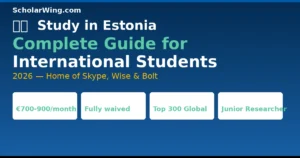
The Main Scholarship: Dora Plus — Full Tuition + Monthly Stipend
Dora Plus is the Estonian Research Council’s flagship scholarship for incoming international master’s and PhD students.
What it covers:
- Full tuition waiver
- Monthly stipend of €700-900 for Master’s and PhD students
- Duration: standard program length
Who it explicitly favors: Dora Plus explicitly favours STEM, IT, natural sciences, and fields aligned with Estonia’s R&D strategy.
For IT, computer science, cybersecurity, data science, engineering, and natural sciences applicants, Dora Plus is the strongest funding pathway available.
Acceptance rates: Acceptance rates are not published, but Estonian universities report roughly 1 in 4 to 1 in 6 applicants receiving Dora Plus funding in STEM fields. In humanities, the ratio is lower.
What makes a strong application: A strong motivation letter that connects your research interests to Estonian institutions and priorities makes a measurable difference.
Deadline: For 2026/27 academic year intake: typically late March for autumn programs. Check the Archimedes Foundation website annually — the deadline shifts slightly year to year.
Apply through: Archimedes Foundation portal — archimedes.ee
Estonian Government Scholarship — Degree and Exchange Study
The second major pathway is the Estonian Government Scholarship for Degree and Exchange Study, administered by the Education and Youth Board of Estonia (Harno).
What it covers: The rate of the scholarship for Master’s studies is 350 euros per month.
Who can apply: Foreign students who wish to study at a higher education institution in Estonia during the 2026/2027 academic year in formal degree studies or as an exchange student. The scholarship supports Master’s studies in all fields. Applications will be accepted from students from countries whose citizenship is in one of the countries listed.
Important: Not all countries are eligible for this scholarship. A specific list of eligible nationalities publish annually. Check the scholarship guide at studyinestonia.ee for the current country list before applying.
Application window 2026: Degree and exchange study scholarship application conditions and deadline for the 2026 application round will be announced in August. The 2025/26 window ran September 2 – October 1 as a reference point.
Apply through: Education and Youth Board of Estonia at harno.ee, email: rvo.dokumendid@harno.ee
Top Universities in Estonia for International Students
University of Tartu — The Flagship The University of Tartu is consistently is ranking among the top 300 universities globally. Estonia’s oldest and most prestigious institution, founded in 1632.
The University of Tartu offers more than 30 master’s programs fully taught in English, including popular options in IT, data science, cybersecurity, natural sciences, law, medicine, social sciences, and humanities.
Rector’s Merit Scholarship at Tartu: Rector’s Merit Scholarship: 25-50% tuition reduction for students with GPA 4.5+ out of 5.0 (or equivalent top 10% of class). Automatically considered based on application — no separate form.
Apply at: ut.ee
TalTech — Tallinn University of Technology Estonia’s engineering and technology university. Strongly aligned with Estonia’s tech sector. Programs in cybersecurity, computer science, engineering, business IT, and data science.
A funded PhD in Computer Science or Cybersecurity at Tartu or TalTech is genuinely competitive internationally — Estonia’s research profile in these fields is disproportionate to its size.
PhD as junior researcher: Most PhD positions at TalTech (and University of Tartu) are structured as junior researcher employment contracts, not traditional studentships. This means PhD students receive a salary and employee benefits, not just a scholarship allowance.
Apply at: taltech.ee
Tallinn University Known for education, digital media, social sciences, and humanities. Strong Erasmus Mundus program in AI for Sustainable Societies (AISS) at Tallinn University — fully funded with tuition waiver, housing, travel, and food allowance covered.
Apply at: tlu.ee
The PhD Model in Estonia — Junior Researcher Employment
This is the most unique aspect of Estonian doctoral education and the one most guides miss entirely.
PhD positions in Estonia are typically funded differently from master’s scholarships. Most PhD students in science and engineering are employed as junior researchers on university or research institute payroll. This means: PhD students receive a salary as university employees, with employment contracts, social insurance, and employee protections.
Practical implications:
- You are paid as an employee, not awarded a scholarship
- You contribute to the Estonian national pension and social insurance system
- You have employee rights including sick leave and annual leave
- The income is taxable in Estonia
This model is particularly common in computer science, IT, engineering, and natural sciences at Tartu and TalTech. When searching for PhD opportunities in these fields, look for advertised junior researcher positions at ut.ee/en/research/doctoral-studies and taltech.ee/research — not just scholarship listings.
English Language Requirements — EMI Accepted
Estonian universities, including Tartu, offer flexible English language requirements, allowing students to apply without IELTS under certain conditions. An English-Medium Instruction (EMI) letter from your previous institution confirming English as the sole language of instruction is accepted for many programs.
This flexibility makes the University of Tartu one of the most accessible European universities for IELTS-free applications, particularly benefiting students from English-medium education systems across Africa, Asia, and other regions.
For students who completed their degree at an English-medium institution, a free EMI/MOI Certificate from your university registrar may substitute for IELTS for many Estonian programs. Generate the correct format at: MOI Generator.
Confirm with your specific program before assuming EMI is accepted, some competitive programs may still require a formal test score.
Student Visa for Estonia
Non-EU/EEA international students need a Long-Stay Visa (Type D) and a Temporary Residence Permit for Study to study in Estonia for programs lasting more than 90 days.
Process:
- Receive admission letter from your Estonian university
- Apply for a Type D long-stay visa at the Estonian Embassy or consulate in your home country
- On arrival, apply for a Temporary Residence Permit at the Estonian Police and Border Guard Board within the first weeks
Documents typically required:
- Valid passport
- University admission letter
- Proof of sufficient funds (approximately €200-300/month minimum — scholarship documentation satisfies this)
- Proof of accommodation
- Health insurance valid in Estonia
- Application form
Processing time: 4-8 weeks. Apply as soon as you have your admission offer.
Work rights: International students with a valid residence permit may work up to 16 hours per week during term time in Estonia, with no limitation during summer holidays.
Application portal: Most Estonian universities use Dream Apply, a single online portal for applications to University of Tartu, TalTech, Tallinn University, and others. Apply at dreamapply.com.
Cost of Living in Estonia — Significantly Below Western Europe
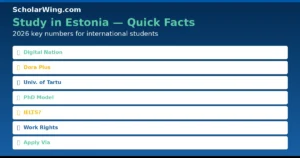
Estonia is considerably cheaper than Germany, Netherlands, or Scandinavia — making the €700-900 Dora Plus stipend genuinely livable.
Typical monthly costs in Tartu (university city):
- Accommodation: €200-400/month (university dormitory cheaper; private market moderate)
- Food: €150-250/month (grocery stores affordable; restaurants moderate)
- Transportation: €15-30/month (city buses; student discounts)
- Personal expenses: €80-150/month
Total typical budget: €450-830/month in Tartu. The Dora Plus €700-900 stipend covers costs comfortably in Tartu and adequately in Tallinn.
Tallinn vs Tartu: Tallinn is Estonia’s capital and slightly more expensive. Tartu (home of University of Tartu) is a university city, more affordable, with a strong student community.
Why Estonia for International Students?
1. World’s most digitally advanced country Estonia has the most advanced digital government infrastructure in the world. X-Road (the data exchange layer), e-Residency, digital ID, and paperless governance are all Estonian inventions. For IT, cybersecurity, digital policy, and governance students, this is a living laboratory unavailable anywhere else.
2. Global tech companies founded here Skype, Wise, Bolt, and Pipedrive are all Estonian. Estonia produces more tech unicorns per capita than almost any country in the world. The startup ecosystem is active, accessible, and genuinely innovative and international students can participate.
3. EU membership — EU-recognized degree A University of Tartu or TalTech degree is fully EU-recognized — equivalent to a German, French, or Dutch degree in terms of academic standing and EU mobility.
4. Genuine research quality Estonia’s research profile in cybersecurity and computer science is disproportionate to its size. The University of Tartu has research groups working at the frontier in areas including cybersecurity, AI, bioinformatics, and digital humanities — genuinely competing with much larger European institutions.
5. Lower competition than Germany or UK Fewer international students target Estonia specifically. Dora Plus accepts roughly 1 in 4-6 applicants in STEM, challenging, but substantially better odds than DAAD or Chevening in competitive cycles.
Erasmus+ at Estonian Universities
As EU institutions, Estonian universities participate in Erasmus+ across all programs.
Erasmus+ mobility grants: Monthly grant: €700-800 for students from Program Countries (EU member states, Iceland, Norway, Liechtenstein, North Macedonia, Serbia, Turkey).
For Partner Country students (most developing countries), Erasmus+ mobility grants are lower but still available.
How to apply: Apply through your home university’s International Office. They nominate you; the Estonian university then formally accepts you.
The key: initiate the process at your home university 8-10 months before your planned exchange. Most Erasmus+ coordinators have strict internal deadlines, and missing them means waiting a full year.
Practical Tips for Applying to Estonia
1. Use DreamApply — most Estonian universities use the same portal University of Tartu, TalTech, Tallinn University, Estonian Academy of Arts, and others all accept applications through Dream Apply. One account, multiple applications.
2. For PhD — search junior researcher positions, not just scholarships In STEM fields, PhD funding in Estonia comes through junior researcher employment, not scholarship applications. Search active positions at ut.ee/en/research/doctoral-studies and taltech.ee/research.
3. Dora Plus deadline is late March — apply by February Prepare your application by February for a late-March Dora Plus deadline. A strong motivation letter connecting your research to Estonian R&D priorities is explicitly more impactful than a generic one.
4. Tartu vs Tallinn For most international research students, the University of Tartu is the stronger academic choice. For engineering, cybersecurity, and technology entrepreneurship, TalTech in Tallinn is equally strong. Tartu is cheaper and more student-focused.
5. Combine Dora Plus with University of Tartu Rector’s Scholarship The University of Tartu’s Rector’s Merit Scholarship (25-50% tuition reduction) is considered automatically for high-GPA applicants. If you’re eligible for Dora Plus and have strong grades, both can complement each other.
FAQ
What is Dora Plus and who can apply?
Dora Plus is Estonia’s flagship scholarship for international Master’s and PhD students, funded by the European Social Fund and coordinated by Archimedes Foundation. It covers full tuition plus a monthly stipend of €700-900. It explicitly favors STEM, IT, and natural sciences fields. Deadline is typically late March for autumn intake.
How are PhD students funded in Estonia?
Most PhD students in STEM and engineering at Estonian universities are employed as junior researchers on university payroll, not as scholarship recipients. They receive a salary, employment contract, and social insurance contributions. Search for junior researcher positions rather than scholarship listings.
What is the Estonian Government Scholarship?
It is €350/month for Master’s degree studies, administered by the Education and Youth Board (Harno). Eligibility depends on your nationality, a specific country list is published annually. Application window is September-October.
Does Estonia accept EMI Certificate instead of IELTS?
Yes, for many programs at the University of Tartu and other Estonian universities, an English-Medium Instruction letter from your previous institution will be accept. Confirm with your specific program.
What is Dream Apply?
Dream Apply is the centralized application portal used by most Estonian universities. One account allows you to apply to University of Tartu, TalTech, Tallinn University, and others simultaneously.
What is the cost of living in Estonia?
Tartu (university city) costs approximately €450-830/month — affordable by European standards. The Dora Plus stipend of €700-900/month covers basic costs comfortably in Tartu.