
“Germany Has Excellent Universities” Is Why Everyone Gets Rejected
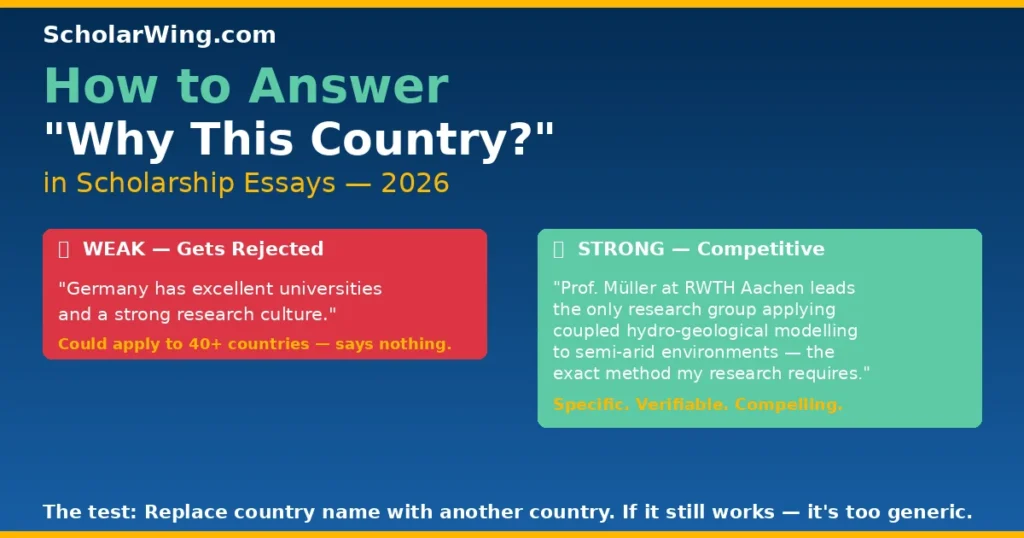
Selection committees have read thousands of scholarship essays. The most common sentence in “Why Germany?” essays across DAAD applications is some variation of: “Germany has excellent universities and a strong research culture.”
It is true. It is also completely useless as an essay answer.
Every applicant writes it. It says nothing specific about why Germany is the right destination for your research, your career, your specific gap. A sentence that could apply to 40 countries simultaneously tells the selection committee nothing that differentiates you from the other 2,000 people who submitted the same observation.
DAAD is competitive, not because of grades, but because of clarity. Answer two things specifically: Why Germany? What impact will you create?
This guide gives you the specific framework for answering “Why this country?” for Germany, UK, China, Korea, and Japan — with real before/after examples for each.
The Framework That Works for Every Country
Before country-specific answers, understand the structure that makes any “Why this country?” answer competitive.
A strong answer to “Why this country?” does three things simultaneously:
1. Connects the country to your specific academic goal Not “Germany has good engineering programs” but “Professor [Name] at TU Munich is the only researcher working on [specific methodology] that my research builds directly on.”
2. Connects the country to your career context Not “studying in the UK will broaden my horizons” but “The UK-Pakistan Chevening alumni network in Lahore is directly relevant to my post-scholarship goal of building a bilateral health policy collaboration between the two countries.”
3. Acknowledges something specific you know about the country Not “Korea has advanced technology” but “Korea’s National Health Insurance Service has built the world’s most comprehensive linked health database, my research methodology requires exactly this type of longitudinal administrative data.”
The formula: Specific academic reason + Specific career connection + Specific country knowledge.
“Why Germany?” — For DAAD Applications
Germany gets more international scholarship applications than almost any other country. The selection pool is large. Generic “Why Germany?” answers are eliminated early.
What DAAD is really asking: Why is Germany — specifically, the right place for your proposed study or research? Why not France, the Netherlands, or Australia?
What doesn’t work:
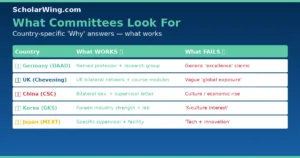
❌ “Germany is known for its engineering and research excellence.” ❌ “Germany has a long history of academic achievement.” ❌ “German universities are tuition-free, making this an affordable option.” ❌ “Germany is a multicultural society that will broaden my perspective.”
All of these could apply to a dozen countries. None answers the actual question.
What Works:
Specific academic reasons:
✅ Professor-specific: “Professor [Name] at [University] is one of very few researchers applying [specific methodology] to [specific problem]. My proposed research on [topic] builds directly on their 2024 paper on [title], which identifies [specific gap] that I intend to address.”
✅ Institution-specific: “The [Institute name] at [University] is the only institution outside [your country] conducting research on [specific area]. Their partnership with [organization] gives my proposed research access to [specific data/infrastructure/network] that does not exist anywhere else.”
✅ Program-specific: “The [specific Master’s program] at [University] is the only program combining [subject A] with [subject B] at graduate level — a combination directly required to address [specific professional problem I encountered in my work].”
What works — career connection:
✅ “Germany’s [specific industry or bilateral agreement] with [my country] means that the professional relationships I build during a DAAD year will have direct utility when I return to [organization] and lead [specific initiative].”
✅ “DAAD alumni chapters in [my country] are active in [specific sector]. Connecting with this network directly supports my post-scholarship goal of [specific plan].”
The test: Replace “Germany” with “France” in your answer. If the sentence still makes sense, your answer isn’t specific enough.
“Why UK?” — For Chevening Applications
Chevening looks for applicants who demonstrate a genuine willingness to collaborate with the UK in tackling shared global and local challenges, such as advancing growth and prosperity, strengthening security, building climate resilience, or supporting sustainable development.
This is the official language. Notice what it says: UK engagement is not about the country being good at things. It is about collaboration on shared challenges.
What Chevening is really asking: Why UK specifically, and how will your UK education, including the UK networks you build, enable you to create impact you could not create with a degree from anywhere else?
What doesn’t work:
❌ “The UK has world-class universities including Oxford and Cambridge.” ❌ “Studying in the UK will improve my English and global perspective.” ❌ “The UK is a leading country in my field.”
What works:
✅ UK-specific professional networks: “The UK-[my country] bilateral partnership in [specific sector] is one I intend to contribute to after my scholarship. Building professional relationships with UK counterparts in [specific institution or organization] during my Chevening year is a core part of my post-scholarship strategy — relationships I cannot build from [my country] without direct UK presence.”
✅ UK-specific academic program: “The [specific course module] in [program name] at [university] addresses [specific policy/technical challenge] through a UK-developed framework that has been applied in [relevant context]. This framework is directly applicable to [specific problem in my country] that I will address in my post-scholarship role at [organization].”
✅ UK alumni network relevance: “Chevening alumni in [my country] work in [specific sector]. The alumni network represents exactly the cross-sectoral leadership connections my work at [organization] requires — connections I cannot build without direct access to this network.”
Chevening-specific additional requirement: Show that you’ve researched your three chosen courses and, focusing your answer only on your first choice course, explain how it connects to your background, career aspirations, and the impact you hope to make. Describe how specific modules or areas of study will equip you with the skills and knowledge needed to achieve your goals.
“Why UK?” and “Why this course?” are functionally linked in Chevening. The country answer and the university answer should reinforce each other.
“Why China?” — For CSC Applications
The “Why China?” essay in CSC applications is evaluated differently from European scholarship essays. The primary filter is research fit and academic alignment but the country-choice question appears in study plans and motivation letters.
What CSC is really asking: Why China’s academic or research environment specifically, and how does your proposed study connect to the China-[your country] development relationship?
What doesn’t work:
❌ “China has made great progress in [field] in recent years.” ❌ “I want to experience Chinese culture and society.” ❌ “China is a rising global power with much to offer.”
What works:
✅ Bilateral development relevance: “China’s expertise in [infrastructure/agriculture/technology] directly parallels [your country]’s development priorities. My proposed study at [Chinese university] in [specific field] will allow me to bring [specific knowledge or methodology] back to [specific role] in [your country].”
✅ Professor/research group: “Professor [Name] at [University] leads the only research group working on [specific topic] with direct applications to [your country/region’s] context. Their published work on [paper title] is the foundation of my proposed research.”
✅ Specific Chinese institutional strength: “China is the world’s largest [producer/implementer/researcher in specific area]. Access to [specific dataset, facility, or partner organization] through [Chinese university] is not available at any institution outside China — and this access is essential to my proposed methodology.”
“Why Korea?” — For GKS Applications
GKS Korea applications require a study plan that includes your rationale for studying in Korea specifically.
What doesn’t work:
❌ “Korea has developed rapidly and is a leader in technology.” ❌ “I am interested in Korean culture and want to experience it.” ❌ “Korea’s universities are internationally recognized.”
What works:
✅ Field-specific Korean strength: “Korea’s [specific industry — semiconductor, shipbuilding, healthcare IT, renewable energy] is among the world’s most advanced. The [specific program/lab] at [Korean university] offers direct access to [specific infrastructure, industry partnership, or research application] that does not exist in my home country.”
✅ Korea-[your country] bilateral context: “Korea’s [Official Development Assistance / specific bilateral program] with [your country] in [sector] makes my proposed study directly relevant. The relationships I build with Korean counterparts during my GKS year will strengthen [specific ongoing or planned collaboration] when I return.”
✅ Korean-specific academic innovation: “Korean researchers at [university] have developed [specific methodology or approach] that is at the frontier of [field]. My thesis will apply this methodology to [your country/region’s] context — research that requires direct access to the research environment where this methodology was developed.”
“Why Japan?” — For MEXT Applications
MEXT applications require both a research plan and a study plan. The “Why Japan?” question is embedded in both documents.
What doesn’t work:
❌ “Japan is known for its technology and innovation.” ❌ “I admire Japanese culture and work ethic.” ❌ “Japan has excellent universities.”
What works:
✅ Research group specificity: “Professor [Name] at [Japanese university] is among the world’s leading researchers in [specific area]. Their laboratory is the primary site where [specific research methodology/technology] is being developed and tested, methodology my proposed PhD requires direct access to.”
✅ Japan-specific technology or infrastructure: “Japan’s [specific national research infrastructure — e.g., RIKEN, specific accelerator facility, specific agricultural research station] is the only facility in the world where [specific experimental condition] can be reproduced. My research question cannot be answered without access to this facility.”
✅ Japan-[your country] development relevance: “Japan’s ODA programs in [your country] in [sector] represent a long-term bilateral relationship. My study at [Japanese university] in [related field] builds technical expertise directly applicable to [specific Japanese-funded project in your country] that I will contribute to after graduation.”
Before and After: Real Essay Transformations
DAAD — Before: “Germany is known for its high-quality engineering education and strong research universities. DAAD scholarships have a long tradition of excellence, and Germany’s approach to sustainable energy is relevant to my country’s development goals.”
After: “Professor Müller’s research group at RWTH Aachen is one of the only teams applying coupled hydro-geological modeling to semi-arid environments, exactly the methodology my research on groundwater depletion in Punjab’s agricultural zones requires. This work cannot be supervised effectively outside Aachen; the group’s proprietary dataset from three North African semi-arid study sites is the comparative baseline my research design depends on.”
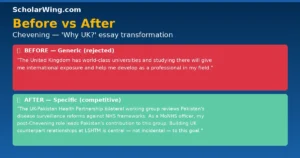
Chevening — Before: “The United Kingdom has world-class universities and studying there will give me international exposure and help me develop as a professional in my field.”
After: “The UK-Pakistan health policy bilateral working group, established under the 2022 UK-Pakistan Health Partnership is the primary channel through which Pakistan’s disease surveillance reforms are being reviewed against UK NHS frameworks. As a public health officer at the Ministry of National Health Services, my post-Chevening role will be to lead Pakistan’s contribution to this working group. Building direct professional relationships with UK counterparts during my Chevening year at the London School of Hygiene and Tropical Medicine is not incidental to this goal, it is central to it.”
The Practical Research Checklist Before Writing Your Answer
Before writing any “Why this country?” answer, gather these specific facts:
For DAAD (Germany):
- ☐ Name of the specific professor you want to work with
- ☐ Title of one of their papers published in the last 3 years
- ☐ Name of the specific research group or institute
- ☐ One specific thing the German academic environment offers that no other country does for your topic
Chevening (UK):
- ☐ Name of one specific module in your first-choice UK program
- ☐ Name of one specific UK-your country bilateral initiative in your field
- ☐ Name of one active Chevening alumni from your country working in your sector
- ☐ One specific way the UK alumni network serves your post-scholarship plan
For CSC (China):
- ☐ Name of your proposed Chinese supervisor
- ☐ One specific China-your country development project in your field
- ☐ One Chinese-specific research facility or dataset you need access to
GKS (Korea):</strong>
- ☐ One specific Korean industry or research area that is world-leading in your field
- ☐ One Korean university lab or program with a specific strength relevant to your topic
For MEXT (Japan):</strong>
- ☐ Name of your proposed Japanese supervisor
- ☐ One Japan-specific research facility, dataset, or infrastructure relevant to your research
Read This: Scholarship Application With a Gap Year or Career Break 2026
FAQ
Does every scholarship ask “Why this country?”
Not always explicitly, but the question is embedded in every “study plan,” “motivation letter,” or “course rationale” essay. Even if not directly asked, your essay must implicitly answer it or it will read as generic.
How long should the “Why this country?” answer be?
As long as it needs to be to be specific. There is typically one section within a 2-3 page motivation letter, roughly one substantial paragraph of 150-250 words for DAAD. For Chevening, the university choice essay explicitly addresses this and is typically 500 words covering the full course rationale.
What if I genuinely don’t have a specific reason beyond the scholarship being prestigious?
That’s the problem the research checklist above is designed to solve before you write, not after. Spend 2-3 hours researching professors, research groups, bilateral programs, and country-specific institutional strengths in your field. The specific reason exists, you haven’t found it yet.
Can I use the same “Why this country?” answer for different scholarship applications to the same country?
Yes, if you’re applying to multiple DAAD programs or both DAAD and a university scholarship in Germany. Your core “Why Germany?” reasoning can be the same. Customize for the specific scholarship’s values, but the country rationale is reusable.