
A Gap Year Is Not a Disqualifier — It Is Either an Asset or a Neutral Factor, Depending on How You Handle It
The most common fear gap year applicants have is that selection committees will see unexplained time between graduation and application as evidence of weakness aimlessness, failure, or lack of seriousness. This fear is almost always unfounded, and in many cases it is completely backwards.
Several of the world’s most competitive scholarships Chevening, DAAD EPOS, Fulbright Humphrey Fellowship, and Australian Awards, require a minimum of two or more years of post-graduation work experience. A fresh graduate with a 4.0 GPA who applies to Chevening immediately after finishing their degree is ineligible. A graduate who worked for three years, even in a field different from their proposed study, is eligible in a way the fresh graduate is not.
The question scholarship committees ask about a gap year is not “why did you stop?” It is “what did you do with that time, and does it connect to where you’re going?”
An unexplained gap creates doubt. A purposeful gap you can articulate clearly is often an advantage.
The Rules: What Each Scholarship Actually Says About Time Since Graduation
Before deciding how to frame your gap, understand the actual eligibility rules, because “gap year” means very different things to different programs.
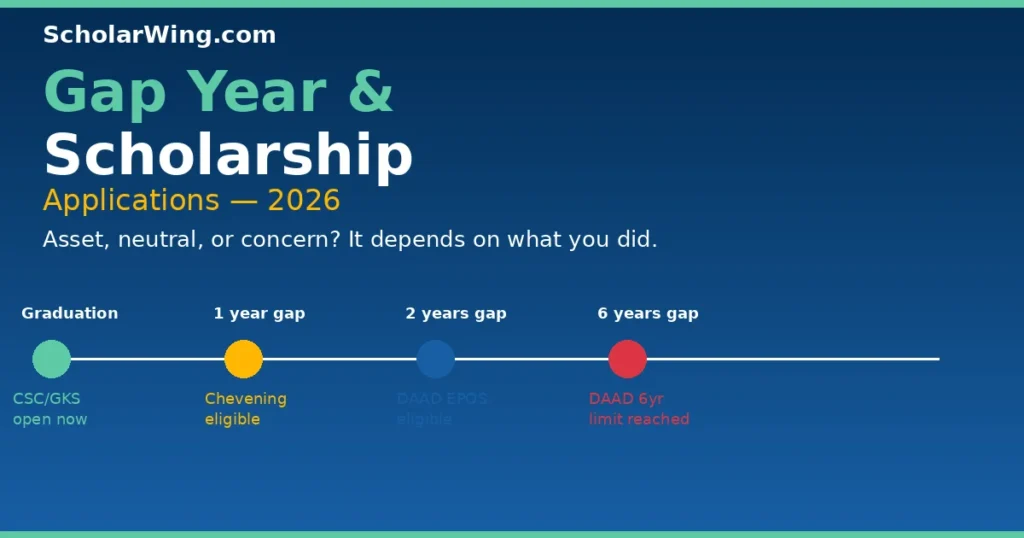
DAAD — The 6-Year Rule DAAD has one of the most specific rules: your latest academic degree should not be older than 6 years at the time of application. This means:
- Graduated in 2020 → applying in 2026 → still within the DAAD window
- Graduated in 2019 → applying in 2026 → outside the 6-year limit for most DAAD programs
- The clock starts from your most recent degree — a Master’s completed more recently than your Bachelor’s resets the window
This is one of the few hard eligibility rules in the scholarship world. Check your graduation year against this limit before investing time in a DAAD application.
Chevening — Requires Minimum 2 Years Work Experience Chevening explicitly requires approximately 2,800 hours of work experience before you can be considered, roughly two full-time years. This means:
- A 2-year gap with no formal employment weakens your Chevening application significantly
- A 2-year gap that included meaningful professional work makes you eligible where you previously weren’t
- Work experience doesn’t have to be in your proposed study field, but it should be describable in terms of leadership and impact
DAAD EPOS and Leadership for Africa — Require 2+ Years Post-Graduation Experience These development-focused programs explicitly target working professionals. A gap year between graduation and professional employment doesn’t disqualify you, but you still need the 2 years of professional experience to be competitive.
CSC China — No Gap-Related Restrictions Published CSC China publishes no formal rule about time since graduation. Under 35 for Master’s, under 40 for PhD, these are the primary age constraints, not years since degree.
GKS Korea — No Gap-Related Restrictions Published GKS Korea similarly has no published rule about gap years. The minimum GPA (2.64/4.0) and age limits are the primary constraints.
Erasmus Mundus — No Gap-Related Restrictions No formal gap year rules. Master’s and PhD programs are open to recent graduates and experienced professionals alike.
How to Frame a Gap Year in Your Application
Scenario 1: Your Gap Was Productive (Work, Volunteering, Projects)
This is the most straightforward situation. A gap year that included employment, freelancing, research, meaningful volunteering, or community projects is a genuine asset for scholarships that weight professional experience.
How to frame it: Describe the gap period the same way you describe your professional experience, as a defined period with specific activities, outcomes, and skills developed. Don’t call it a “gap year” in your application. Call it what it was: employment, a research period, professional development, community work.
In your CV: List the activity as you would any other professional experience:
2022-2024 | Independent Researcher / Community Development Specialist Conducted field research on agricultural water access in [Region]. Collaborated with [Organization] to develop…
In your SOP/motivation letter: Connect the period directly to why you are now applying. “During my two years working with [Organization], I identified a gap in [specific area] that I cannot address without graduate-level training in [field]. This is why I am applying for [Scholarship] to study [specific program].”
Scenario 2: Your Gap Was Mixed (Some Work, Some Inactivity)
This is the most common situation, some months of employment, some freelancing, some personal time, a family commitment, a health issue.
How to frame it: You don’t need to account for every month. Focus on what you did do, not what you didn’t. If you worked part-time, freelanced, or took online courses during this period, these are real activities worth describing. If there were months of genuine inactivity, you don’t proactively mention them, but if directly asked (in an interview), be honest and brief.
What not to do: Don’t invent activities or exaggerate part-time work into full-time employment. Selection committees, particularly for Chevening, verify claims and follow up in interviews. An inflated description that can’t survive a 10-minute conversation is worse than an honest explanation of a quiet period.
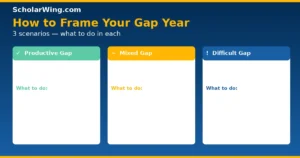
Scenario 3: Your Gap Was Difficult (Health, Family, Financial Crisis)
A gap caused by illness, a family emergency, financial necessity, or mental health challenges is common and understood by selection committees, as long as it is handled honestly and briefly.
How to frame it: You are not required to disclose personal health or family information. However, if the gap is long enough to be conspicuous (more than 12-18 months of apparent inactivity), a brief, honest explanation prevents the committee from imagining something worse.
The framing: acknowledge it briefly, explain the resolution, and pivot immediately to what you have done since. The goal is to close the question, not to dwell on it.
Example framing (in a personal statement or interview):
“Between 2022 and 2023, I took time away from professional work to manage a family health situation. Once resolved, I joined [Organization] in early 2024 and have spent the past two years [specific work]. This experience reinforced my commitment to [field] and made my return plan for this scholarship more specific: I intend to [concrete plans].”
Three sentences. Honest. Closed. Moves forward.
What not to do: Over-explain or over-apologize. One brief, factual explanation is enough. A paragraph of justification reads as defensiveness.
Scenario 4: Your Gap Was Long (4-5+ Years)
A multi-year gap between your last degree and a scholarship application raises specific considerations beyond framing, particularly for DAAD’s 6-year rule.
First, check eligibility:
- DAAD: is your most recent degree within the last 6 years?
- If your Bachelor’s is 7 years old but your Master’s is 3 years old, the Master’s resets the DAAD clock
For programs without hard time limits (CSC, GKS, Erasmus Mundus, Chevening): A 4-5 year gap with professional work is frequently an asset, not a liability. Chevening explicitly prefers applicants with established professional experience and leadership track records, a 5-year professional with demonstrable impact is a stronger Chevening candidate than a fresh graduate.
For academic programs concerned about research currency: If you’re applying for a research degree and your last academic work was 5+ years ago, briefly address this in your research proposal or SOP, reference recent literature you’ve engaged with, mention any independent research or publications during the gap period, and demonstrate that your academic thinking remains current.
Which Scholarships Are Actually Easier to Win With a Gap Year
This is the point most gap year guides miss entirely.
Several of the world’s most prestigious scholarships require two or more years of work experience before you can apply. A gap year spent building that experience is not a detour; it is a prerequisite.
Programs where a gap year with professional work is a genuine competitive advantage:
- Chevening — requires 2,800 hours of work experience. Fresh graduates cannot apply; applicants with 2-5 years of professional experience are the target profile
- DAAD EPOS — explicitly for mid-career professionals with development sector experience
- DAAD Leadership for Africa — targets experienced professionals with clear development impact
- Fulbright — professional experience strengthens most Fulbright applications significantly
- Australian Awards — prefers applicants with professional experience relevant to development priorities
- Joint Japan/World Bank Graduate Scholarship — specifically requires mid-career professionals with 2+ years of development-relevant experience
Programs where a gap year makes little difference:
- CSC China — no formal restrictions; GPA and age are primary filters
- GKS Korea — no formal gap restrictions; minimum GPA is the main threshold
- Erasmus Mundus — open to recent graduates and experienced professionals equally
The Gap Year CV: How to Present Your Timeline
Your CV’s chronological order should be honest and complete, but how you describe each period matters.
What to include:
- All formal employment, including part-time and contract work
- Freelance projects with named clients or organizations
- Significant volunteer work with defined roles and outcomes
- Research, publications, or academic engagement
- Courses, certifications, or professional development undertaken during the gap
What to omit:
- Months of genuine inactivity, you don’t list months of rest on a CV, and gap periods are no different
- Vague descriptions like “personal development” with no supporting detail, these read as cover for nothing
A practical structure for a mixed gap period in your CV:
Jan 2022 – Mar 2023 | Freelance Research Consultant | [City] Conducted qualitative research for three NGO clients in health and education sectors. Deliverables included two published field reports and a data analysis framework adopted by [Organization].
Apr 2023 – Present | [Current Role] | [Organization]
See ScholarWing’s free CV Builder for scholarship-specific formatting: Free CV Builder
The Motivation Letter: Addressing the Gap Directly
If your gap is significant, your motivation letter or SOP may need to acknowledge it — briefly — before pivoting to your current goals.
What NOT to write: “After graduating, I took some time off to explore my interests and figure out what I wanted to do.” — This is the worst version. It describes inactivity without any purpose or outcome.
What DOES work: “Following my graduation in 2021, I worked with [Organization] in [field] for three years before applying to this program. This experience was foundational: I encountered [specific problem] repeatedly, and realized that addressing it effectively requires graduate-level expertise in [area]. This scholarship represents the most direct path to that.”
The gap disappears. What remains is a continuous, purposeful narrative from graduation to application.
For guidance on writing the full motivation letter, use ScholarWing’s free generator: Motivation Letter Generator
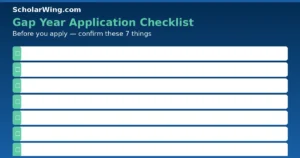
Practical Checklist Before Applying With a Gap Year
- ☐ Check DAAD’s 6-year degree rule against your graduation year
- ☐ Check Chevening’s 2,800 hours work experience requirement — do you meet it?
- ☐ Identify every meaningful activity during your gap (work, freelance, volunteering, research, courses)
- ☐ Update your CV to reflect gap period activities accurately
- ☐ Draft a 2-3 sentence explanation of the gap that closes the question and pivots forward
- ☐ Match your gap period activities to the scholarship’s stated selection criteria
- ☐ Identify which scholarships your gap year actually helps with (vs. which it’s neutral for)
FAQ
Does a gap year disqualify me from DAAD scholarships?
Not by itself, but DAAD has a 6-year rule: your most recent academic degree must not be older than 6 years. If your only degree is a Bachelor’s from 7 years ago, you may be outside the DAAD eligibility window. If you completed a Master’s more recently, that resets the clock.
Does Chevening penalize gap year applicants?
No, Chevening actually requires a minimum of ~2,800 hours of work experience, so a gap year spent in professional work makes you more eligible, not less. A gap year with no professional activity is the concern, not the gap itself.
Do I need to explain my gap year in my scholarship SOP?
Only if the gap is long enough to be conspicuous and unexplained. A 6-month break is unlikely to require comment. A 2-year gap will likely raise questions in an interview if it’s not addressed somewhere in your application. One brief, honest paragraph is enough.
What if my gap year was due to health or family issues?
You are not required to disclose personal health or family information. If you choose to address it, keep it brief: acknowledge it, confirm it’s resolved, and pivot immediately to what you’ve done since. One paragraph is the maximum.
Which scholarship is easiest to apply for after a long gap?
CSC China and GKS Korea have no formal rules about time since graduation. They’re the most accessible programs for applicants with longer gaps, provided they meet the age and GPA requirements.
Can I count freelance or volunteer work as “work experience” for Chevening?
Yes, Chevening counts professional, voluntary, and other relevant experience. What matters is that the experience demonstrates leadership potential and impact, not that it was salaried employment.