
WHF Salim Yusuf Emerging Leaders Programme:
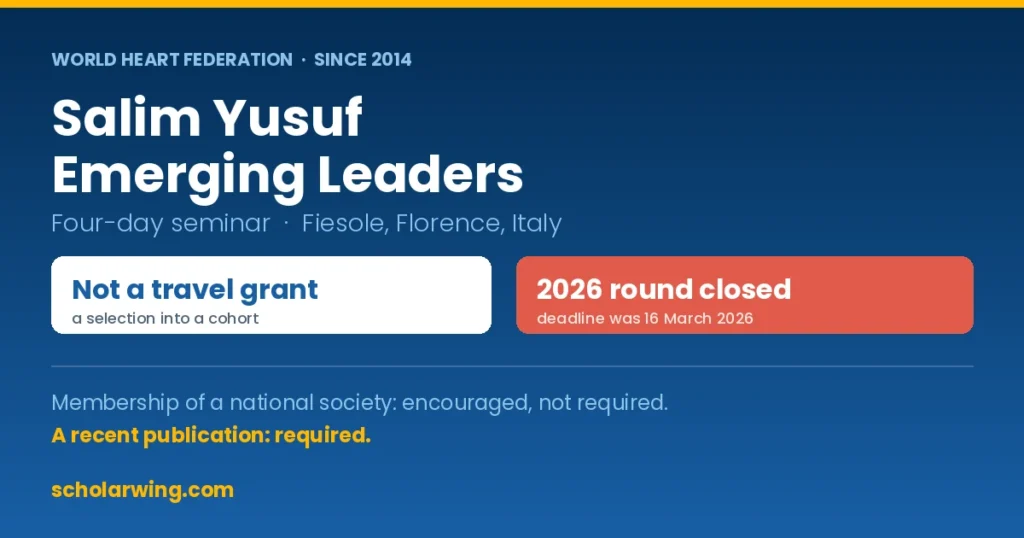
Before you read the eligibility list, understand what this is. The World Heart Federation does not hand out a travel grant here. It selects a cohort, trains it together for four days, and expects the group to keep working afterwards.
What the programme is
Dr Salim Yusuf created the Salim Yusuf Emerging Leaders Programme in 2014, with the aim of building a long-term community of experts who collaborate, run research and act together to reduce premature deaths from cardiovascular disease.
The core is a four-day in-person seminar, with training and networking in cardiovascular health policy and implementation science. Participants take part in intensive seminars, workshops and collaborative group work with international experts, and develop project proposals aligned with WHF’s priorities.
The audience is wide by design: healthcare professionals, researchers and global health advocates, drawn from academia, civil society, healthcare and the private sector.
Each year has a different theme
This is not a fixed curriculum, and knowing the recent themes tells you how WHF thinks.
2023 focused on digital health. 2024 on fixed-dose combination therapies. 2025 on AI in cardiovascular disease, with an implementation science emphasis. 2026 on integrated care for cardiovascular disease and multiple long-term conditions.
Read that list as a trajectory rather than a lottery. WHF keeps choosing themes where delivery, not discovery, is the bottleneck. An application that frames your work as a delivery problem in your own health system fits this programme far better than one framing it as a laboratory question.
Where the cycle stands
The 2026 round has closed. Applications shut on 16 March 2026, successful applicants heard by end of June 2026, and the seminar runs 29 November to 3 December 2026 at the Menarini Foundation House of Sciences in Fiesole, Florence, Italy.
WHF has not yet announced the 2027 round. Judging by this cycle, expect an application window in the early months of the year and a decision around mid-year, though WHF publishes no commitment to that pattern and you should check its page rather than trust the rhythm.
That gap is the opportunity. You have months, and the main requirement needs months.
Eligibility criteria
1. Early or mid-career, with your training or tertiary education finished.
2. Fluent spoken and written English.
3. Demonstrated leadership, through formal roles or through recent or current projects.
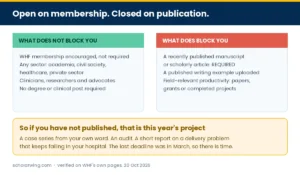
4. A recently published manuscript or scholarly article.
5. Field-relevant productivity, such as peer-reviewed publications, grants or completed projects.
6. WHF member organization membership encouraged, though not required.
Look carefully at points four and five, because together they are the programme’s real filter. WHF is not asking about your potential. It is asking what you have already produced.
And notice point six. After years of reading fellowship rules that hinge on your national society’s membership, this one does not. If you work in cardiovascular health and you publish, your institution’s affiliations will not block you here.
The application file
WHF asks for six things, all in English.
1. The completed online application form.
2. A motivation letter.
3. A one-minute video.
4. A published writing example.
5. A letter of support from your institution, and from your WHF member organization where that applies.
6. A travel support request, where applicable.
The one-minute video deserves its own plan. Sixty seconds is short enough that most people either over-script it or ramble. Decide the single idea you want the panel to remember, say it in the first fifteen seconds, then spend the rest showing the work behind it. Film it in a quiet room with the light in front of you rather than behind. Record it weeks early, watch it once with the sound off, and record it again.
The published writing example is where applications are won or lost, because it is the one item you cannot produce in a hurry. If you have nothing published, that is your project for this year, not a reason to abandon the programme.
What it funds
Here the honest answer is short. WHF’s application includes a “travel support request, where applicable”. No page we read states what that support covers, whether accommodation is included, or whether any seed funding follows the seminar.
So we print no figure. Ask WHF directly at emergingleaders@worldheart.org before you plan a trip to Italy around it, and ask three specific questions: what travel support covers, whether accommodation during the seminar is provided, and whether cohort projects receive any funding afterwards.
A four-day seminar in Florence is not a small cost, and the “where applicable” wording means somebody decides case by case.
Step-by-step application process
Step 1, now: audit your publication record honestly. If you have a recent manuscript or scholarly article, you meet the hardest criterion. If not, go to step 2.
Step 2, now, if you have not published: start. A case series from your own department, an audit, a short report on a local implementation problem. Our guide on writing a research proposal covers framing a question that a journal will take seriously.
Step 3, November: write to emergingleaders@worldheart.org and ask whether the 2027 round is confirmed, what the theme will be, and what travel support covers.
Step 4, December: identify your implementation problem. Not your research interest, the delivery failure you see in your own health system. That is the language this programme speaks.
Step 5, January: ask your institution for the letter of support. Give them the programme’s name and dates rather than a vague request.
Step 6, January: draft the motivation letter, built around what you have delivered and what you intend to deliver, with your own country’s cardiovascular burden at the center.
Step 7, February: film the one-minute video, then refilm it. Treat it as the hardest item, not an afterthought.
Step 8, February: choose the published writing example that best shows field-relevant productivity, which is not always your longest paper.
9, when the window opens: submit early, and include the travel support request if you need it.
Step 10: expect a mid-year decision, based on the 2026 cycle’s end-of-June notification.

Who this suits, and who it does not
It suits a cardiologist, physician, nurse, public health researcher or health policy professional who has published something, leads something, and can name a delivery problem in their own system.
It does not suit someone looking for tuition funding, a clinical fellowship or a degree. There is no degree here, and no clinical training. If that is what you need, our medical and health sciences scholarships page carries degree and fellowship funding instead.
For comparison inside the same field, our posts on the WFSA Fellowship Programme and the World Physiotherapy congress bursaries cover the two other shapes of professional funding: clinical placements and conference travel.
FAQ
What is the Salim Yusuf Emerging Leaders Programme?
A World Heart Federation programme, created in 2014, that trains and connects early and mid-career professionals working in cardiovascular health.
What does it involve?
A four-day in-person seminar with training in cardiovascular health policy and implementation science, workshops, group work and project proposal development.
Where is it held?
The 2026 seminar runs at the Menarini Foundation House of Sciences in Fiesole, Florence, Italy, from 29 November to 3 December 2026.
Is the 2026 round open?
No. It closed on 16 March 2026, with notifications by the end of June 2026.
When will 2027 open?
WHF has not announced it. The 2026 cycle closed in March with a mid-year decision, so prepare on that assumption and check WHF’s page.
Who can apply?
Healthcare professionals, researchers and global health advocates from academia, civil society, healthcare and the private sector, early or mid-career, with training completed.
Do I need to be a member of a WHF organization?
No. WHF encourages it but does not require it.
Do I need a publication?
Yes. WHF requires a recently published manuscript or scholarly article, and the application asks for a published writing example.
What documents are required?
An online form, a motivation letter, a one-minute video, a published writing example, a letter of institutional support, and a travel support request where applicable.
A video? Really?
Yes, one minute. Plan it weeks ahead rather than on the final evening.
Does it pay for travel?
The application includes a travel support request where applicable. WHF publishes no detail on what it covers, so ask directly.
Are there seed grants for projects?
No page we read states any. Ask WHF before assuming.
Who do I contact?