
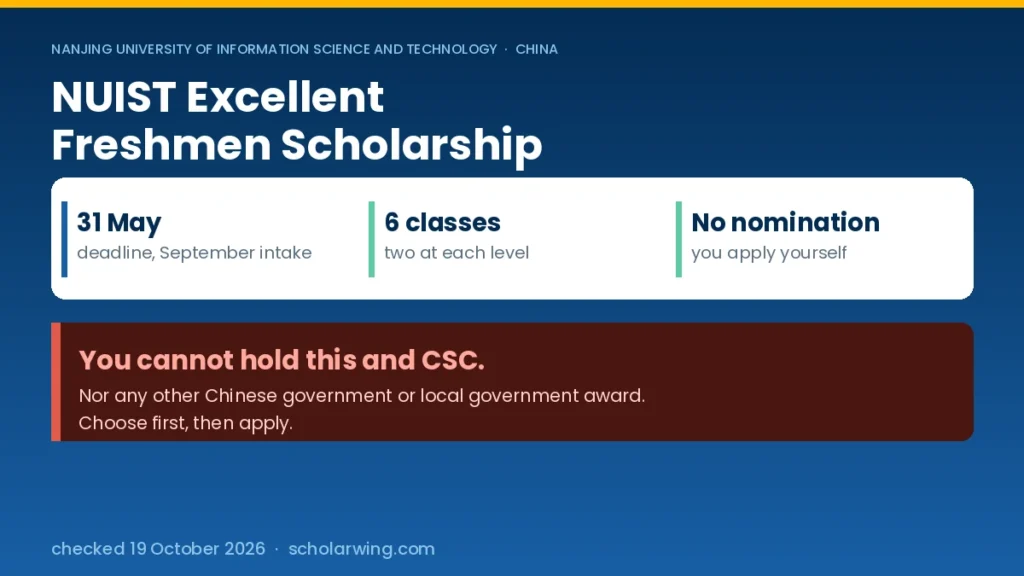
NUIST Excellent Freshmen Scholarship:
In meteorology, the famous money is closed to almost everyone.
The World Meteorological Organization’s fellowships cannot be applied for by an individual. You have to work at a national meteorological service and your country’s Permanent Representative with WMO has to nominate you. In Pakistan that means the Pakistan Meteorological Department, and if you do not work there, every WMO-branded fellowship you find online is shut.
NUIST is the back door into the same world. It is China’s main meteorology university, which is why WMO runs a programme there at all. And its own scholarship asks nobody’s permission: you register an account, you apply, and no nomination appears anywhere in the process.
Deadline 31 May, for a September start.

Six awards, not one
Most listings mention only the top award. There are two classes at each level, and the second class is real money.
| Level | 1st class | 2nd class |
|---|---|---|
| Undergraduate | Tuition | 50% of tuition |
| Master’s | Tuition and accommodation | Tuition |
| Doctoral | Tuition, accommodation and CNY 2,500 a month | Tuition and accommodation |
Read the doctoral row carefully. Second class still covers tuition and accommodation, which is a complete study package minus living money. For a PhD applicant, that turns a rejection from first class into something still worth having.
Note what the top award does not include at master’s level: no monthly stipend. Only the doctoral first class pays one.

What “accommodation covered” is worth
On our earlier check of NUIST’s pages, the university charged CNY 1,500 per academic year for a quad room at undergraduate and master’s level, and CNY 4,000 per academic year for a PhD single room.
So accommodation cover is useful rather than transformative, and the real money in this scheme is the tuition waiver and, for doctoral first class, the CNY 2,500 a month.
The rule that forces a choice
You cannot hold this scholarship together with a Chinese government scholarship, a local government scholarship, or one from another organization.
That ends the common strategy of applying everywhere and choosing later. A reader aiming at China has to decide between NUIST’s own award and the CSC route, and our CSC guide covers how that one works and who it suits.
Our general advice is simple. If your field is meteorology, atmospheric science or the environment, NUIST’s own scholarship puts you at the right university with a simpler application. If you want a wider choice of universities, CSC is the broader instrument.
Who qualifies
1. Non-Chinese citizen, in good health, who complies with Chinese law and NUIST’s rules and meets the admission requirements.
2. Grades: CGPA of 3.0 out of 4.0 or an average of 70 out of 100 in your highest degree.
3. Age limits, and these are firm: under 25 for undergraduate, under 35 for master’s, under 40 for doctoral.
4. Language: HSK 4 (180+) for Chinese-taught undergraduate study, HSK 5 (180+) for Chinese-taught postgraduate study, or TOEFL 80 / IELTS 6.0 for English-taught programmes if you come from a non-English-speaking country.
Note the English route. IELTS 6.0 is a low bar by European standards, and English-taught programmes remove the HSK requirement entirely.

The documents that decide your timeline
Most of the list is ordinary: passport, recent photo, notarized diploma and transcripts, physical examination form valid six months, non-criminal record.
Four items take real time.
A study plan or research proposal. At least 200 words for undergraduate, at least 1,000 words for graduate applicants. A thousand words on a research question is a serious piece of writing, and our personal statement guide covers building the argument.
Two recommendation letters from professors or associate professors, for postgraduate applicants. Our guide on asking a professor for a reference letter covers the brief to give them.
An acceptance letter from a NUIST supervisor, for doctoral applicants. This is the long pole. You have to find a supervisor whose work matches yours, write to them, and persuade them before you apply. Start in December, not April.
A bank statement covering at least dormitory and living costs, in your name or a guardian’s. Scholarship applicants still have to show this, which surprises people.
Three conditions after you win
You cannot change your field of study or your programme length without giving up the scholarship. Extensions come at your own expense.
You must attend NUIST’s annual review, which means the award is renewed on performance rather than granted once.
The scholarship is not held for you if you miss registration. Miss the date and it goes.
Step-by-step application process
Step 1, now: decide between NUIST and CSC, because you cannot hold both.
Step 2, December, if you are applying for a doctorate: write to potential supervisors. Read their recent papers first and write about the work, not about yourself. Without that acceptance letter there is no doctoral application.
Step 3, January: get your diploma and transcripts notarized. Pakistani notarization and attestation take longer than people allow.
Step 4, February: book HSK or IELTS if you hold neither. English-taught programmes need only IELTS 6.0.
Step 5, March: write the study plan. A thousand words, about a question rather than an ambition.
Step 6, April: ask your two referees, and arrange the physical examination form, which stays valid only six months.
7, May: register on the NUIST Online Application System and select the Excellent Freshmen Scholarship programme.
Step 8: submit before 31 May.
If NUIST does not work out, our ICTP Postgraduate Diploma guide covers the other route into this field that needs no nomination, with an Earth System Physics stream and a 15 March deadline.
FAQ
When is the deadline? 31 May, for a September intake.
How many award classes are there?
Six. Two at each of undergraduate, master’s and doctoral level.
Does it pay a monthly stipend?
Only the doctoral first class, at CNY 2,500 a month.
Can I hold this and a CSC scholarship?
No. You cannot hold another Chinese government, local government or organizational scholarship at the same time.
What are the age limits?
Under 25 for undergraduate, under 35 for master’s, under 40 for doctoral.
What grades do I need?
CGPA 3.0 out of 4.0, or an average of 70 out of 100, in your highest degree.
Do I need Chinese?
Only for Chinese-taught programmes. English-taught programmes accept TOEFL 80 or IELTS 6.0.
Do I need a supervisor first?
For doctoral applications, yes. An acceptance letter from a NUIST supervisor is required.
How long should the study plan be?
At least 200 words for undergraduate and at least 1,000 words for graduate applicants.
Do I still need a bank statement with a scholarship?
Yes, covering at least dormitory and living costs.
Can I change my subject after arriving?
No. Changing your field or programme length means giving up the scholarship.
How do I apply?
Through the NUIST Online Application System for International Students, selecting the Excellent Freshmen Scholarship programme.