
Erasmus Mundus FLOODRisk 2027:
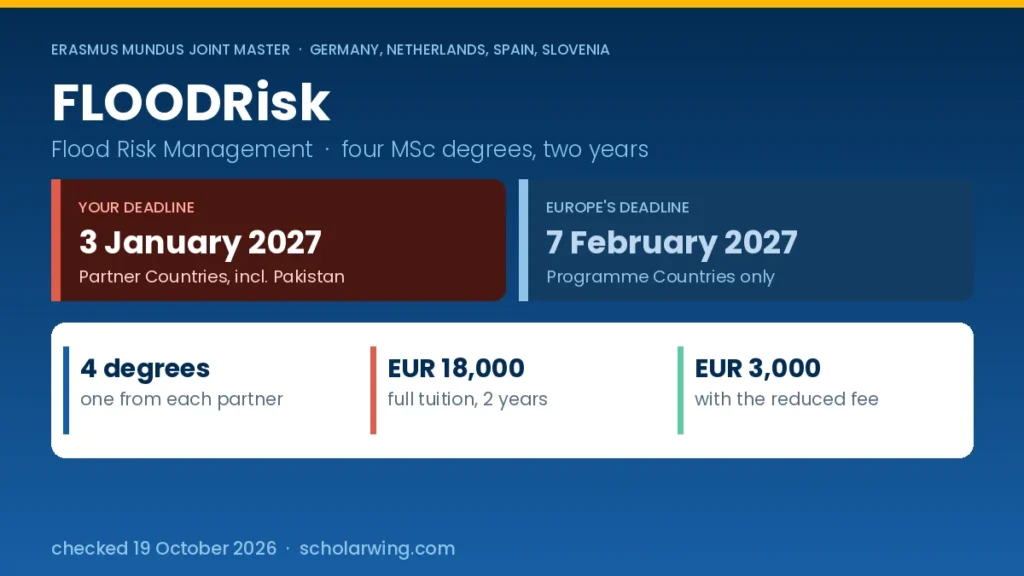
Most Erasmus Mundus programmes hand you one joint degree. FLOODRisk hands you four.
Graduates leave with MSc degrees from IHE Delft, TU Dresden, UPC Barcelona and the University of Ljubljana. Four universities, four countries, two years, one application.
And the same trap that catches Pakistani applicants on every Erasmus Mundus programme sits here too. Your deadline is 3 January 2027. Europe’s is 7 February. Apply in late January and your file goes forward for admission only, with the scholarship already decided without you.
Four semesters, four universities
Semester 1 at TU Dresden, which puts engineering and non-engineering students on common ground, with a fieldtrip to flood-prone areas.
Semester 2 at IHE Delft, inside IHE’s Hydro informatics programme: modelling and decision support systems worked through real cases, plus an international fieldtrip.
3rd Semester at UPC Barcelona and the University of Ljubljana, covering specialized modules such as debris flow and coastal flooding, then moving to Ljubljana for spatial planning and the socio-economic and institutional side of flood risk.
Semester 4 is your thesis, affiliated with one partner, and you may run the research with an industrial partner.
That third semester is the part worth reading twice. Flood risk in Pakistan is rarely a modelling failure; it is a planning, institutions and money failure. A programme that puts spatial planning and institutional frameworks in the curriculum rather than treating them as an afterthought is unusually well matched to what our readers go home to.
Three ways to pay for this
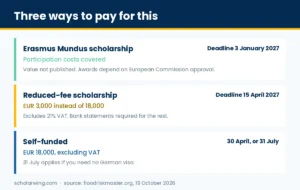
| Route | What you pay | Deadline |
|---|---|---|
| Erasmus Mundus scholarship | Participation costs covered under the Erasmus Mundus model | 3 January 2027 for Pakistan |
| Reduced-fee scholarship | Tuition drops from €18,000 to €3,000, excluding 21% VAT. You cover everything else | 15 April 2027 |
| Self-funded | €18,000 excluding VAT, plus living costs | 30 April 2027, or 31 July if no German visa is needed |
The middle row is the one almost nobody writes about, and it is the one that saves a realistic number of students. A limited number of reduced-fee awards cut the tuition bill by €15,000. You still fund your own living costs, and for that route you must submit bank statements showing you can pay the rest privately by 15 April.
So a reader who misses the January scholarship date still has a route in April. Not a free one, but a real one. Treat 3 January as the target and 15 April as the fallback rather than the other way round.
One honest warning about the scholarship itself
The consortium states that final awards depend on European Commission approval. Neither the number of full scholarships nor their monthly value appears on its pages.
For comparison, GroundwatCH, which shares IHE Delft and TU Dresden as partners, publishes €1,400 a month for the full two years under the same Erasmus Mundus rules. FLOOD Risk publishes no figure of its own, so we print none. Ask the consortium directly before you build a budget on it.
Eligibility criteria
1. A first degree equivalent to a BSc, worth 180 ECTS.
2. A GPA of at least B or B+ on the US system, or a UK upper second.
3. A related subject: civil or environmental engineering, geosciences, environmental sciences, geography, natural resources, or comparable.
4. Sufficient mathematics and water-related subjects. The consortium names no level, so a thin math’s record deserves addressing rather than hiding.
5. An internationally recognized English qualification. FLOOD Risk points to IHE Delft’s own English requirements for the detail.
6. Final-year students may apply with at least 120 ECTS completed, provided the degree arrives by 15 August of the start year.
That last rule is the quiet opportunity. A student in the final year of a BS in civil or environmental engineering can apply this January, and most never try.
The English clause that saves applications
If your English result will not be ready by 3 January 2027, apply anyway. You may upload the result by 1 February 2027, then resubmit the application and email the programme.
Missing the test is recoverable. Missing the application date is not. Our guide on IELTS preparation covers getting a usable band quickly if you are starting from nothing.
Step-by-step application process
Step 1, this week: check your ECTS and your GPA against 180 credits and a B or B+. These two decide everything and take ten minutes to verify.
Step 2, this week: request transcripts and your grading-system explanation. Pakistani universities are slow on the second, and European admissions offices need it to read your marks.
Step 3, late October: book an English test if you hold no valid result. A January sitting still works because of the 1 February window.
Step 4, November: open the online application and work out which documents you lack while there is time to chase them.
Step 5, November and December: write your motivation properly. Build it on a flood you have actually watched, not on a general concern about climate. Our personal statement guide covers turning a lived observation into an argument.
Step 6, December: approach your referees. Our guide on asking a professor for a reference letter covers briefing them well.
Step 7: submit before 3 January, not on it. A 23:59 CET deadline lands in the early hours of 4 January in Pakistan and nobody should be gambling on that.
Step 8, if January passes: prepare the reduced-fee route. That means bank statements proving you can cover the rest, submitted by 15 April.
Our wider Erasmus Mundus scholarships page lists the other joint masters on the same calendar, and several share this early Partner Country date.
FAQ
When is the deadline for Pakistani students? 3 January 2027 at 23:59 CET.
Why do other sites say February?
7 February is the Programme Country deadline, which also covers Albania, Bosnia and Herzegovina, Kosovo and Montenegro. Pakistan is not in that group.
How many degrees do I get?
Four. MSc degrees from IHE Delft, TU Dresden, UPC Barcelona and the University of Ljubljana.
How much is the tuition?
€18,000 excluding VAT, or €3,000 excluding 21% VAT under the reduced-fee scholarship.
What is the full scholarship worth?
The consortium does not publish a figure, and final awards depend on European Commission approval.
What if I miss 3 January?
Your file is considered for admission only. The reduced-fee route stays open until 15 April.
What degree do I need?
A BSc equivalent to 180 ECTS with a B or B+ GPA, in engineering, geosciences, environmental sciences, geography or a related field.
Can I apply in my final year?
Yes, with 120 ECTS completed and the degree in hand by 15 August of the start year.
What if my English result is late?
Apply by 3 January, upload the result by 1 February, then resubmit and email the programme.
Where do I study?
Dresden, then Delft, then Barcelona and Ljubljana, then a thesis with one partner.
How long is it?
Two years, four semesters.