
Erasmus Mundus GroundwatCH 2027:
Two dates sit on this programme’s page. Most Pakistani readers see the wrong one.
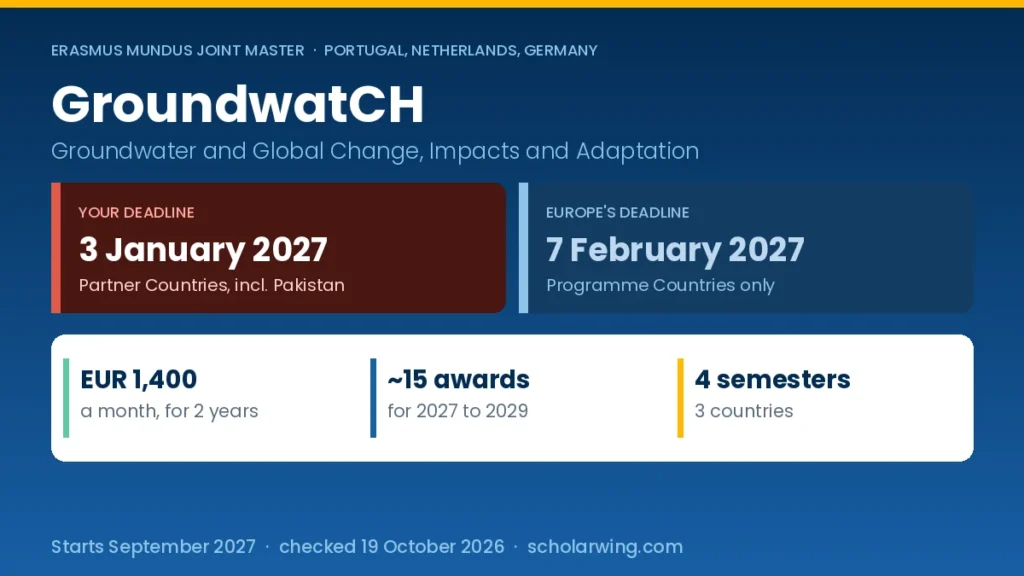
Programme Country applicants, meaning students inside Europe, apply by 7 February 2027. Partner Country applicants, which includes Pakistan, apply by 3 January 2027 at 23:59 CET. Thirty-five days separate the two, and every European blog, newsletter and roundup quotes the February date because that is the one their own readers need.
Apply in late January and your file still gets read. It just gets read for admission only. The Erasmus Mundus scholarship closed on you three weeks earlier.
What the scholarship is worth
| Item | Detail |
|---|---|
| Monthly allowance | €1,400 a month, for the full two years |
| Participation costs | Tuition, library and lab costs, full insurance, other mandatory costs |
| Awards | About 15 a year for the 2027 to 2029 intakes |
| Tuition if you self-fund | €18,000 for two years, excluding VAT, fieldtrips included |
| Health insurance if you self-fund | €1,120 |
| Disability support | A contribution toward individual needs, under the grant agreement’s conditions |
That €1,400 runs for twenty-four months, not ten. Put next to Dresden’s own estimate of €250 to €350 for accommodation and €200 for meals, the allowance covers a normal student life with room to spare in Germany, and covers Lisbon and Delft comfortably rather than luxuriously.
Where you actually study
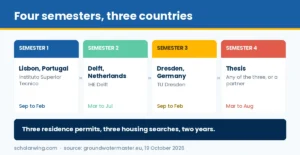
Four semesters, three countries, one degree.
Semester 1 at Instituto Superior Técnico, Lisbon, September to February. Semester 2 at IHE Delft, March to July. And Semester 3 at TU Dresden, September to February. Last Semester 4 is your research thesis, at one of the three universities or an associated partner, March to August.
The next edition starts in September 2027.
Moving countries twice inside two years sounds romantic and costs real time. Three residence permits, three housing searches, three bank accounts. Plan for it rather than discovering it, and our guide on student visa requirements covers the paperwork side.
Eligibility criteria
1. A bachelor’s equivalent to 180 ECTS credits. This is lower than many European master’s programmes demand, and a three or four-year Pakistani bachelor’s generally clears it.
2. A CGPA of at least B or B+ on the US system, or a UK upper second.
3. A relevant subject: geology, hydraulic, civil, environmental or agricultural engineering, geosciences, environmental or climate sciences, geography, or something close to these.
4. Sufficient mathematics. The consortium says so without naming a level, so a weak math’s record is worth addressing in your answers rather than hoping nobody looks.
5. An internationally recognized English test, unless your country sits on the exemption list.
6. Final-year students may apply with at least 120 ECTS completed, a university statement giving your expected graduation date, and your transcript. You must graduate before 15 August of the start year.
That sixth rule matters more than it reads. A student in the last year of a BS can apply this January, and most assume they cannot.
What you submit
Certified copies of your diplomas, translated into English by a sworn translator if they are not already. Certified transcripts showing grades, your average mark and an explanation of the grading system. A CV covering work and research. Answers to five motivation questions, each with its own character limit. Two recommendation letters dated within the last six months, from two university teachers, or one teacher and one employer, or internationally recognized scientists.
Every file goes in as a PDF of no more than 2 MB.
Two details deserve your attention. The letters must be dated within six months, so a glowing letter from 2024 is dead paper, and our guide on asking a professor for a reference letter covers requesting a fresh one. And the grading-system explanation trips up Pakistani applicants constantly, because HEC transcripts rarely carry one and your university has to issue it.
Write the five answers yourself
The consortium states that it wants your own words and that AI-generated text will lose points.
Take that at face value. Five questions with character limits are not an essay competition; they are a test of whether you can say something specific about groundwater in short form. Write about the well that ran dry in your district, the salinity in your family’s land, the aquifer data you could not find. Our personal statement guide covers building that into an argument, and the method is the same here in miniature.
Six dates, and only one of them funds you
| Date | What it is |
|---|---|
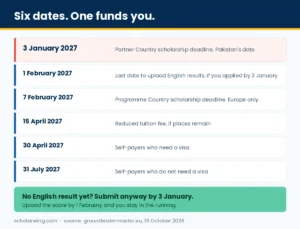
| 3 January 2027, 23:59 CET | Partner Country scholarship deadline. This is Pakistan’s date. |
| 1 February 2027 | Last date to upload English results, if you applied by 3 January |
| 7 February 2027 | Programme Country scholarship deadline, for European applicants |
| 15 April 2027 | Application and financial confirmation for a reduced tuition fee, if places remain |
| 30 April 2027 | Self-payers who need a visa |
| 31 July 2027 | Self-payers who do not need a visa |
The English clause is the useful one. If your IELTS or TOEFL result will not arrive by 3 January, submit the rest of the application anyway and upload the result by 1 February. The consortium states that applicants who submitted before 3 January remain in scholarship consideration. Missing the test is survivable. Missing the application is not.
Step-by-step application process
Step 1, this week: request your transcripts and the grading-system explanation. Pakistani universities take weeks over the second one and it is a required document.
Step 2, this week: ask both referees. The letters must be dated within six months, so a letter requested today is valid through the deadline comfortably.
Step 3, late October: book the English test if you have no valid result. Even a January sitting works, because of the 1 February upload window.
Step 4, November: arrange the sworn translation of any diploma not already in English.
Step 5, November and December: write the five answers. Your own words, inside the character limits, about groundwater problems you have actually seen.
Step 6, December: compress every PDF under 2 MB and check each one opens. A 3 MB transcript scan is a real reason applications fail.
Step 7: submit before 3 January, not on it. A European deadline at 23:59 CET falls in the early hours of 4 January in Pakistan, and nobody should be testing that at the last minute.
Step 8, if you are in your final year: attach the university statement with your expected graduation date and confirm you will graduate before 15 August 2027.
Our wider Erasmus Mundus scholarships page covers the other joint masters with the same funding model, several of which also run Partner Country deadlines ahead of European ones.
FAQ
When is the deadline for Pakistani students? 3 January 2027 at 23:59 CET, as a Partner Country applicant.
Why do other sites say February? 7 February is the Programme Country deadline, for applicants inside Europe. It does not apply to Pakistan.
How much is the scholarship?
€1,400 a month for the full two years, plus tuition, library and lab costs and full insurance.
How many scholarships are there?
About 15 a year for the 2027 to 2029 intakes.
What if I apply late?
Your file is considered for admission only, not for the Erasmus Mundus scholarship.
What does it cost without a scholarship?
€18,000 for two years excluding VAT, with fieldtrips included, plus €1,120 health insurance.
What degree do I need?
A bachelor’s equivalent to 180 ECTS with a CGPA of B or B+, in geology, engineering, geosciences, environmental or climate sciences, geography or similar.
Can I apply in my final year?
Yes, with 120 ECTS completed, a university statement and your transcript. You must graduate before 15 August of the start year.
What if my English result is not ready?
Submit by 3 January and upload the result by 1 February 2027.
Where do I study?
Lisbon, then Delft, then Dresden, then a thesis at one of the three or an associated partner.
When does it start?
September 2027.
Can I use AI to write the motivation answers?
The consortium states that AI-generated text will lose points. Write them yourself.