
NF-POGO 2027:
Every other ocean programme we cover puts somebody between you and the application.
WMU Sasakawa needs your employer to file the form. The UN-Nippon Foundation Fellowship only takes serving government officials. NF-IMLI needs your government to nominate you.
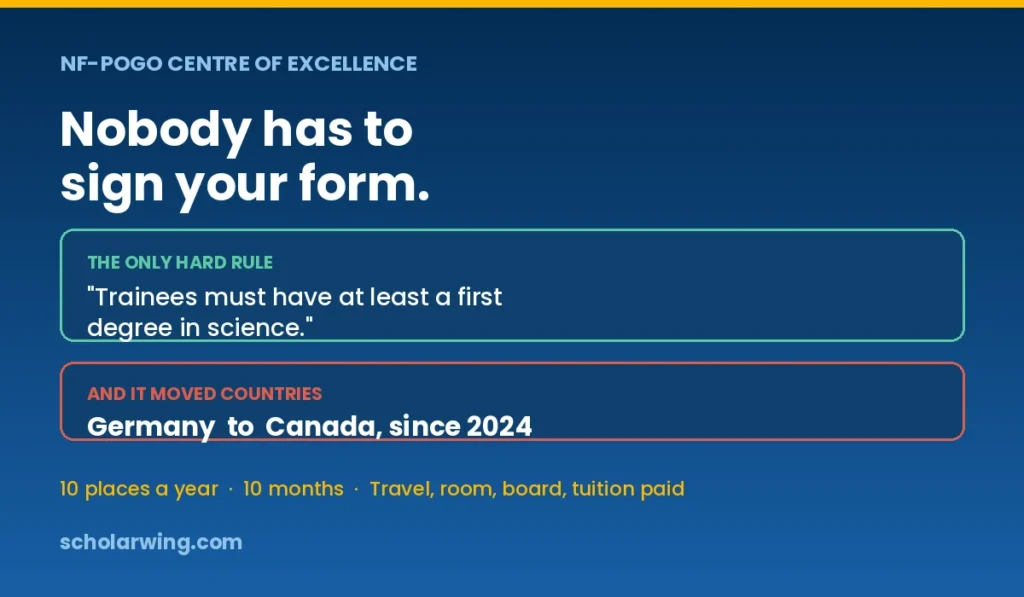
NF-POGO needs none of that. You apply yourself, with a science degree, and that is the whole gate.
First, the thing most articles get
This programme has moved twice. It ran in Bermuda, then at the Alfred Wegener Institute on Helgoland in Germany, where the tenth cohort ran from May 2023 to April 2024.
Phase IV now runs in Canada, hosted by the Ocean Frontier Institute. Scholars sit at the Fisheries and Marine Institute of Memorial University in St. John’s, Newfoundland and Labrador, and at Dalhousie University in Halifax, Nova Scotia, with a trip to the Hakai Institute on Quadra Island in British Columbia. Dalhousie’s Faculty of Open Learning and Career Development, the Marine Institute, the Hakai Institute and the International Ocean Institute-Canada all sit in the partnership.
If an article tells you to apply to Germany, it is reading from a page that stopped being true in 2024.
What it is, honestly
A ten-month postgraduate training programme in observational oceanography, taking ten students a year from across the world. It awards training, not a degree, and your promotion board will treat a certificate differently from a master’s. Say that to yourself before you commit ten months.
What you get instead is time at sea and on instruments, which no master’s in Pakistan can give you. The course covers oceanography, field training, data management, modelling and coding, science communication, ocean governance, innovation and entrepreneurship, leadership, and English proficiency development.
That last item deserves a line of its own. The programme develops your English as part of the course. Very few funded programmes anywhere say that out loud, and it changes who should feel welcome to apply.
What it covers
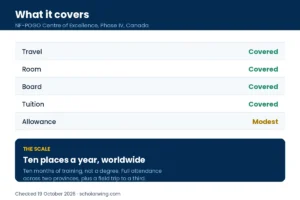
| Item | Covered |
|---|---|
| Travel | Yes |
| Room | Yes |
| Board | Yes |
| Tuition | Yes |
| Allowance | A modest one |
Scholarships come from NF-POGO through the Centre of Excellence. You attend the entire programme, with no partial attendance.
Eligibility criteria
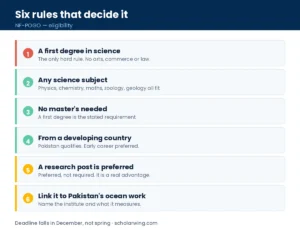
1. At least a first degree in science. POGO’s own words: “Trainees must have at least a first degree in science.” This is the only hard requirement, and it is lower than almost anything else in this field, where a master’s or a government post usually comes first.
2. No particular subject. Marine biology helps and nobody demands it. Physics, chemistry, mathematics, environmental science, geology, zoology and computer science all fit. Preference goes to candidates “with a leaning towards quantitative analyses” of marine biological, physical or chemical data, so your comfort with numbers matters more than the name on your degree.
3. From an emerging or developing country. Pakistan qualifies.
4. Early career. Priority goes to “young researchers near the outset of their careers”. No age limit appears anywhere.
5. Preferably already in a research or academic institution, planning to return home afterwards. A preference, not a bar. A science graduate without a post may still apply, and should understand that he is competing against people who have one.
6. Relevance to your own country’s ocean work. Candidates must show that the training relates to ongoing or planned ocean observations at home. For Pakistan that means naming something real: the National Institute of Oceanography, Karachi’s coastal monitoring, fisheries stock assessment, mangrove and delta work in the Indus system, or sea level and cyclone observation along the Makran and Sindh coasts.
The deadline nobody expects
| Cycle | Deadline | Start |
|---|---|---|
| 2026-27 | 12 December 2025 | September 2026 |
| 2027-28 | Expect December 2026 | Expect September 2027 |
December is the surprise. Most scholarship readers hunt in spring, when this one has already closed for the year. Watch ofi.ca/programs/centre/apply from early November, because the window and the announcement sit close together.
Step-by-step application process
Step 1, this week: check the application page. The last call closed on 12 December. If the next one is open, everything below becomes urgent rather than theoretical.
Step 2: write down your country link before anything else. Which Pakistani ocean observation does your training serve? Find the institute, find what it measures, and if you can, speak to someone there. This is the part most applications are thin on and the part POGO explicitly asks for.
Step 3: show your quantitative side. Any work with data, statistics, coding, modelling or instrumentation belongs at the front of your application, whatever your degree is called. A zoology graduate who has handled datasets is a stronger fit than a marine biology graduate who has not.
Step 4: get a position if you can. A role at a university department or research institute moves you from “may apply” into the preferred group. Even an unpaid research assistantship changes how your file reads.
Step 5: write the motivation around returning home. POGO funds people who go back and build ocean observation where it is thin. Our personal statement guide covers the structure, and the specific thing POGO wants is a plan for the ten months after you land back in Karachi, not just the ten months in Canada.
Step 6: apply directly. No employer letter, no ministry, no nomination. This is the rare one you can do alone, at your own pace, tonight.
Step 7: clear ten months. Full attendance, in Canada, across two provinces and a field trip to a third. Make sure the time genuinely exists before you accept.
Where this sits among the other ocean routes
Use this as the entry point to the field. NF-POGO takes you with a science degree and no job title. Once you have the training and a research post, WMU Sasakawa and the UN-Nippon Foundation Fellowship open up, and both pay for a longer and more senior stage of a career. The full list sits on our maritime and ocean science page.
FAQ
Do I need a science degree?
Yes. POGO states that trainees must have at least a first degree in science. Commerce, arts and law degrees do not qualify.
Does it have to be marine biology?
No. No specific subject appears anywhere. Preference goes to candidates with a leaning towards quantitative analysis of marine data.
Do I need a master’s?
No. A first degree is the stated requirement.
Do I need a job?
No, though preference goes to applicants already holding a position in a research or academic institution who plan to return home.
Does my employer or government have to apply for me?
No. You apply yourself. This is the only ocean programme in our maritime list with no employer or nomination requirement.
Is Pakistan eligible?
Yes. Priority goes to young researchers from emerging and developing countries.
Do I get a degree?
No. It is a ten-month postgraduate training programme, not a master’s.
Where is it held?
In Canada. Memorial University’s Marine Institute in St. John’s and Dalhousie University in Halifax, with a trip to the Hakai Institute in British Columbia.
What does it pay for?
Travel, room, board, tuition and a modest allowance.
How many places are there?
Ten a year, worldwide.
When is the deadline?
The last cycle closed on 12 December 2025. Expect a December date for the next one and check from early November.
My English is weak. Should I still apply?
The course includes English proficiency development as part of its own curriculum, which tells you how the programme thinks about this.