
UN Ocean Fellowship 2028:
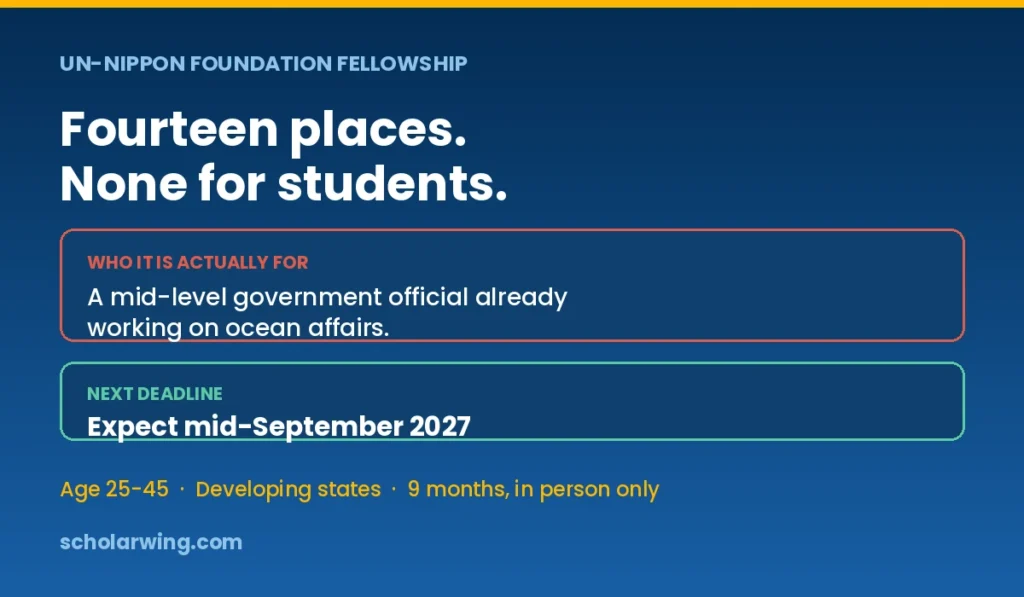
Fourteen. That is how many of these the United Nations awards in a year, for the whole world.
The UN-Nippon Foundation Fellowship on Ocean Affairs and the Law of the Sea takes a serving official out of his ministry for nine months, puts him inside UN Headquarters in New York for three of them, and sends him to a university for the other six to write real research. The Nippon Foundation pays. The UN Office of Legal Affairs runs it.
It is also not a scholarship, and a student cannot have it. Read the next section before you read anything else.
Who is this is actually for
The call asks for a mid-level government official or professional who deals directly with ocean affairs or the law of the sea. In Pakistan that means somebody already inside the Ministry of Maritime Affairs, the Maritime Security Agency, a port authority, a fisheries department, the Navy’s legal side, or a research institution working on ocean policy.
It does not mean a law graduate who finds the ocean interesting. A first university degree is the floor, not the qualification. What gets you considered is the job you hold today.
If you are a student rather than an official, two other maritime routes on this site suit you better: our NF-IMLI guide covers an actual law degree in Malta, where half the places are held for women, and our WMU Sasakawa guide covers a maritime MSc in Sweden. Both sit on the maritime and ocean science page with the rest of the field.
The nine months, phase by phase
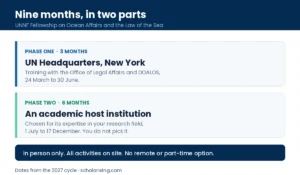
The programme runs as one continuous nine-month block in two parts.
| Phase | Where | When, 2027 cycle | What happens |
|---|---|---|---|
| Phase One | UN Headquarters, New York, with OLA and DOALOS | 24 March to 30 June | Three months of training inside the division that runs the law of the sea for the United Nations |
| Phase Two | An academic host institution | 1 July to 17 December | Six months of research, at an institution chosen for its expertise in your research field |
Two details matter more than they look.
It is in person only. Participants attend all activities on site. There is no remote option and no part-time version. You need nine months of leave from your department, cleared before you apply, not after you are selected.
The UN matches the host institution to your research. You do not choose it. The UN names no fixed university list publicly. Each host is an academic institution participating in the UNNF Programmes, picked for its expertise in your field. So your research proposal decides where you spend half the fellowship.
Eligibility criteria
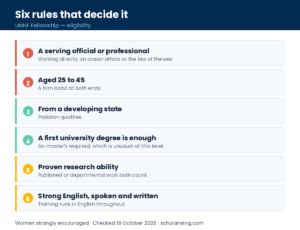
1. Aged 25 to 45. A firm band at both ends.
2. At least a first university degree or equivalent. No master’s requirement, which is unusual at this level and makes the job history count for more.
3. From a developing State. Pakistan qualifies.
4. A mid-level government official or professional working directly on ocean affairs or the law of the sea.
5. Demonstrated ability to undertake advanced academic research and studies. Previous research, published or departmental, is what shows this.
6. A strong command of spoken and written English. Training runs in English. French and Spanish materials may be available on request, which does not change the requirement.
Women are explicitly wanted here
The call states that the Programmes aim for gender balance and geographical diversity, and that female applicants are strongly encouraged to apply.
That is worth more than encouragement in a field like this one. A woman working in Pakistan’s maritime sector is competing in a pool the UN has said out loud it wants to balance, and there are very few women in that sector to compete with. If your department is choosing who to support, this sentence belongs in the conversation.
Dates, and what they mean for you
| Cycle | Deadline | Results |
|---|---|---|
| 2026 | 14 September 2025 | — |
| 2027 | 13 September 2026 | Awardees and reserves posted by mid-December 2026 |
| 2028 | Expect mid-September 2027 | Expect mid-December 2027 |
The pattern is stable: applications close in the second week of September, and the list goes up about three months later. Fourteen places for 2027, fourteen for 2026.
Work backwards from September and the real schedule looks like this. Start the leave conversation with your department in January. Have your research question settled by May. Build the application in July and August. Submit in the first week of September, not the second.
Step-by-step application process
Step 1, January: get leave agreed in principle. Nine continuous months, in person, abroad. No head of department agrees to that in a week, and no application survives without it.
Step 2, February to April: pick your research question. It has to serve your department and it has to be answerable in six months. Pakistan has real material here: maritime boundary matters, port state control, illegal fishing, marine pollution enforcement, seafarer welfare, and the implementation gaps in conventions the country has signed.
Step 3, May: write the proposal properly. This single document decides your selection and which university hosts you. Our personal statement guide covers the thinking, though a research proposal is a different task: a question, a method, a reason the UN should care, and a use for the answer once you are home.
Step 4: assemble evidence of research ability. Anything you have written that carries your name, including internal departmental work.
Step 5: check the application platform. The 2027 round used Indico.UN and refused emailed applications and documents. Confirm the platform for your cycle rather than assuming, since it changed once already.
Step 6: submit complete, and early. Late or incomplete applications are not considered. Incomplete is the one that catches people, because a missing upload counts.
Step 7: expect the list in mid-December, with awardees and reserves posted together. A reserve place is not a rejection.
FAQ
Can a student apply?
No. The fellowship is for mid-level government officials and professionals already working on ocean affairs or the law of the sea.
Do I need a master’s degree?
No. At least a first university degree or equivalent.
What are the age limits?
25 to 45.
Is Pakistan eligible?
Yes. The fellowship is open to candidates from developing States.
How many fellowships are there?
Fourteen for the 2027 cycle, and fourteen for 2026.
Can I do it remotely or part-time?
No. The programme runs in person and participants attend all activities on site.
Where will I do the research phase?
At an academic host institution participating in the UNNF Programmes, chosen for its expertise in your research field. The UN does not publish a fixed list.
How much does it pay?
The call describes it as funded advanced training and points to the fellowship website for conditions and financial support. We have not been able to confirm the amounts, so we print none.
When is the next deadline?
The 2027 round closed on 13 September 2026. Expect mid-September 2027 for the following cycle.
Does being a woman help?
The UN states that the Programmes aim for gender balance and that female applicants are strongly encouraged to apply.