
NF-IMLI Scholarship 2027:
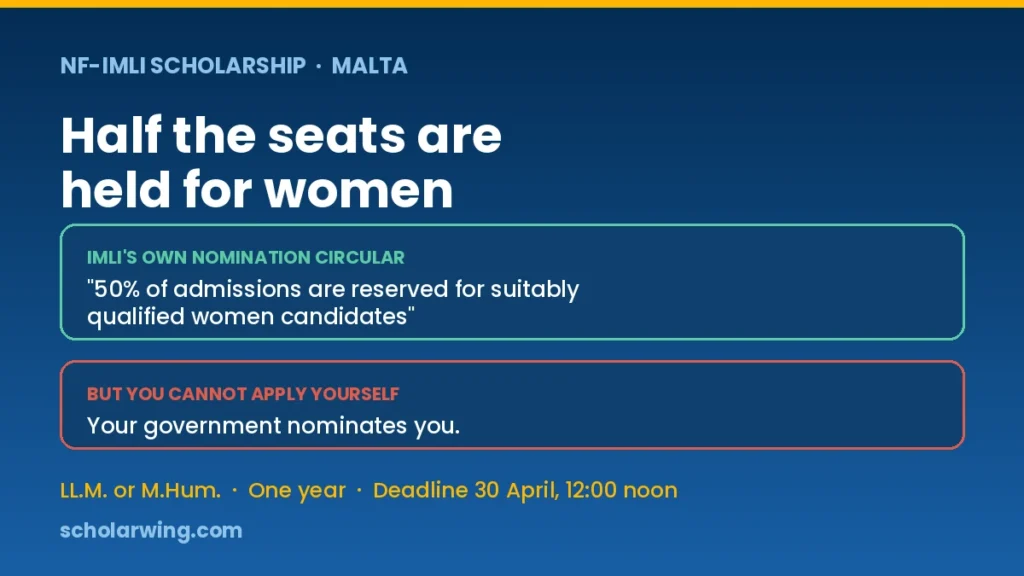
IMLI’s own nomination circuNF-IMLI Scholarship lar contains a sentence that almost no Pakistani applicant has read: “50% of admissions are reserved for suitably qualified women candidates.”
Half the seats at the International Maritime Organization’s law institute, held open, every year. In a country where maritime law has very few women in it, that line is not a footnote. It is the single strongest argument a woman lawyer in Karachi can put in front of the ministry that decides who gets nominated.
Which brings us to the harder half of this guide. You do not apply to IMLI the way you apply to a university. Your government nominates you. Everything else follows from that nominates you. Everything else follows from that.
What IMLI is
The IMO International Maritime Law Institute sits in Malta and the International Maritime Organization established it. It runs two one-year programmes, October to June or July:
| Programme | Who it takes |
|---|---|
| LL.M. in International Maritime Law | “open exclusively to graduates in law” |
| M.Hum. in International Maritime Legislation | candidates holding “a degree in any other discipline related to international maritime law” |
That split matters. A shipping officer, a port administrator or a policy graduate who wants IMLI does not fail, he simply applies to the M.Hum. instead of the LL.M. Most listicles mention only the LL.M. and send non-lawyers away.
The Nippon Foundation funds the scholarship side, and its own page says the NF-IMLI scholarship goes to up to 15 candidates a year, with a focus on developing countries.
How the nomination works, and why it decides everything
Read these four rules together, because they describe one process.
Your government nominates you, using IMLI’s nomination form from the application package. There is no route where a private individual sends a file to Malta and waits.
IMLI limits admissions per country. If your country nominates two or more candidates, the nominating authority must put them in a priority order. So your own ministry ranks you against other Pakistanis before anyone in Malta reads your name.
Academic clearance comes first, money second. The circular is explicit about the sequence: the Institute clears a candidate academically first, and only then approaches donors. Winning a place does not mean winning a fellowship.
Even a fellowship may not cover everything. Where IMLI awards one, the nominating authority remains responsible for “the additional funding component”. Your ministry needs to know that before it signs anything.
What it costs and how the money actually works
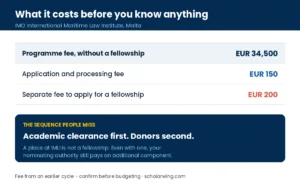
| Item | Amount |
|---|---|
| Programme fee, paid by the nominating authority without a fellowship | €34,500 |
| Application and processing fee, non-refundable | €150 |
| Separate fee to apply for a fellowship | €200 |
Two things about that table surprise people.
The €200 fellowship fee sits on top of the €150 processing fee, and it buys an application, not an award. Budget €350 before you know anything.
The €34,500 comes from IMLI’s nomination circular for an earlier cycle and the current call does not restate it. Confirm the figure for your year before you take it to anyone who controls a budget.
Fellowships are “strictly personal, non-transferable” and you must use one in the academic year awarded. You cannot win one and de
Eligibility criteria
The right degree for the right programme. The LL.M. takes law graduates only. The M.Hum. takes a degree in another discipline related to international maritime law.
2. A government nomination. Nominated through the nomination form in the application package, with a priority order where a country sends more than one name.
3. English proficiency. Applicants “must therefore be proficient in the English language” and meet the Institute’s own language requirements, set out in the application annex.
4. Computer competence, with proof submitted.
5. A medical report. Completed and stamped by a registered Government medical practitioner. Not a private clinic letter.
6. Two references. From people unrelated to you who can confirm your ability to undertake the programme.
No work experience requirement appears anywhere in the circular. It asks only for “suitably qualified” candidates, which makes IMLI unusually open to a recent law graduate compared with most maritime funding unusually open to a recent law graduate compared with most maritime funding with most maritime funding compared with mo maritime funding with most funding. 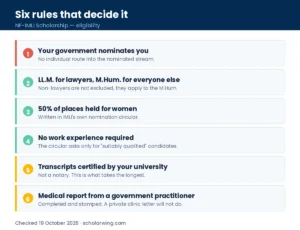
The documents, in the order they will delay you
From the current call, an application carries: the completed and signed form with a recent photograph, certified copies of university qualifications officially certified by the issuing university, evidence of English proficiency, proof of computer competence, the government medical report, a motivation form giving your reasons for applying and your career objectives, and the two references.
The certification line is the one that costs weeks. IMLI wants your transcripts certified by the university that issued them, not attested by a notary or a lawyer. Start that process the week you decide to apply, because Pakistani universities rarely do it quickly.
Deadline
30 April, at 12:00 noon. The 2026-2027 call set it as Thursday 30 April 2026 at noon and added that “no late submissions will be accepted.”
Work backwards from that. Your government’s internal nomination process closes before IMLI’s date, not on it, so the real conversation with the ministry starts in January or February.
Step-by-step application process
Step 1, now: identify who nominates. In Pakistan the route runs through the federal ministry handling maritime affairs. Ask who holds the IMLI nomination file, whether Pakistan nominated anyone last cycle, and what the internal deadline is. Everything else waits on this answer.
Step 2: pick your programme honestly. LL.M. if you hold a law degree. M.Hum. if you do not. Applying to the wrong one wastes a nomination the country may only use once.
Step 3, if you are a woman: put the 50% rule in writing. Quote IMLI’s circular to the ministry. A nominating authority choosing between two candidates has a documented reason to send you, and most officials do not know the provision exists.
Step 4: start the transcript certification immediately. Your issuing university has to certify the copies. This is the long pole.
Step 5: book the government medical report. A registered government practitioner has to complete and stamp it.
Step 6: write the motivation form around Pakistan’s maritime problems. IMLI exists to build maritime legal capacity in states that lack it. Name the gap, whether that is port state control, flag state implementation, marine pollution enforcement or seafarer welfare, and name what you will do with the training at home.
Step 7: submit the fellowship application and pay the €200 separately. The fellowship is its own application. Nobody considers you for money automatically.
Step 8: get everything in well before 30 April at noon. No late submissions, stated plainly.
If IMLI does not fit
If no nomination is available to you, WMU Sasakawa in Sweden funds a maritime MSc with 30 awards a year, although it needs your employer to apply. The UN-Nippon Foundation Fellowship on Ocean Affairs and the Law of the Sea takes mid-level officials aged 25 to 45 from developing states for nine months between New York and a host institution, and closes in September.
FAQ
Can I apply directly to IMLI?
No. Your government nominates you using IMLI’s nomination form. There is no individual route into the nominated stream.
Is the 50% women provision real?
Yes. IMLI’s nomination circular states that “50% of admissions are reserved for suitably qualified women candidates”.
I am not a law graduate. Is IMLI closed to me?
No. The LL.M. takes law graduates exclusively, but the M.Hum. in International Maritime Legislation takes a degree in another discipline related to international maritime law.
Do I need work experience?
The circular sets none. It asks for “suitably qualified” candidates, which makes this friendlier to recent graduates than most maritime funding.
If IMLI accepts me, do I have the money?
Not yet. Academic clearance comes first, and the Institute then seeks donors. The two decisions are separate.
What if I get a fellowship, is everything paid?
Not necessarily. Where IMLI awards one, the nominating authority stays responsible for “the additional funding component”.
What does it cost without a fellowship?
IMLI’s circular puts the programme fee at €34,500, paid by the nominating authority. Confirm the current figure, since the latest call does not restate it.
Can I defer a fellowship to next year?
No. Fellowships stay strictly personal and non-transferable, and you must use one in the academic year awarded.
How many NF-IMLI scholarships exist?
The Nippon Foundation’s page says the NF-IMLI scholarship supports up to 15 candidates a year, with a developing-country focus.