
WMU Sasakawa Fellowship 2027
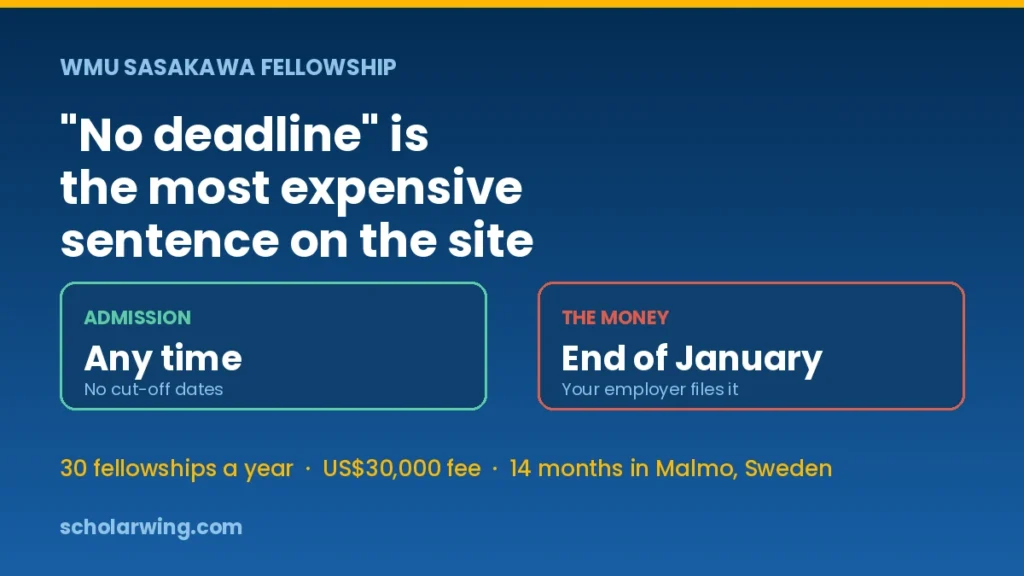
One sentence on WMU’s website costs people this fellowship every year: “Applications can be submitted at any time; there are no cut-off dates.”
That sentence is true, and it is about admission. The money works nothing like it. The Sasakawa Fellowship needs two extra documents in by the end of January in the year you want to start, and one of them your employer has to write. A reader who takes the no-deadline line at face value, applies in March, and gets admitted will then discover he has a place at the world’s leading maritime university and a bill for thirty thousand dollars.
So read this guide backwards from January, not forwards from the application form.
What WMU actually is
The World Maritime University sits in Malmö, Sweden, and the International Maritime Organization set it up. It is not a normal university with a maritime department. Its students are already working in the industry, which shapes every rule below.
The MSc in Maritime Affairs runs 14 months across three terms. Anyone who already holds a relevant postgraduate qualification can take an accelerated route of 10 months instead. The Class of 2027 begins on 21 September 2026, and term three ends on 29 October 2027.
You pick one of seven specializations:
| Specialization |
|---|
| Maritime Education & Training |
| Maritime Energy Management |
| Maritime Law & Policy |
| Maritime Safety & Environmental Administration |
| Ocean Sustainability, Governance & Management |
| Port Management |
| Shipping Management & Logistics |
The degree is a Master of Science, and you must pass every subject to receive it. There is no partial pass.
What it costs and what the fellowship covers
Print these numbers before you decide anything, because they explain why the fellowship matters so much.
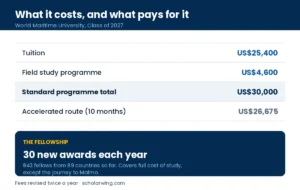
| Item | Class of 2027 |
|---|---|
| Tuition | US$25,400 |
| Field study programme | US$4,600 |
| Standard programme total | US$30,000 |
| Accelerated programme total | US$26,675 |
WMU revises fees twice a year, so confirm yours before you budget.
The Nippon Foundation funds the Sasakawa Fellowship, and WMU’s own record says it provides 30 new awards each year. Across its history the programme has funded 843 fellows from 89 countries. WMU states that the majority of its fellowships “cover the full costs of studying at the University (except the journey to Malmö)”, while some donors cover only the tuition fee, so ask which kind you have been offered.
The fellowship also brings things that are not money and matter later:
- A week-long field study in Japan
- Regional Network Meetings, which the Sasakawa Peace Foundation has organized since 2001
- Access to the WMU-Sasakawa Global Ocean Institute and its six Professorial Chairs
- A standing network of maritime professionals across 89 countries
Eligibility criteria
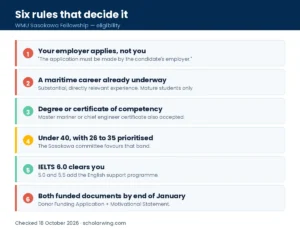
1. A maritime career already underway. WMU asks for “substantial, directly relevant professional experience” and admits only mature students already established in a maritime career. A fresh graduate with a shipping internship does not qualify. This is the rule that decides most cases.
2. The right qualification. Either a relevant bachelor’s degree or equivalent, or the highest-grade master mariner or chief engineer certificate or an equivalent maritime qualification. That second route matters in Pakistan, where many strong candidates hold a certificate of competency rather than a degree.
3. Your employer files the application. WMU puts it plainly: “The application must be made by the candidate’s employer.” The Sasakawa route needs a Donor Funding Application from your organization. Some countries also require a central agency endorsement through a covering letter or countersignature.
4. Age. WMU usually restricts awards to applicants under 40, and the Sasakawa committee prioritizes applicants aged 26 to 35.
5. English. An internationally recognized test. At IELTS 6.0 or above you need no English support programme. Bands 5.0 and 5.5 place you in the English for Special and Specific Purposes programme alongside your studies.
6. Computer competence. At least the ability to work in Microsoft Office.
Two further points apply to Sasakawa specifically. A limited number of awards go to government employees from developing countries, and the committee looks for strong academic and professional records together. Some donors also priorities particular regions, specializations or female applicants, so your profile may fit one donor and not another.
The two deadlines, stated plainly
This is the heart of the guide.
| What | When |
|---|---|
| WMU admission application | Any time. No cut-off dates. |
| Donor Funding Application, from your organization | End of January in the year of entry |
| Sasakawa Fellowship Motivational Statement | End of January in the year of entry |
WMU adds that donors begin allocating fellowships very early each year and continue over several months, and asks candidates to “apply as early as possible to maximize their chances”. So an application in October outranks a better one in May, because by May the money has already moved.
Asian candidates applying for Sasakawa must complete the Motivation Statement. Treat that as the main document of your whole application, not a formality.
Step-by-step application process
Step 1, now: talk to your employer. The funding application is theirs to submit, not yours. Find out who signs it, tell them what you want to study and how it serves the organization, and get a yes in principle before you write a word. If your employer will not file it, this fellowship shuts you out, and you should learn that in week one rather than in February.
Step 2: check whether a central agency endorsement applies. Some countries require a covering letter or countersignature from a central body on top of the employer’s application. Ask WMU directly which applies to Pakistan, because nobody will tell you later.
Step 3: pick one specialization and one reason. Seven choices look generous until a panel reads a statement that wants three of them. Pick the one your current job touches and your organization’s gap sits in.
Step 4: sit the English test early. Aim for IELTS 6.0 so you avoid the support programme. A 5.5 does not end your application, which is unusual and worth knowing, but it adds work during a 14-month degree.
Step 5: submit the admission application as early as you can. It has no deadline, which is exactly why you send it in September or October rather than January. Admission first, money second.
Step 6: write the Motivational Statement around your organization, not yourself. The Nippon Foundation funds people who will go back and change something. Name the port, the authority, the training institute or the fleet, name what is wrong with it, and name what you will do differently with this degree.
Step 7: get both funded documents in before the end of January. Your employer’s Donor Funding Application and your Motivational Statement. Confirm receipt rather than assuming it.
Step 8: do not contact the donors. WMU forwards eligible files to donors itself and asks applicants not to approach them directly. Write to WMU instead.
What to do if you have no maritime employer
Say it honestly to yourself early. WMU and Sasakawa exist for serving professionals, and the employer rule does not bend. Two other routes on this list suit someone outside that system better. NF-IMLI in Malta awards a postgraduate qualification in international maritime law and takes up to 15 a year with a developing-country focus. The UN-Nippon Foundation Fellowship on Ocean Affairs takes mid-level officials aged 25 to 45 from developing states, closes in September, and runs nine months between New York and a host institution.
FAQ
Can I apply without my employer?
No. WMU states the application must be made by the candidate’s employer, and the Sasakawa route needs a Donor Funding Application from your organization. There is no individual route.
Is there really no admission deadline?
Correct, for admission. WMU accepts applications at any time. The funding documents close at the end of January, and donors allocate from early in the year, so the practical deadline is much earlier than the stated one.
I hold a master mariner certificate, not a degree. Can I apply?
Yes. WMU accepts the highest-grade master mariner or chief engineer certificate, or an equivalent maritime qualification, in place of a bachelor’s degree.
I am 38. Am I too old?
Not automatically. WMU usually restricts awards to applicants under 40, and the Sasakawa committee prioritizes 26 to 35. At 38 you are eligible and competing against a prioritized band, so your employer’s backing and your statement have to carry more weight.
How many fellowships are there?
WMU’s own record says The Nippon Foundation provides 30 new awards each year. The Nippon Foundation’s page says up to 35. Plan on 30.
Does the fellowship pay for my flight to Sweden?
WMU says the majority of its fellowships cover the full cost of studying “except the journey to Malmö”. Budget the airfare yourself and confirm your specific award in writing.
Do I get a degree or a certificate?
A Master of Science in Maritime Affairs. You must pass every subject to receive it.
Can I bring my family?
WMU’s financial support page does not address dependents. Ask before you plan, because a 14-month programme makes this a real question.
Is IELTS 5.5 enough?
It gets you in, with the English for Special and Specific Purposes programme attached. Aim for 6.0 so your 14 months go on your specialization instead.