
Marshall Scholarship
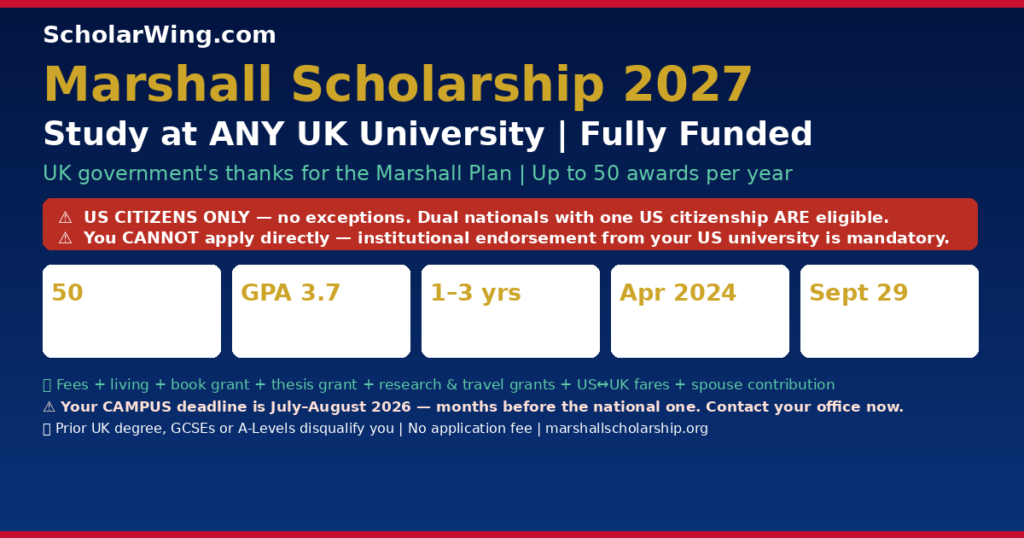
⚠️ Read This First: The Marshall Scholarship Is for US Citizens Only
Before anything else, the eligibility boundary that determines whether the rest of this guide applies to you:
Be citizens of the United States of America (at the time they apply for a scholarship); by the time they take up their scholarship (i.e. September 2027), hold their first undergraduate degree from an accredited four-year college or university in the United States.
The Marshall Scholarship is open exclusively to United States citizens. If you are a Pakistani, Nigerian, Bangladeshi, Kenyan, Indian or other non-US national, you are not eligible regardless of your academic record.
At the time of application and at the time of taking up the scholarship in October 2027, you must be a US citizen. Dual nationals with one US citizenship are eligible.
Dual nationals qualify. If you hold Pakistani-American, Nigerian-American, Indian-American or any other dual citizenship including US citizenship, and you completed your undergraduate degree at a US university, you are eligible.
This guide is therefore written for two groups: American citizens (including dual nationals from our community), and everyone else who should read the alternatives section at the end rather than invest time in an application they cannot submit.
Marshall Scholarships finance young Americans of high ability to study for a graduate degree in the United Kingdom. Up to 50 young Americans are selected each year to study a graduate degree at a UK university, in any field of study. The Marshall Scholarship Programme aims to enable intellectually distinguished young Americans, their country’s future leaders, to study in the UK.
The 2027 national deadline is 29 September 2026 but your campus deadline is almost certainly in July or August 2026.
What the Marshall Scholarship Is
The Marshall Scholarship was established by the United Kingdom as an act of thanks for the Marshall Plan, the American programme that rebuilt Western Europe after the Second World War. It is Britain’s return gesture: funding America’s most promising graduates to study in the UK, and in doing so strengthening the relationship between the two countries.
Established to strengthen the enduring relationship between the United States and the UK, this highly competitive program selects up to 50 exceptional scholars each year.
The Marshall Scholarship funds 1-3 (typically 2) years of graduate study at any university in the UK (including Oxford) and is awarded to seniors and recent graduates who demonstrate exceptional academic merit, leadership potential and ambassadorial potential.
The Three Selection Criteria
| Criterion | What It Means |
|---|---|
| Academic merit | Exceptional intellectual distinction |
| Leadership potential | Evidence you will lead in your field and country |
| Ambassadorial potential | Capacity to represent America well and build US–UK understanding |
Ambassadorial potential is distinctive to Marshall. Rhodes tests character and leadership; Clarendon tests academics only. Marshall explicitly asks whether you will be a good representative of the United States in Britain, and whether you will strengthen the bond between the two nations.
What the Scholarship Covers
Value: University fees, cost of living expenses, annual book grant, thesis grant, research and daily travel grants, fares to and from the United States and, where applicable, a contribution towards the support of a dependent spouse.
| Component | Detail |
|---|---|
| University fees | ✅ Full tuition and fees |
| Cost of living | ✅ Living stipend |
| Book grant | ✅ Annual |
| Thesis grant | ✅ |
| Research grant | ✅ |
| Daily travel grant | ✅ |
| Return fares US ↔ UK | ✅ |
| Dependent spouse contribution | ✅ Where applicable |
The dependent spouse contribution is unusual. Very few graduate scholarships provide any support for a partner. Marshall does, where applicable meaningful for married scholars.
Duration and Funding Pathways
A Marshall Scholarship isn’t a fixed “one program” award. You choose from five funding pathways: One-year pathway: a single one-year master’s degree (minimum 10-month program). Two consecutive one-year master’s degrees, at the same or different UK universities.
The Two Year Marshall Scholarship is tenable for 2 academic years (ie 22 months), but may be extended by the Commission, though not beyond the end of a third academic year. Third-year extensions are granted by the Commission on a limited basis, for strong academic reasons, subject to the availability of funds. The One Year Marshall Scholarship is tenable for 1 academic year (ie 12 months) and cannot be extended.
| Pathway | Duration | Extension |
|---|---|---|
| One-Year Marshall | 12 months (min 10-month programme) | ❌ Cannot be extended |
| Two-Year Marshall | 2 academic years (22 months) | ✅ Possible third year, limited basis |
| Two consecutive one-year master’s | Same or different UK universities | Within two-year structure |
| Doctoral study | Up to three years | Subject to Commission approval |
⚠️ Critical Disqualification Rule
You are disqualified if you apply for both the one-year and two-year scholarship.
Choose one pathway. Applying for both the One-Year and Two-Year Marshall disqualifies you entirely. Decide before you apply.
Full Eligibility Requirements
Be citizens of the United States of America (at the time they apply for a scholarship); by the time they take up their scholarship (i.e. September 2027), hold their first undergraduate degree from an accredited four-year college or university in the United States; have obtained a grade point average of not less than 3.7 (on a 4.0 scale) on their undergraduate degree at the time of application – rounded GPAs are not accepted; have graduated from their first undergraduate college or university after April 2024; not have studied for, or hold a degree or degree-equivalent qualification from a British University or GCSE or A Levels taken at school in the UK.
✅ You Must
| Requirement | Detail |
|---|---|
| US citizenship | At time of application AND at time of taking up the award |
| US undergraduate degree | From an accredited four-year US college or university, held by September 2027 |
| GPA | 3.7 minimum on a 4.0 scale |
| Graduation date | After April 2024 |
❌ You Are Not Eligible If
| Disqualifier | Detail |
|---|---|
| ❌ Non-US citizen | No exceptions |
| ❌ GPA below 3.7 | Rounded GPAs are not accepted |
| ❌ Graduated before April 2024 | Too early for the 2027 cycle |
| ❌ Hold a British degree | Or degree-equivalent qualification |
| ❌ Studied for a British degree | Even without completing it |
| ❌ Took GCSEs or A-Levels at a UK school | Disqualifies you |
| ❌ Applied in more than one region | Automatic disqualification |
| ❌ Applied for both one-year and two-year | Automatic disqualification |
⚠️ The “Rounded GPA” Rule Catches People Out
The minimum GPA is 3.7 on a 4.0 scale; rounded GPAs are not accepted. In practice, most competitive Marshall applicants have GPAs significantly above 3.7.
A 3.65 GPA is not a 3.7. Your transcript figure is what counts, unrounded. And note the practical reality: 3.7 is the floor, not the competitive level. Successful Marshall Scholars typically present substantially higher.
⚠️ The UK Education Bar Is Absolute
If any of these don’t apply to you for example, you’ve already completed a UK master’s you are not eligible, regardless of how strong your application would otherwise be. Double-check this before investing weeks into essays and reference requests.
If you attended a UK school and sat GCSEs or A-Levels there, you are ineligible even if your entire university education was American. Verify this before you start.
⚠️ You Cannot Apply Directly — Institutional Endorsement Is Mandatory
This is the single most important procedural fact in this guide.
Can I apply to the Marshall Scholarship directly without institutional endorsement? No. All applications must go through your endorsing undergraduate institution. The Marshall Commission does not accept direct applications from individuals. Contact your institution’s fellowships office as soon as possible most internal deadlines fall in July or August 2026, significantly before the national deadline.
The institution will then ensure that the application is complete and make a decision whether they wish to endorse the application or not. If the Institution elects to endorse the application, they will add a letter of endorsement on behalf of the candidate and will then submit it through the system to the appropriate regional committee. Candidates are advised to contact their undergraduate institution as soon as possible if they are considering applying for a Marshall Scholarship.
How Endorsement Works
- You apply through your undergraduate institution’s fellowships office
- The institution reviews your application internally
- The institution decides whether to endorse you
- If endorsed, they add an endorsement letter and submit to your regional committee
- If not endorsed, your application does not proceed
Your real competition starts on your own campus. Many universities run internal selection because they endorse only a limited number of candidates.
Campus Deadlines Are Months Earlier
The Marshall Scholarship’s national deadlines 29 September and 1 October 2026 are real, but they’re rarely the deadline that actually matters to you.
Real campus deadline examples: Campus Deadline: 11:59pm, August 28 | Final Deadline: 5:00pm, September 16.
Contact your fellowships office now. If your campus deadline is in July or August and you discover Marshall in September, you have already missed it.
The 2027 Deadlines
The deadlines for the 2027 Marshall Competition are: 29th of September 2026 for applicants and recommenders at 5:00pm in the time zone of your endorsing institution; 1st October 2026 for endorsement and submission by the US Institution at 5:00pm in the time zone of the endorsing institution.
| Stage | Deadline |
|---|---|
| Portal opened | 29 May 2026 |
| Your campus internal deadline | ⚠️ July–August 2026 (typical) |
| Applicants + recommenders | 29 September 2026, 5:00pm (endorsing institution’s time zone) |
| Institutional endorsement + submission | 1 October 2026, 5:00pm |
| Interviews | Following regional review |
| Results | Shortly after interviews |
| Scholarship begins | September/October 2027 |
Accept or Decline Within 5 Days
Those selected will be notified in writing and will be asked to accept or decline the scholarship offer in writing within 5 days of receiving the offer.
Five days. Decide your priorities between competing scholarships in advance.
The Regional System — Apply in ONE Region Only
Candidates may apply in one region only either that in which they have their permanent home address or ordinary place of residence/employment, or that in which they are studying.
You may choose the region of:
- Your permanent home address, or
- Your ordinary place of residence/employment, or
- Where you are studying
But only one. You are disqualified if you apply in more than one region.
Choose strategically regional committees vary in applicant pool size and composition but choose once.
⚠️ The Award Depends on UK Admission
Is the scholarship still valid if I don’t get into a UK university? No, the award is contingent on you securing admission to an eligible UK program.
All awards are ultimately subject to the ability of those nominated for a Scholarship to receive an offer to study at a UK university.
Winning the Marshall does not guarantee your place. You must still secure admission to your chosen UK programme independently. Apply to your UK universities in parallel with the Marshall process not after.
Practical Application Advice
Start with your fellowships office, today
Even if you are a year out, make contact. They will tell you the internal timeline and often provide essay coaching, mock interviews, and strategic guidance.
Research your UK programme in real depth
Research your proposed UK university and degree programme in detail.
Marshall selectors want to see that you have chosen a specific UK programme for specific intellectual reasons naming faculty, research groups, and course structures. “I want to study at Oxford” is not an answer.
Build the ambassadorial case explicitly
This is where many strong academic applicants underperform. Address directly: what will you bring to Britain, what will you take back to America, and how does your presence strengthen the US–UK relationship?
No application fee
There is no application fee.
⚠️ If You Are NOT a US Citizen — Your Alternatives
If you are reading this from Pakistan, Nigeria, Bangladesh, Kenya, India or elsewhere without US citizenship, Marshall is closed to you. These UK routes are not:
| Scholarship | Who | Level |
|---|---|---|
| Chevening | 160+ countries | Master’s |
| Commonwealth Scholarship | Commonwealth countries | Master’s + PhD |
| Clarendon Fund (Oxford) | Any nationality, no separate application | Master’s + DPhil |
| Gates Cambridge | Any nationality outside UK | Master’s + PhD |
| Rhodes Scholarship | 60+ constituencies incl. Pakistan, India, West Africa | Master’s + DPhil |
| Said Foundation | Syria, Jordan, Lebanon, Palestine | Master’s |
| Ruth First (Durham) | 10 southern African countries | Master’s |
| Mo Ibrahim (SOAS, Birmingham, LBS) | African nationals | Master’s + MBA + PhD |
Start with Clarendon no separate application, no nationality restriction, 200+ awards annually, and leadership portfolios are not assessed.
Quick Reference
| Element | Detail |
|---|---|
| Scholarship | Marshall Scholarship |
| Funded by | United Kingdom government |
| Origin | UK’s thanks for the Marshall Plan |
| Eligible nationality | ⚠️ US citizens ONLY |
| Dual nationals | ✅ Eligible if one citizenship is US |
| Awards per year | Up to 50 |
| Study location | Any UK university |
| Field of study | Any |
| Duration | 1–3 years (typically 2) |
| GPA minimum | 3.7 / 4.0 — not rounded |
| Graduation window | After April 2024 |
| Prior UK education | ❌ Disqualifies (degree, GCSEs, A-Levels) |
| Direct application | ❌ Not possible — endorsement required |
| Regions | Apply in ONE only |
| One-year + two-year | ❌ Applying for both disqualifies |
| Covers | Fees, living, book grant, thesis grant, research + daily travel grants, US↔UK fares, dependent spouse contribution |
| Application fee | None |
| Portal opened | 29 May 2026 |
| Campus deadline | ⚠️ July–August 2026 (varies) |
| Applicant deadline | 29 September 2026, 5:00pm |
| Institution deadline | 1 October 2026, 5:00pm |
| Accept/decline window | 5 days |
| Contingent on | Securing UK university admission |
| Selection criteria | Academic merit, leadership potential, ambassadorial potential |
| Official site | marshallscholarship.org |
FAQ
Can non-US citizens apply?
No. Applicants must be citizens of the United States of America at the time they apply. Dual nationals with one US citizenship are eligible.
Can I apply directly to the Marshall Commission?
No. All applications must go through your endorsing undergraduate institution. The Marshall Commission does not accept direct applications from individuals.
I have a UK master’s, can I apply?
No. Persons already studying for or holding a British degree or degree-equivalent qualification are not eligible. This includes GCSEs or A-Levels taken at a UK school.
Can I apply for both the one-year and two-year scholarship?
No, you are disqualified if you apply for both.
How many regions can I apply in?
One only, either where you have your permanent home address or ordinary place of residence/employment, or where you are studying.
What if I don’t get into a UK university?
The award is contingent on you securing admission to an eligible UK program.
What is the real deadline?
The national deadline is 29 September 2026, but most internal campus deadlines fall in July or August 2026, significantly before the national deadline.
Is there an application fee?
No.
Free Application Tools
- Motivation Letter: Motivation Letter Generator
- SOP / Study Plan: SOP Generator
- CV: Free CV Builder
- Reference Letter: Reference Letter Generator
- MOI Certificate (if needed): MOI Generator
- Research Proposal (PhD): Research Proposal Generator