
Clarendon Fund Scholarship Oxford
There Is No Clarendon Application — Which Is Exactly Why People Miss It
The Clarendon Fund is one of the largest fully funded graduate scholarship schemes at any top-five global university, and its defining feature is what you don’t have to do:
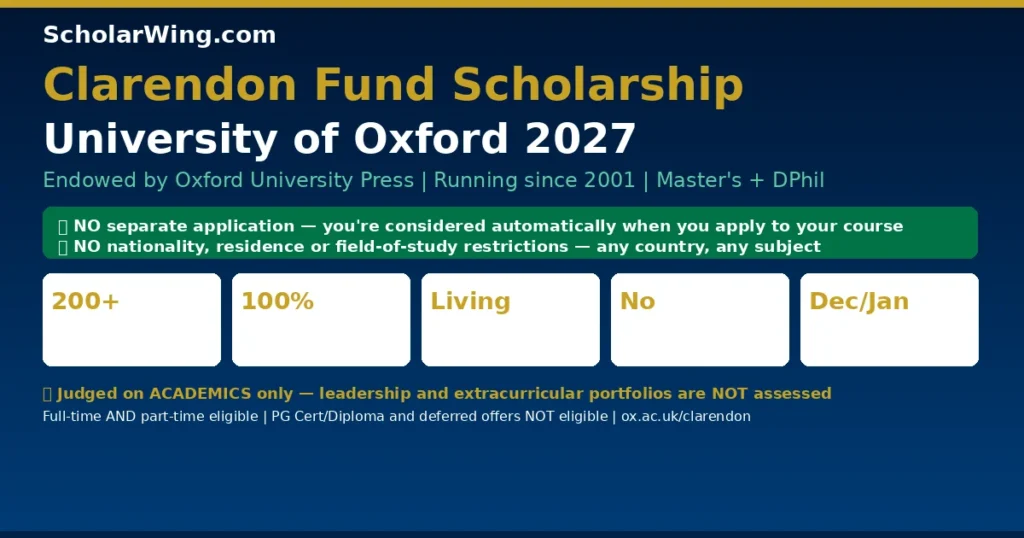
You will be automatically considered for Clarendon if you apply by the December or January deadline, whichever is relevant to your course. You do not need to submit a separate application. Clarendon not only offers over 200 new, fully-funded scholarships each year to assist outstanding graduate scholars, but also the opportunity to join one of the most active, internationally diverse and multidisciplinary communities at Oxford.
There is no Clarendon portal, no Clarendon essay, and no Clarendon interview. The entire process runs invisibly alongside your regular Oxford graduate application, which makes it remarkably straightforward but also easy to miss if you do not hit the right deadline.
No portal, no essay and no separate interview. Your Oxford course application is your scholarship application.
This cuts both ways. There is nothing extra to prepare but there is also no second chance. Miss your course’s December or January funding deadline and you are simply not considered, no matter how strong you are.
Clarendon scholarships cover course fees and provide a grant for living expenses for the period of fee liability of a scholar’s course. There are no restrictions on nationality, ordinary residence or field of study. All full-time and part-time DPhil and Master’s courses are eligible.
No nationality restriction, no residence restriction and no field restriction. Pakistan, Nigeria, Bangladesh, Kenya, India every country is eligible on identical terms.
What the Clarendon Fund Is
The Clarendon Fund is one of Oxford University’s most prestigious scholarship programmes, offering fully funded awards to outstanding graduate students of any nationality. The fund is endowed by Oxford University Press and supports scholars across all disciplines from humanities and social sciences to STEM based purely on academic excellence and potential.
The fund is endowed by Oxford University Press, the university’s own publishing house and one of the largest academic publishers in the world. OUP’s commercial surplus funds the scholarships, which is why Clarendon can sustain 200+ new awards annually without external donors attaching country or subject conditions.
Since the first Clarendon scholars arrived at Oxford in 2001, Clarendon has enabled over two decades of scholars across every discipline Oxford teaches.
In 2025/26 Clarendon is celebrating its 25th intake of exceptional scholars.
The Funding Package
All Clarendon Scholarships cover tuition and college fees in full. Scholars on a full-time course will receive an annual grant for living expenses of at least the UKRI minimum doctoral stipend rate, which is normally sufficient to cover the living costs of a single student living in Oxford. The scholarships are normally offered for the full period for which you are liable to pay tuition fees to the University.
| Component | Detail |
|---|---|
| University tuition fees | ✅ Paid in full |
| College fees | ✅ Paid in full |
| Living costs grant | ✅ Annual, full-time scholars |
| Duration | Full period of fee liability |
| Partial awards | ❌ Clarendon does not do partial funding |
⚠️ On the Stipend Figure — Sources Disagree
Published living-grant figures vary between sources, so verify the current rate on Oxford’s official Clarendon pages before relying on a number.
In 2025-26, scholars receive at least £20,780. this figure tracks the UKRI minimum doctoral stipend rate, which is the benchmark Oxford’s own wording references.
For 2025-26, full-time scholars receive at least £15,009 per year for living expenses a lower figure reported elsewhere.
Treat the UKRI-linked figure as the guide and confirm at ox.ac.uk. The key structural point is that the grant is pegged to a national benchmark and rises with it, rather than being a fixed legacy amount.
Co-Funded Awards
Some Clarendon awards are co-funded with colleges, departments, or external partners, which may include additional benefits.
A portion of Clarendon scholarships are jointly funded with Oxford colleges or departments. These sometimes carry extra benefits additional research or travel allowances, for example. You do not choose or apply for these separately; they are allocated through the same process.
Duration by Course Type
Funding for the full period of fee liability (1 year for taught Master’s, 3-4 years for DPhil).
| Course | Typical Funded Duration |
|---|---|
| Taught Master’s (MSc, MSt, MBA, MFE) | 1 year |
| Two-year Master’s (MPhil, BPhil) | 2 years |
| DPhil (PhD) | 3–4 years |
⭐ Selection Criteria — Academics Only, Not Leadership
This is the most important strategic point in this guide, and it distinguishes Clarendon sharply from Rhodes, Chevening, and Knight-Hennessy.
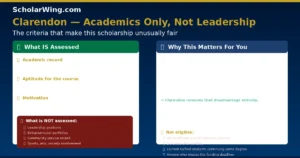
Selection is based on academic record, aptitude for the proposed course, and motivation not leadership profiles or extracurricular portfolios.
Applications are assessed against the following criteria: Academic record. Aptitude for the proposed course of study. Student motivation.
| Criterion | What It Means |
|---|---|
| Academic record | Your grades, degree classification, academic prizes |
| Aptitude for the proposed course | Whether your background genuinely fits this specific course |
| Motivation | Why this course, why Oxford, why now |
What is NOT assessed:
- ❌ Leadership positions
- ❌ Extracurricular portfolios
- ❌ Community service record
- ❌ Sports, arts, or society involvement
Why this matters enormously for your community: Students from Pakistan, Nigeria, Bangladesh, and Kenya are frequently disadvantaged in scholarships like Rhodes or Chevening, which reward the kind of structured extracurricular infrastructure debating societies, model UN, organized volunteering that many schools and universities in developing countries simply do not offer.
Clarendon removes that disadvantage entirely. If your academic record is outstanding and you can articulate a genuine, well-matched reason for your chosen course, you compete on equal footing with anyone in the world.
Selection is based entirely on academic excellence and research potential as assessed through the standard Oxford admissions process. This makes the Clarendon accessible to every strong graduate applicant regardless of nationality, field, or background.
Eligibility
There are no restrictions on nationality, ordinary residence or field of study. All full-time and part-time DPhil and Master’s courses are eligible.
✅ Eligible
| Requirement | Detail |
|---|---|
| Nationality | Any — no restrictions |
| Ordinary residence | Any — no restrictions |
| Field of study | Any degree-bearing graduate subject |
| Course mode | Full-time and part-time |
| Level | Master’s (taught and research) + DPhil |
| English proficiency | Oxford’s standard requirements IELTS, TOEFL, or equivalent |
❌ Not Eligible
Postgraduate Certificate or Diploma courses are not eligible for this scholarship.
Students who hold a deferred graduate offer are not eligible for Clarendon consideration.
Current Oxford students continuing the same degree into the next academic year are not eligible.
| Excluded | Reason |
|---|---|
| ❌ PG Certificate courses | Not degree-bearing |
| ❌ PG Diploma courses | Not degree-bearing |
| ❌ Deferred offer holders | Must be applying for a new course this cycle |
| ❌ Current Oxford students continuing same degree | Must be starting a new course |
| ❌ Late applicants | Missing the funding deadline ends consideration |
How to Apply — The Whole Process
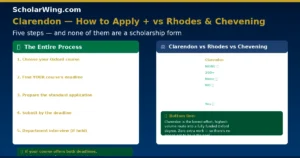
You start by applying to your chosen graduate course through Oxford’s standard admissions system before the December 2026 or January 2027 deadline, whichever applies to your programme. That single application is your scholarship application, the moment you submit it on time, you are in consideration.
Step 1: Choose your Oxford graduate course
Visit the Oxford Graduate Courses page to find your desired program.
Browse ox.ac.uk graduate courses. Choose a Master’s or DPhil that genuinely matches your academic background remember that “aptitude for the proposed course” is an explicit selection criterion.
Step 2: Find YOUR course’s funding deadline
This is the single most important action. Deadlines are course-specific, not university-wide.
Review the course requirements, application materials, and the relevant funding deadline (December 2 or January 8, depending on the course).
For the 2026 cycle, the two funding deadlines were 2 December 2025 and 8 January 2026 depending on course. Most deadlines fall in December or January. Visit the official course page to confirm your exact deadline.
⚠️ Never assume. Check your specific course page. Some courses use the December deadline; others use January.
Step 3: Prepare your standard Oxford application
Applicants must upload all standard documents required for their chosen Oxford course.
Typically this includes:
- Academic transcripts and degree certificates
- CV / résumé
- Personal statement or statement of purpose
- Research proposal (for DPhil applicants)
- Academic references
- English language test scores (IELTS / TOEFL or equivalent)
- Written work samples (course-dependent)
Step 4: Submit by the deadline — that’s it
If you apply for a full-time or part-time Master’s or DPhil at Oxford by the relevant December or January funding deadline for your course, you will be automatically considered for a Clarendon scholarship.
There is no box to tick for Clarendon on most course applications, and nothing extra to upload.
Step 5: Course interview (if your department holds one)
Shortlisted candidates will be invited for interview after all applications are evaluated.
Note: this is your department’s admissions interview, not a separate Clarendon interview. There is no Clarendon interview.
Strategic Advice for Applicants
Apply by the December deadline if your course offers both
Apply before January (preferably by the earliest December deadline for your course), Oxford graduate courses often have multiple funding deadlines and early applicants get maximum scholarship consideration.
If your course has both a December and a January deadline, submitting by December generally maximizes your funding consideration across Clarendon and other Oxford schemes simultaneously.
Make “aptitude for the course” explicit
Since leadership is not assessed, your personal statement should work harder on academic fit. Demonstrate:
- Specific prior coursework or research that prepares you for this course
- Familiarity with the course structure and who teaches on it
- A clear intellectual reason this particular Oxford course not Oxford generally
Your motivation must be substantive
“Motivation” here means academic motivation, not emotional narrative. What question do you want to answer? What will this course let you do that nothing else will?
Clarendon stacks with your other applications
Applying to Oxford does not prevent you applying for Rhodes, Chevening, Commonwealth, or Gates Cambridge. Clarendon requires zero additional effort, so there is no reason not to be in the pool.
Clarendon vs Other Oxford and UK Routes
| Feature | Clarendon | Rhodes (Oxford) | Chevening |
|---|---|---|---|
| University | Oxford | Oxford | Any UK |
| Separate application | ❌ None | ✅ Required | ✅ Required |
| Awards/year | 200+ | ~100 globally | ~1,500 |
| Nationality limits | ❌ None | ✅ Constituencies | ✅ Country list |
| Field limits | ❌ None | ❌ None | ❌ None |
| Leadership assessed | ❌ No | ✅ Heavily | ✅ Heavily |
| Level | Master’s + DPhil | Master’s + DPhil | Master’s only |
| Endorsers/referees | Standard academic | 4–8 endorsers | 2 referees |
It is the lowest-effort, highest-volume route into a fully funded Oxford degree. It should be part of every Oxford applicant’s plan by default.
Quick Reference
| Element | Detail |
|---|---|
| Scholarship | Clarendon Fund Scholarship |
| University | University of Oxford, UK |
| Endowed by | Oxford University Press |
| Running since | 2001 |
| Awards per year | 200+ new scholarships |
| Separate application | ❌ None — automatic consideration |
| Clarendon essay | ❌ None |
| Clarendon interview | ❌ None |
| Nationality restriction | ❌ None |
| Residence restriction | ❌ None |
| Field restriction | ❌ None |
| Levels | Master’s (taught + research) and DPhil |
| Course mode | Full-time and part-time |
| Tuition fees | ✅ Paid in full |
| College fees | ✅ Paid in full |
| Living grant | Annual pegged to UKRI minimum doctoral stipend (verify current rate) |
| Partial awards | ❌ None, full funding only |
| Duration | Full period of fee liability |
| Selection criteria | Academic record, aptitude for course, motivation |
| Leadership assessed | ❌ No |
| PG Cert / Diploma | ❌ Not eligible |
| Deferred offer holders | ❌ Not eligible |
| Continuing Oxford students (same degree) | ❌ Not eligible |
| Deadline | Your course’s December or January funding deadline |
| Official site | ox.ac.uk/clarendon |
FAQ
Are there nationality restrictions?
No, there are no restrictions on nationality, ordinary residence or field of study.
What does Clarendon cover?
Tuition and college fees in full, plus an annual grant for living expenses for full-time scholars, normally for the full period of fee liability.
Is leadership or extracurricular activity assessed?
No, selection is based on academic record, aptitude for the proposed course, and motivation, not leadership profiles or extracurricular portfolios.
Is there a Clarendon interview?
No, there is no Clarendon portal, no Clarendon essay, and no Clarendon interview. Any interview you receive is your department’s admissions interview.
Are part-time courses eligible?
Yes, all full-time and part-time DPhil and Master’s courses are eligible.
Can I apply if I hold a deferred Oxford offer?
No, students who hold a deferred graduate offer are not eligible for Clarendon consideration.
Are PG Diplomas eligible?
No, Postgraduate Certificate or Diploma courses are not eligible.
When is the deadline?
Your course’s own December or January funding deadline. Visit the official course page to confirm your exact deadline.
Free Application Tools
- Motivation Letter: Motivation Letter Generator
- SOP / Study Plan: SOP Generator
- CV: Free CV Builder
- Reference Letter: Reference Letter Generator
- MOI Certificate (if needed): MOI Generator
- Research Proposal (PhD): Research Proposal Generator