
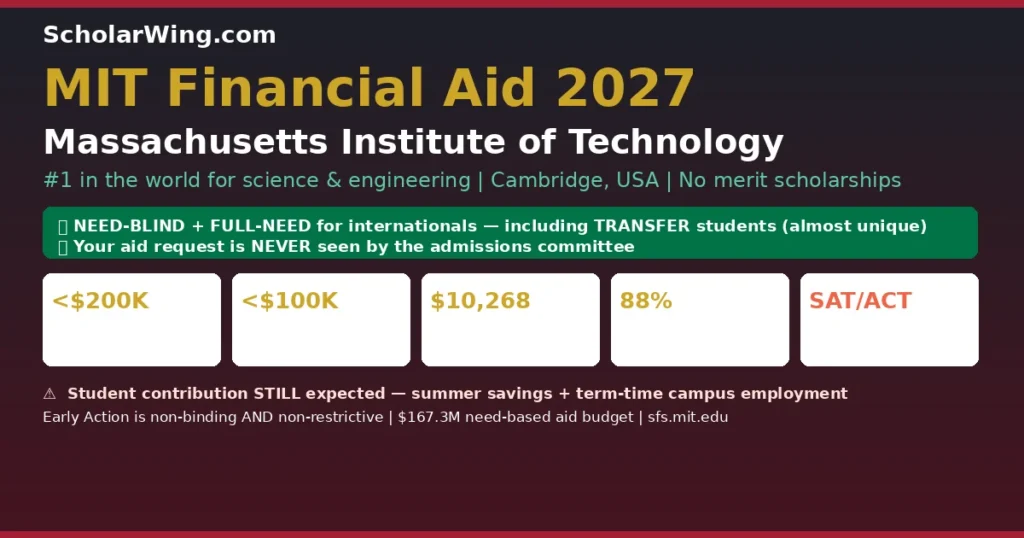
MIT Financial Aid
MIT Is Need-Blind for International Transfer Students Too — Almost No One Else Is
Every elite US university on this site offers need-blind admission to international first-year applicants. MIT does something rarer:
Here’s what makes MIT genuinely rare: it is completely need-blind for every international applicant, including freshman AND transfer students. Requesting a full ride does not hurt your chances of admission, your application is judged entirely on its merits. If admitted, MIT meets 100% of your demonstrated financial need with grants and zero loans.
Freshman and transfer. International transfer students a group almost universally excluded from generous aid policies receive the same need-blind treatment at MIT.
Additional:
We are proud to be one of the very few institutions in the United States that are need-blind and full-need need-blind means that we don’t consider your ability to pay for college in the admissions process; full-need means we are committed to meeting 100% of demonstrated financial need with our aid, which means no student is disadvantaged in the admissions process because of their financial need.
And MIT makes explicit what other universities leave implied:
The admissions committee never sees your financial aid application. It is structurally impossible for your need to influence the decision.
Beginning with the 2025–2026 academic year, students from families with an annual income under $200,000 typically attend MIT tuition-free. For the 50% of American families with income below $100,000, parents can expect to pay nothing at all toward the full cost of their students’ MIT education, which includes tuition as well as housing, dining, fees, and an allowance for books and personal expenses.
One important difference from Harvard that you must plan for: MIT still expects a student contribution — from summer savings and term-time work — even in the $0 parent contribution tier.
The Two Income Thresholds — Recently Raised Substantially
Undergraduates with family income below $200,000 can expect to attend MIT tuition-free starting next fall, thanks to newly expanded financial aid. And for the 50 percent of American families with income below $100,000, parents can expect to pay nothing at all toward the full cost of their students’ MIT education, which includes tuition as well as housing, dining, fees, and an allowance for books and personal expenses. This $100,000 threshold is up from $75,000 this year, while next year’s $200,000 threshold for tuition-free attendance will increase from its current level of $140,000.
What Changed:
| Threshold | Previously | Now |
|---|---|---|
| $0 parent contribution | $75,000 | $100,000 |
| Tuition-free | $140,000 | $200,000 |
Both thresholds rose dramatically. MIT said it has earmarked $167.3 million for need-based financial aid this year to undergraduates, up roughly 70 percent from a decade ago.
Tier 1: Family Income Under $100,000 → $0 Parent Contribution
| Covered | Status |
|---|---|
| Tuition | ✅ |
| Housing | ✅ |
| Dining | ✅ |
| Fees | ✅ |
| Books allowance | ✅ |
| Personal expenses allowance | ✅ |
| Parent contribution | $0 |
Tier 2: Family Income Under $200,000 → Tuition-Free
This means that your total grant and scholarship aid will cover at least the cost of MIT’s tuition.
Your grant covers at minimum the full tuition. Housing, dining and fees are assessed individually based on your family’s circumstances.
⚠️ The Student Contribution — MIT’s Key Difference
This is the detail that distinguishes MIT’s package from Harvard’s, and it must be planned for.
Students, however, are still expected to contribute toward their own expenses from their summer savings contribution and student employment during the school year. As a student, you may be able to offset your expected student contribution with an outside scholarship or a Federal Pell Grant if eligible.
Even in the $0 parent contribution tier, you as the student are expected to contribute through:
| Source | Detail |
|---|---|
| Summer savings contribution | Earnings from summer work |
| Term-time student employment | On-campus work during the academic year |
| Outside scholarships | Can offset your student contribution |
| Federal Pell Grant | US students only not available to internationals |
For international students specifically: You cannot access the Federal Pell Grant. Your student contribution must come from summer earnings, campus employment, or external scholarships you win independently.
This is a real, plannable cost. Budget for it, and actively pursue outside scholarships winning one directly reduces what you must earn.
The Real Numbers — What Students Actually Pay
The full price of an MIT education is $92,760 for the 2026–2027 academic year. However, most students pay far less than that. We offer full-need financial aid, which means we meet 100% of your demonstrated financial need for all four years of your undergraduate career. The median annual price paid by an undergraduate who received an MIT Scholarship was $10,268 in the 2024–2025 academic year.
| Metric | Figure |
|---|---|
| Full sticker price (2026-27) | $92,760/year |
| Median actually paid by aid recipients (2024-25) | $10,268/year |
| Aid guaranteed for | All four years |
The gap between $92,760 and $10,268 is the entire point. The sticker price should not deter you.
Graduation Outcomes
88% of MIT students from the Class of 2025 graduated debt-free. Those who do borrow tend to have debt at graduation lower than the national average a median of $20,288 and all alumni benefit from the lifelong return on investment of an MIT education, including an average starting salary of $145,820 for graduates entering industry according to the most recent Graduating Student Survey.
| Outcome | Figure |
|---|---|
| Class of 2025 graduating debt-free | 88% |
| Median debt (for those who borrow) | $20,288 |
| Average starting salary (industry) | $145,820 |
⚠️ MIT Strictly Requires the SAT or ACT — Unlike Most Peers
This is the single most important practical difference between MIT and the other need-blind universities on this site.
Does MIT require the SAT for international students? Yes. Unlike most schools that meet full need, MIT strictly requires the SAT or ACT from all applicants, including first-year and transfer students.
No test-optional pathway. No exceptions. First-year and transfer applicants alike.
While Harvard, Dartmouth, Amherst and others have adopted test-optional or test-flexible policies in recent years, MIT reinstated its requirement and enforces it strictly.
What this means for you practically:
- Register for the SAT or ACT early, test dates fill quickly in Pakistan, Nigeria, Bangladesh, Kenya and many other countries
- Budget for test fees and possible travel to a test center
- Allow time for a retake if your first score is below your target
- Score reporting takes weeks do not leave this to the final month
If you are targeting MIT, the SAT/ACT is non-negotiable. Plan 12–18 months ahead.
Early Action — Non-Binding AND Non-Restrictive
Pro tip: MIT’s Early Action is non-binding, this means you can apply EA, get a decision in December, and still apply to other schools Regular Decision. There is no penalty. If MIT is a top choice, apply Early Action. EA is not restricted either, you can apply EA to MIT and EA to other schools simultaneously.
| Feature | MIT Early Action |
|---|---|
| Binding? | ❌ No, you are not obligated to attend |
| Restrictive? | ❌ No, you may apply EA elsewhere simultaneously |
| Decision | December |
| Can still apply RD elsewhere | ✅ Yes |
| Penalty for declining | None |
This is unusually applicant-friendly. Compare with Dartmouth’s Early Decision, which is binding. MIT’s EA gives you an early answer with zero downside.
Strategic advice: If MIT is among your top choices, apply Early Action. A December decision admit, defer, or deny, lets you calibrate your remaining Regular Decision applications with real information.
No Merit Scholarships — At All
The Massachusetts Institute of Technology offers 100% need-based financial aid with no merit or athletic scholarships at all to international undergraduates.
Like Harvard, Amherst, and Dartmouth, MIT offers zero merit awards. There is no “MIT scholarship” to apply for separately, no academic excellence prize, no athletic scholarship.
The process is:
- Apply for admission
- Submit financial aid documentation (separately never seen by admissions)
- If admitted, your aid package arrives with your acceptance
Why MIT Specifically — For STEM Students
If you are an international student looking for a school that will pay for everything tuition, housing, food, books, even flights home and you want the best STEM education on the planet, MIT should be at the very top of your list. MIT is not just one of the best universities in America it is consistently ranked the #1 university in the world for science and engineering.
MIT is consistently ranked first globally for engineering and technology. For students in your community pursuing computer science, electrical engineering, mechanical engineering, physics, mathematics, biological engineering, or related fields, MIT represents the global summit of the discipline combined with genuine financial accessibility.
MIT’s institutional philosophy is unusual and worth understanding:
We establish our tuition and aid not as a product company would set a price (to cover operating costs with some margin for profit), but based on what we think is required to recruit, enroll, and educate the problem-solvers who will make the world a better place. We operate our education at a short-term loss to MIT in order to make a long-term investment in our common future.
MIT deliberately operates its education at a financial loss, funded by alumni endowment, because it views educating talented problem-solvers as its mission rather than its product. That philosophy is why a student from Karachi or Lagos with no ability to pay can attend.
Financial Aid Documents
International applicants submit the CSS Profile (College Board) and supporting income documentation. Check whether MIT offers a free alternative for applicants facing CSS Profile fee hardship several peer institutions accept the ISFAA.
| Requirement | Detail |
|---|---|
| CSS Profile | Primary aid application |
| Income documentation | Non-US equivalents accepted |
| FAFSA | ❌ Not applicable to international students |
| Federal aid | ❌ Not available to internationals |
⚠️ Verify current document requirements and any fee-waiver options directly at sfs.mit.edu.
MIT vs Other Need-Blind Options
| Feature | MIT | Harvard | Dartmouth |
|---|---|---|---|
| Need-blind (internationals) | ✅ | ✅ | ✅ |
| Need-blind for TRANSFERS | ✅ Yes | Verify | ✅ Yes |
| $0 parent contribution under | $100,000 | $100,000 | ~$125,000 |
| Tuition-free under | $200,000 | $200,000 | — |
| Student contribution expected | ✅ Yes | Varies | $1,500 (yr 2+) |
| SAT/ACT required | ✅ Strictly | Varies | Varies |
| Early round | EA — non-binding, non-restrictive | — | ED — binding |
| Merit scholarships | ❌ None | ❌ None | ❌ None |
| Best for | STEM | Broad | Broad + travel allowance |
Apply to several. Each has slightly different strengths, and your odds at any single institution are low.
Quick Reference
| Element | Detail |
|---|---|
| University | MIT, Cambridge, Massachusetts, USA |
| Global rank | #1 for science and engineering |
| Merit scholarships | NONE — need-based only |
| Athletic scholarships | NONE |
| Need-blind for internationals | ✅ Yes |
| Need-blind for international TRANSFERS | ✅ Yes, very rare |
| Aid seen by admissions? | ❌ Never |
| Meets 100% of need | ✅ All four years |
| Under $100,000 income | $0 parent contribution tuition, housing, dining, fees, books, personal |
| Under $200,000 income | Tuition-free |
| Threshold increases | $75K → $100K; $140K → $200K |
| Student contribution | ⚠️ Still expected, summer savings + term employment |
| Pell Grant offset | US students only |
| Full price (2026-27) | $92,760/year |
| Median paid by aid recipients | $10,268/year |
| Class of 2025 debt-free | 88% |
| Average starting salary | $145,820 |
| Need-based aid budget | $167.3 million |
| SAT/ACT | ⚠️ STRICTLY REQUIRED, all applicants |
| Early Action | Non-binding and non-restrictive |
| EA decision | December |
| Aid form | CSS Profile (verify fee-waiver options) |
| Official site | sfs.mit.edu / mitadmissions.org |
FAQ
What do families under $100,000 pay?
Parents can expect to pay nothing at all toward the full cost, which includes tuition as well as housing, dining, fees, and an allowance for books and personal expenses.
Does MIT require the SAT?
Yes, unlike most schools that meet full need, MIT strictly requires the SAT or ACT from all applicants, including first-year and transfer students.
Is Early Action binding?
No, MIT’s Early Action is non-binding and non-restrictive. You can apply EA to MIT and EA to other schools simultaneously, get a decision in December, and still apply Regular Decision elsewhere.
What do students actually pay?
The median annual price paid by an undergraduate who received an MIT Scholarship was $10,268 in 2024–2025, against a full price of $92,760.
Are there merit scholarships?
No, MIT offers 100% need-based financial aid, with no merit or athletic scholarships at all.
Free Application Tools
- Motivation Letter: Motivation Letter Generator
- SOP / Study Plan: SOP Generator
- CV: Free CV Builder
- Reference Letter: Reference Letter Generator
- MOI Certificate (if needed): MOI Generator
- Research Proposal (PhD): Research Proposal Generator