
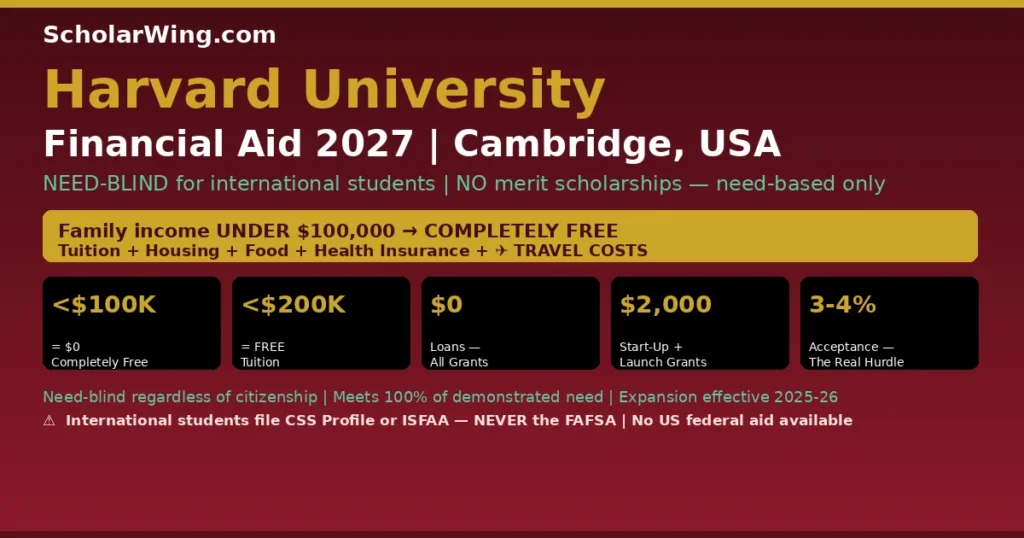
Harvard University Financial Aid
Under $100,000 Family Income? Harvard Is Completely Free — Including Your Flight
Harvard announced a major financial aid expansion that fundamentally changes the calculation for international families:
This University announced that undergraduate tuition will be free for students of families who make annual incomes of $200,000 or less. The university will also make schooling completely free for students from families with annual incomes of $100,000 or less, covering tuition, food, housing, health insurance and travel costs. The expansion of financial aid will begin in the 2025-26 academic year.
Read that list again: tuition, food, housing, health insurance and travel costs. For families under $100,000 annual income, Harvard covers everything including the international airfare that makes US study impossible for so many otherwise-qualified students.
For the overwhelming majority of families in Pakistan, Nigeria, Bangladesh, Kenya, Ghana, India, and similar contexts, household income falls far below $100,000 USD. If admitted, you would attend Harvard at zero cost.
And crucially asking for that aid does not hurt your admission chances:
Financial Aid Policies:
Harvard’s financial aid policies apply to international students as well as domestic ones. In addition, the university maintains a need-blind admission policy for all applicants, regardless of citizenship. This means that financial need does not impact admissions decisions. International students are eligible for the same financial aid packages as domestic students, making Harvard one of only a few U.S. institutions that offer need-blind admissions and full-need financial aid to non-U.S. citizens.
The honest constraint, stated plainly:
While Harvard’s expanded financial aid program is welcome news, it is important to acknowledge the extremely competitive nature of Harvard admissions. With an acceptance rate of 3-4%, gaining admission remains the primary hurdle for most prospective students. Thousands of highly qualified applicants compete for approximately 2,000 spots in the freshman class each year. This means that even with these generous financial aid policies, most applicants will not benefit simply because they won’t be admitted.
The money is not the obstacle. Admission is.
The Two Income Thresholds — Exactly What You Get
Students whose family income is $100,000 and below will attend Harvard College free of charge, an increase from the prior income threshold of $85,000. Students whose family income is $200,000 and below will be granted “free tuition plus”: their financial aid will cover the full cost of tuition and they will be evaluated individually for further aid to cover other billed expenses such as room, board, and fees.
Tier 1: Family Income Under $100,000 → Completely Free
| Covered | Status |
|---|---|
| Tuition | ✅ 100% |
| Housing | ✅ 100% |
| Food | ✅ 100% |
| Health insurance | ✅ 100% |
| Travel costs | ✅ Included |
| Your family pays | $0 |
Plus two additional grants:
Students with annual family incomes of $100,000 and below will also receive $2,000 start-up grants in their first years and $2,000 launch grants in their junior years to “help support the transition beyond Harvard.”
| Grant | Amount | When |
|---|---|---|
| Start-up grant | $2,000 | First year |
| Launch grant | $2,000 | Junior year |
If you qualify for the <$100k full ride, remind your student to check their financial aid portal for the $2,000 Start-Up Grant in August. It is specifically for move-in costs, books, and a laptop.
The start-up grant is for move-in costs, books, and a laptop, practical expenses that catch new international students unprepared. Check your financial aid portal in August.
Tier 2: Family Income $100,000–$200,000 → Free Tuition Plus
Families earning between $100,000 and $200,000 receive financial aid covering at least tuition, with additional assistance potentially available.
The expansion also targets the “missing middle.” Families earning up to $200,000 receive a full tuition waiver. While these families typically contribute toward room and board, Harvard remains 100% loan-free.
Harvard families under $100,000 typically pay nothing; under $200,000 pay 0-10 percent.
Tier 3: Above $200,000 → Still Assessed
Families earning above $200,000 may still qualify for financial aid depending on their circumstances.
Higher income does not automatically disqualify you. Family size, multiple children in college, and unusual circumstances all factor into Harvard’s assessment.
⚠️ The “Typical Assets” Clause — Read This Carefully
The income thresholds are not the whole story.
Harvard’s <$100k and <$200k rules assume “typical assets.” They generally ignore your home equity (the value of the house you live in), but they will look at second homes, large stock portfolios, or business values.
| Asset Type | Treatment |
|---|---|
| Your primary home equity | ✅ Generally ignored |
| Second homes / property | ⚠️ Assessed |
| Large stock portfolios | ⚠️ Assessed |
| Business values | ⚠️ Assessed |
Why this matters for international families: In many countries Pakistan, Nigeria, India, Bangladesh families commonly own agricultural land, rental property, or family businesses even when cash income is modest. These assets will be assessed.
A family with a $20,000 annual income but significant inherited land or a family business may receive a calculated contribution above zero. Be prepared to document your circumstances honestly and completely.
The good news: Your family home, the house you actually live in is generally not counted against you.
Loan-Free: What That Actually Means
A major benefit of this program is that Harvard’s financial aid packages are strictly loan-free.
The financial aid at Harvard is grant-based, which means you’re not required to repay it.
Harvard’s financial aid policy does not expect students to take on loans, making it one of the few institutions that are need-blind for admissions, meet 100% of financial need, and offer loan-free financial aid packages.
Many colleges “meet full need” by packaging federal or institutional loans into the offer. You graduate owing money. Harvard replaces all potential loans with direct grants.
While other students may face new caps on Parent PLUS loans or changes to repayment plans, Harvard students continue to graduate with zero debt because the university replaces all potential loans with direct grants.
⚠️ Critical: International Students Cannot Access US Federal Aid
International students cannot access US federal financial aid (Pell Grants, federal student loans, work-study). All institutional aid comes from university endowments and donor funding. This makes the choice of target universities particularly important – families requiring aid must target institutions with international aid policies, not just universities they qualify for academically.
This is a foundational point many international applicants misunderstand. There is no US government aid available to you. Every dollar must come from the university’s own endowment.
This is precisely why need-blind, full-need institutions matter so much and why the list is short:
International students at need-blind US universities (Harvard, Yale, Princeton, MIT, Amherst, Dartmouth, Bowdoin, Notre Dame, Brown, Washington and Lee) receive financial aid covering 100 percent of demonstrated need. Most universities are need-aware for internationals, meaning applying for aid affects admissions decisions.
Build your application list around this reality. Academic fit alone is insufficient, you must target institutions with genuine international aid policies.
There Is No Separate “Harvard Scholarship” to Apply For
Because this is a need-based policy rather than a competitive scholarship, there is no separate application to win a named award. The process is: apply for admission, then submit the required financial documentation, and your aid package is calculated as part of your admission offer.
Students searching for “Harvard scholarships for international students” are looking for something that does not exist. Harvard offers no merit scholarships no academic excellence awards, no leadership prizes, no named scholar programs for undergraduates.
The process is simply:
- Apply for admission
- Submit financial documentation
- If admitted, receive your aid package
Required Financial Aid Documents
You use the same income thresholds, but you fill out the CSS Profile or a specific International Student Financial Aid Application instead of the FAFSA.
⚠️ International students do NOT file the FAFSA. The FAFSA is for US federal aid, which you cannot access.
| Document | Detail |
|---|---|
| CSS Profile | College Board form — charges a fee |
| OR ISFAA | International Student Financial Aid Application — free alternative |
| IDOC documentation | IDOC-submitted income and tax documentation (non-US equivalents accepted for international families) |
| Additional documents | Any additional documentation requested during review |
“Non-US equivalents accepted” is important. Harvard understands that Pakistani, Nigerian, Bangladeshi, and Kenyan families do not have IRS tax returns. Local tax documents, salary certificates, employer letters, and equivalent records are accepted.
Net Price Calculator
Use the net price calculator, a tool provided by Harvard, to estimate your cost of attendance based on your family’s financial situation. This calculator takes into account your family’s income, assets, and other financial factors to give you a more accurate estimate of what you can expect to pay.
Use this before you apply. Harvard’s net price calculator gives you a realistic estimate of your family contribution. Running it early tells you whether Harvard is financially viable before you invest months in the application.
The Context: Harvard Has Been Doing This Since 2004
Since the Harvard Financial Aid Initiative launched in 2004, the university has expanded its threshold to cover tuition, food and housing costs four times. Currently, 55% of undergraduates receive financial aid, and their families paid an average of $15,700 for the 2023-24 year.
| Metric | Figure |
|---|---|
| Initiative launched | 2004 |
| Threshold expansions | 4 times |
| Undergraduates receiving aid | 55% |
| Average family payment (2023-24) | $15,700 |
| US families now qualifying | ~86% |
This is a sustained institutional commitment with two decades of track record — not a one-off announcement.
The Competitive Landscape — Harvard Is Not Alone
Princeton and Stanford had raised their income threshold for free attendance to $100,000. Dartmouth announced that a $150-million bequest would enable it to nearly double its free-attendance threshold from $65,000 of family income to $125,000 the highest in the country. MIT announced that undergraduates from families with incomes below $100,000 would attend free of charge.
| University | Free Attendance Threshold |
|---|---|
| Dartmouth | $125,000 (highest reported) |
| Harvard | $100,000 |
| Princeton | $100,000 |
| Stanford | $100,000 |
| MIT | $100,000 |
Strategic implication: Do not apply to Harvard alone. Several peer institutions offer comparable or better thresholds and are equally need-blind for internationals. Apply to multiple, your odds at any single institution are low, but your odds across five strong applications are meaningfully better.
Quick Reference
| Element | Detail |
|---|---|
| University | Harvard University, Cambridge, Massachusetts, USA |
| Merit scholarships | NONE — need-based aid only |
| Need-blind for internationals | ✅ Yes — regardless of citizenship |
| Meets 100% of need | ✅ Yes |
| Loans in package | ❌ ZERO — all grants |
| Under $100,000 income | Completely free — tuition, housing, food, health insurance, travel |
| Start-up grant | $2,000 (first year — move-in, books, laptop) |
| Launch grant | $2,000 (junior year) |
| $100,000–$200,000 income | Free tuition, plus individual assessment for room/board/fees |
| Above $200,000 | May still qualify depending on circumstances |
| Typical assets clause | Primary home generally ignored; second homes, stocks, business assessed |
| Aid forms | CSS Profile or ISFAA — NOT FAFSA |
| Tax documents | Non-US equivalents accepted |
| Net price calculator | Available — use before applying |
| US federal aid | ❌ Not available to internationals |
| Acceptance rate | 3–4% |
| Class size | ~2,000 |
| Undergrads on aid | 55% |
| Aid initiative since | 2004 |
| Expansion effective | 2025-26 academic year |
| Official site | college.harvard.edu/financial-aid |
FAQ
Does Harvard offer scholarships to international students?
There is no separate application to win a named award, this is a need-based policy rather than a competitive scholarship. You apply for admission, submit financial documentation, and your aid package is calculated as part of your admission offer.
Is Harvard need-blind for international students?
Yes, the university maintains a need-blind admission policy for all applicants, regardless of citizenship. Financial need does not impact admissions decisions.
What do families under $100,000 pay?
Nothing, schooling is completely free, covering tuition, food, housing, health insurance and travel costs.
Are there loans in the package?
No, Harvard’s financial aid packages are strictly loan-free. The university replaces all potential loans with direct grants.
Do I file the FAFSA?
No, international students fill out the CSS Profile or a specific International Student Financial Aid Application instead of the FAFSA.
Will my family’s property count against me?
Harvard generally ignores your primary home equity, but will look at second homes, large stock portfolios, or business values.
How competitive is admission?
Harvard’s acceptance rate is 3-4%, with thousands of highly qualified applicants competing for approximately 2,000 spots each year. Gaining admission remains the primary hurdle.
Free Application Tools
- Motivation Letter: Motivation Letter Generator
- SOP / Study Plan: SOP Generator
- CV: Free CV Builder
- Reference Letter: Reference Letter Generator
- MOI Certificate (if needed): MOI Generator
- Research Proposal (PhD): Research Proposal Generator