
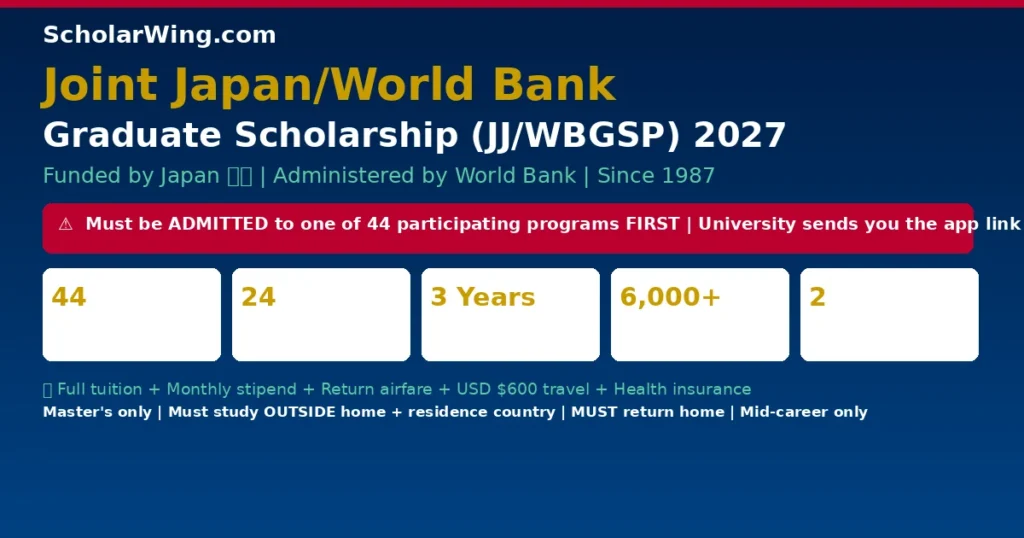
Joint Japan/World Bank Graduate Scholarship Program
You Cannot Apply for the World Bank Scholarship Unless You Are Already Admitted to One of 44 Specific Programs
The Joint Japan/World Bank Graduate Scholarship Program (JJ/WBGSP) is one of the world’s most significant scholarships for development professionals and one of the most misunderstood. The single most important eligibility fact:
Please note that if you are not admitted to one of these 44 Participating Master’s Programs, you are not eligible to apply for a JJ/WBGSP Scholarship in 2026.
This is not a scholarship you apply for and then choose a university. It works in reverse: you must first gain unconditional admission to one of exactly 44 specific Master’s programs at 24 specific universities. Only then can you apply for the scholarship.
And a second critical detail most guides omit:
The online application form link will be provided exclusively by JJ/WBGSP Participating Programs to candidates they have shortlisted as eligible.
There is no public scholarship application link. The participating university shortlists eligible admitted candidates and sends them the application form directly. If you are not shortlisted by your university, you never receive the link.
Since 1987, JJWBGSP has enabled more than 6,000 mid-career professionals from 160 developing countries to complete graduate degrees in development-related fields. On an annual basis, the Government of Japan solely funds the JJWBGSP.
The Government of Japan funds it. The World Bank administers it. Together they have invested in six thousand development professionals across four decades building institutional capacity across the developing world.
What Is the JJ/WBGSP — Japan’s Investment in Development Leaders
The Joint Japan/World Bank Graduate Scholarship Program (JJ/WBGSP) offers scholarships to professionals with relevant experience seeking a master’s degree in the development field. The program covers many costs associated with studying abroad. In return, recipients are required to return to their home country to contribute to its economic and social development.
The JJ/WBGSP is a highly competitive, fully funded scholarship supporting professionals from developing countries to pursue master’s degrees in development-related fields at leading universities worldwide. The program is administered by the World Bank and funded by the Government of Japan, with the objective of building a new generation of development leaders who will return to their home countries to contribute to social and economic progress.
The program’s logic is institutional capacity building: developing countries need skilled professionals in economic policy, public administration, infrastructure management, tax policy, and environmental governance. JJ/WBGSP identifies professionals already working in these fields, gives them world-class graduate education, and returns them home with significantly enhanced capability.
This is explicitly NOT a scholarship for students. It is a scholarship for practitioners.
Two Tracks — Developing Country Nationals and Japanese Nationals
It runs two tracks: one for mid-career professionals from developing countries pursuing Master’s degrees in development-related fields, and another for Japanese nationals committed to poverty alleviation who are pursuing graduate degrees outside Japan.
Track 1: Developing Country Nationals (main track — this guide’s focus)
- Master’s degrees at 44 participating programs
- Two application windows annually
- Requires 3+ years development work experience
Track 2: Japanese Nationals
- Master’s OR PhD degrees outside Japan
- Separate application window (February-April)
- For Japanese professionals committed to development and poverty alleviation
- Must not be employed by the Government of Japan or its related agencies, including JICA, local governments and the Central Bank.
Full Financial Package
The package covers tuition, a monthly living stipend, round-trip airfare, a USD 600 travel allowance, and health insurance.
The scholarships cover the duration of the graduate program or two years, whichever is less.
Complete Coverage:
| Benefit | Detail |
|---|---|
| Tuition fees | Full coverage |
| Monthly living stipend | Living expenses, accommodation, books |
| Round-trip airfare | Economy class — to study country + return home |
| Travel allowance | USD $600 (one-time) |
| Health insurance | Basic medical coverage |
| Duration | Program length OR 2 years — whichever is less |
Note: The monthly stipend amount varies by host country to reflect cost of living in that location. A scholar at a Japanese university receives a different amount than one at a US or African university.
The 44 Participating Programs at 24 Universities
Subject to available funding, JJ/WBGSP offers scholarships for 44 Participating Master’s Programs in 24 universities in the U.S., Europe, Africa, Oceania and Japan in key areas of development, including economic policy management, tax policy, and infrastructure management.
Regions with participating programs:
- United States — leading public policy and development schools
- Europe — including ISS Erasmus Rotterdam (Netherlands) and others
- Africa — African universities building regional capacity
- Oceania — including ANU Crawford School of Public Policy (Australia)
- Japan — Japanese universities including development-focused programs
Confirmed participating institutions include:
- ANU Crawford School of Public Policy (Australia) Collaborating with ANU Crawford School of Public Policy, the World Bank offers the JJ/WBGSP Scholarships to applicants who meet ANU admission requirements and receive unconditional offers to study at Crawford School’s participating programs.
- ISS (International Institute of Social Studies), Erasmus University Rotterdam (Netherlands) To qualify for the scholarship, you must secure an unconditional admission to the MA in Development Studies.
- University of Tokyo — Graduate School of Agriculture and Life Sciences (International Program)
- Plus 21 other universities across the five regions
⚠️ The list of 44 programs changes each cycle. Always check worldbank.org/en/programs/scholarships/jj-wbgsp for the current cycle’s list before applying to any university.
Fields covered:
Programmes focus on development topics including economic policy, public administration, infrastructure management, and environmental governance.
Also: tax policy, economic policy management, public financial management, development studies, agriculture and rural development, and related fields.
Eligibility — Strict Requirements
Hold a bachelor’s (or equivalent) degree earned at least 3 years prior to the Application Deadline date; Be employed in development-related work in a paid full-time position at the time of submitting the scholarship application.
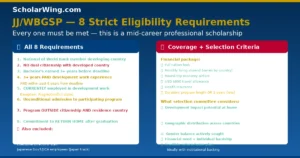
Complete Requirements:
1. National of a World Bank Member Developing Country Be a national of a World Bank member developing country.
2. No Dual Citizenship with a Developed Country Not hold dual citizenship with a developed country.
If you hold both a developing country passport and a developed country passport (US, UK, Canada, Australia, Japan, EU member, etc.), you are not eligible.
3. Bachelor’s Degree Earned 3+ Years Before Deadline Your undergraduate degree must be at least 3 years old at the application deadline.
4. Minimum 3 Years Paid Development Work Experience Have at least 3 years of paid development-related employment acquired since earning a bachelor’s degree and acquired within the past six years from the date of the Application Deadline.
Both conditions: at least 3 years total, AND acquired within the past 6 years. If your development work was 10 years ago and you have been in a different field since, you may not qualify.
Additional:
5. Currently Employed in Development Work Be employed in development-related work in a paid full-time position at the time of submitting the scholarship application.
Exception for Fragile and Conflict States: The only exception to this criterion is for developing country nationals from a country that is on the list of Fragile and Conflict States featured in Annex 3 of the Application Guidelines. In such cases, we do take into consideration the limited employment opportunities in those countries.
Applicants from countries designated as fragile or conflict-affected Afghanistan, Somalia, South Sudan, Yemen, Syria, and others receive consideration for the limited employment opportunities in their contexts.
6. Unconditional Admission to a Participating Program On or before the scholarship application deadline date, be admitted unconditionally (except for funding) for the upcoming academic year to at least one of the JJ/WBGSP participating master’s programs located outside of the applicant’s country of citizenship and country of residence. The letter of admission must be uploaded before submitting the scholarship application.
⚠️ Critical: The program must be OUTSIDE both your country of citizenship AND your country of residence. A Kenyan living in Uganda cannot study at a participating program in Kenya OR Uganda.
7. Commitment to Return Home In return, recipients are required to return to their home country to contribute to its economic and social development.
8. World Bank Staff and Relatives Excluded World Bank Group staff, their relatives, and Executive Directors’ staff are not eligible.
Application Process — Reverse Order
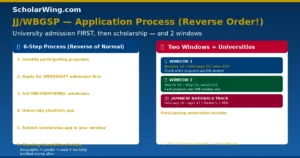
Step 1: Identify participating programs (12-18 months ahead)
Visit worldbank.org/en/programs/scholarships/jj-wbgsp → view current cycle’s 44 participating programs. Identify programs matching your field, and note which application window each falls under.
Step 2: Apply for university admission FIRST
Apply directly to your chosen participating program(s). Each university has its own admission deadline often earlier than the scholarship window.
Example ISS Erasmus Rotterdam: Apply for academic admission by 2 March 2026. To qualify for the scholarship, you must secure an unconditional admission to the MA in Development Studies.
Step 3: Receive unconditional admission
“Unconditional except for financing” meaning you meet all academic requirements. Financing being unresolved is fine; that is what the scholarship addresses.
Step 4: Be shortlisted by the university
The online application form link will be provided exclusively by JJ/WBGSP Participating Programs to candidates they have shortlisted as eligible.
The university reviews its admitted students for JJ/WBGSP eligibility and sends the scholarship application link to those who qualify.
Step 5: Submit the JJ/WBGSP application in the correct window
Submit the JJ/WBGSP Application Online: Complete the online JJ/WBGSP application during the appropriate window (Window 1: January 15 to February 27 or Window 2: March 30 to May 29 for developing country nationals).
Two windows depending on your program:
| Window | Dates (2026 reference) | Note |
|---|---|---|
| Window 1 | January 15 – February 27, noon EST | Some programs |
| Window 2 | March 30 – May 29, noon EST | Other programs |
| Japanese nationals | February 16 – April 17 | Separate track |
Each participating program falls under one window only. Check which window your program uses.
Step 6: Await results
Final selection also considers geographic distribution, gender balance, financial need, and individual hardship. Approved finalists are confirmed by the JJ/WBGSP Steering Committee, and successful candidates are notified shortly thereafter.
What the Selection Committee Considers
Final selection also considers geographic distribution, gender balance, financial need, and individual hardship.
Beyond eligibility, the JJ/WBGSP selects based on:
Development impact potential: Your capacity to influence policy, institutions, and development outcomes when you return home. Applicants in positions of institutional influence ministries, central banks, development agencies, major NGOs are particularly strong.
Geographic distribution: The program deliberately balances scholars across regions and countries. This means competition varies by country applicants from under-represented countries may face less competition.
Gender balance: The program actively seeks gender balance in each cohort.
Financial need and hardship: Applicants who genuinely could not fund their studies otherwise are prioritized.
Return commitment credibility: Your plan to return and contribute must be specific and believable ideally with institutional backing (a position you will return to).
Quick Reference
| Element | Detail |
|---|---|
| Program | Joint Japan/World Bank Graduate Scholarship (JJ/WBGSP) |
| Funded by | Government of Japan |
| Administered by | World Bank |
| Since | 1987 |
| Alumni | 6,000+ from 160 developing countries |
| Level | Master’s only (developing country track) |
| Programs | 44 at 24 universities |
| Regions | US, Europe, Africa, Oceania, Japan |
| Coverage | Tuition + stipend + airfare + $600 travel + health |
| Duration | Program length OR 2 years (whichever less) |
| Bachelor’s | Earned 3+ years before deadline |
| Work experience | 3+ years paid development work (within past 6 years) |
| Currently employed | Yes — in development work (fragile state exception) |
| Admission required | Unconditional, to participating program, BEFORE applying |
| Study location | Outside citizenship AND residence country |
| Dual citizenship | No developed country dual citizenship |
| Return commitment | MANDATORY |
| Window 1 | January 15 – February 27, noon EST |
| Window 2 | March 30 – May 29, noon EST |
| Japanese track | February 16 – April 17 |
| Application link | Sent by university — no public link |
| Official site | worldbank.org/en/programs/scholarships/jj-wbgsp |
FAQ
Where do I find the application link?
The online application form link is provided exclusively by JJ/WBGSP Participating Programs to candidates they have shortlisted as eligible. There is no public application link.
What does the scholarship cover?
Tuition, a monthly living stipend, round-trip airfare, a USD 600 travel allowance, and health insurance.
Can I study in my home country?
No, the program must be located outside the applicant’s country of citizenship and country of residence.
What if I’m from a conflict-affected country?
Applicants from countries on the Fragile and Conflict States list receive consideration for limited employment opportunities in those contexts.
When are the application windows?
Window 1: January 15 to February 27. Window 2: March 30 to May 29 (noon EST). Japanese nationals: February 16 to April 17.
Is there a PhD option?
Not for developing country nationals Master’s only. The Japanese nationals track includes PhD.
Free Application Tools
- Motivation Letter: Motivation Letter Generator
- SOP / Study Plan: SOP Generator
- CV: Free CV Builder
- Reference Letter: Reference Letter Generator
- MOI Certificate (if needed): MOI Generator
- Research Proposal (PhD): Research Proposal Generator