
Knight-Hennessy Scholarship
The Knight-Hennessy Scholarship Deadline Is October 6, 2026 — And You Need Two Applications
The Knight-Hennessy Scholars program is one of the world’s most prestigious graduate scholarships, and one that most applicants discover too late. Before anything else:
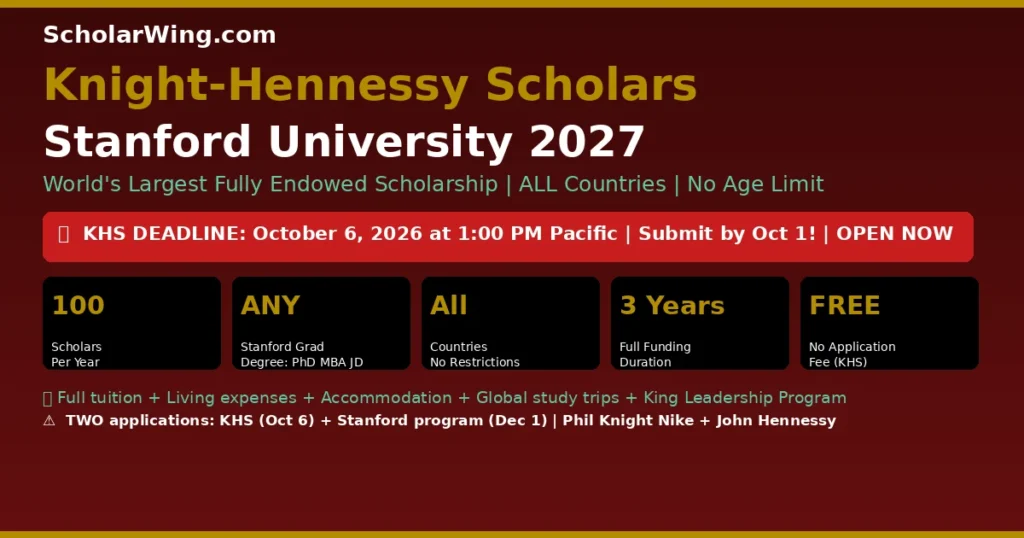
The Knight-Hennessy Scholars 2027 application closes 6 October 2026 at 1:00 p.m. Pacific Time.
The KHS application portal does slow down in the final 72 hours as thousands of people submit at once. Finalize your application by 1 October 2026, not 6 October. Give yourself a real buffer.
And the second critical fact most guides miss:
You must submit your graduate degree program application by December 1, 2026 to remain eligible for Knight-Hennessy Scholars. If you submit your graduate program application after December 1, 2026 but before your graduate program’s deadline, you will remain eligible for admission to your graduate program but you will not be eligible for admission to Knight-Hennessy Scholars.
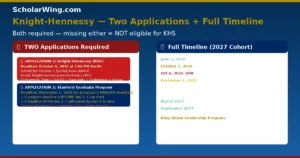
Two applications. Two separate deadlines. Both mandatory. Missing either one means losing KHS eligibility even if the other application is strong.
Knight-Hennessy Scholars is the world’s largest fully endowed graduate scholarship program. It is named after Phil Knight, co-founder of Nike, and John Hennessy, former President of Stanford University. Each year, up to 100 high-achieving students from around the world with demonstrated leadership and civic commitment receive full funding to pursue a wide-ranging graduate education at Stanford, with the goal of developing a new generation of global leaders.
Who Are Phil Knight and John Hennessy
The scholarship is named after Phil Knight and John Hennessy.
Phil Knight — Born 1938, Phil Knight co-founded Nike in 1964 (originally Blue Ribbon Sports) with his track coach Bill Bowerman at the University of Oregon. Nike became the world’s largest athletic footwear and apparel company. Knight is a Stanford Graduate School of Business alumnus (MBA 1962). In 2016, he donated $400 million to Stanford to establish the Knight-Hennessy Scholars program, the largest gift in Stanford’s history at the time.
John Hennessy — A pioneering computer scientist who co-developed the RISC (Reduced Instruction Set Computing) architecture that underlies virtually all modern microprocessors. He served as President of Stanford University from 2000 to 2016 during which Stanford became arguably the world’s most influential university in technology and entrepreneurship. He now chairs Alphabet (Google’s parent company).
The scholarship reflects their shared belief: that a new generation of interdisciplinary, globally minded leaders is needed to address the complex challenges facing humanity and that Stanford is the ideal incubator for developing them.
The Scholarship — Full Financial Package and Scope
Knight-Hennessy scholars receive funding for up to three years for any graduate degree(s) at Stanford.
The scholarship covers full tuition, living expenses, accommodation, leadership development, and additional benefits for eligible scholars.
Coverage:
| Benefit | Detail |
|---|---|
| Full tuition | 100% — all years, any Stanford program |
| Living expenses | Stipend for daily living |
| Accommodation | Housing support |
| King Global Leadership Program | Leadership development activities |
| Global study trips | Domestic and international |
| Workshops with leaders | Access to world-leading figures |
| Duration | Up to 3 years |
The King Global Leadership Program
Through the King Global Leadership Program, scholars will broaden knowledge, develop skills, and strengthen character as they go through community experiences, workshops, meetings with leaders, domestic and global study trips, and personal development opportunities.
The leadership program is not an add-on, it is central to what distinguishes KHS from a standard tuition scholarship. Scholars from across Stanford’s seven schools are brought together into a multidisciplinary community. You study your chosen degree program (law, medicine, business, engineering, education) while simultaneously developing your capacity as a leader through structured experiences you would not access otherwise.
Every Stanford Graduate Degree Is Eligible
Full-time Masters and PhD degrees in any subject offered at Stanford (for example, but not limited to, DMA, JD, MA, MBA, MD, MFA, MPP, MS, or PhD) with some exceptions.
This is what makes KHS uniquely powerful, it funds ANY Stanford graduate program:
| Program | School |
|---|---|
| PhD (any field) | Engineering, Sciences, Humanities, Education, Medicine, Law, Business |
| MS | Engineering, Sciences, and others |
| MA | Humanities, Social Sciences, Education |
| MBA | Stanford Graduate School of Business |
| JD | Stanford Law School |
| MD | Stanford School of Medicine |
| MFA | Stanford Department of Art and Art History |
| MPP | Public Policy |
| DMA | Musical Arts |
| Dual degrees | e.g., MD/MBA, JD/MBA, PhD/MBA, etc. |
A computer scientist pursuing a PhD in AI, a physician pursuing an MD, a future policymaker pursuing an MPP, a musician pursuing a DMA, a lawyer pursuing a JD, all can receive the same Knight-Hennessy scholarship for the same Stanford.
Check exceptions: A small number of programs may not be eligible. Always verify at knight-hennessy.stanford.edu.
Three Selection Criteria — What KHS Actually Looks For
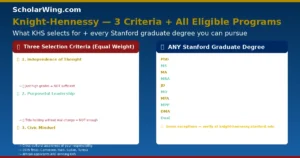
The KHS application invites applicants to make their case for selection by demonstrating independence of thought, purposeful leadership, and a civic mindset.
1. Independence of Thought
Intellectual curiosity and the capacity for original thinking. KHS is not looking for top students who performed well within defined academic structures, it is looking for people who think beyond those structures.
What demonstrates independence of thought:
- Original research or creative work that challenged existing frameworks
- Intellectual pursuits you initiated independently (outside curriculum)
- Evidence that you form your own views through rigorous analysis
- Cross-disciplinary thinking — connecting ideas across fields
- Willingness to take intellectual risks and defend unconventional positions
A student who excelled at following academic instructions has high grades. A student who independently pursued original questions often without a guaranteed payoff demonstrates independence of thought.
2. Purposeful Leadership
Leadership that is grounded in purpose not leadership for its own sake or for personal advancement.
The 2025 cohort welcomed first-ever scholars from Cameroon, Haiti, Sudan, and Tunisia. The 2026 cohort included scholars from 31 countries, with first-time additions from Croatia, Portugal, UAE, and Uzbekistan. African applicants are winning Knight-Hennessy.
KHS leadership is about making things happen in the world. Not title-holding, not committee membership, not performative service but genuine change-making. You identified something wrong or missing, and you acted.
What demonstrates purposeful leadership:
- Something you built or changed that outlasted your direct involvement
- Communities or people who moved in a new direction because of your actions
- Decisions you made under uncertainty that showed moral courage
- Evidence that you lead from values, not just competence
3. Civic Mindset
Commitment to serving communities, societies, and the world not just personal or professional goals.
What demonstrates civic mindset:
- Sustained engagement with causes beyond personal benefit
- Post-KHS vision that explicitly includes contribution to public good
- Awareness of your social context and responsibility within it
- International or cross-cultural engagement with development challenges
Eligibility — All Countries, No Restrictions
Applicants from all countries, there are no restrictions based on citizenship, age, field of study, career aspiration, etc.
No country quotas, no age limit, and No field restriction. Every non-Stanford-enrolled student from every country who applies to a Stanford graduate program simultaneously is eligible.
The only practical exclusion: You must be applying to (not already enrolled in) a full-time Stanford graduate program.
Final-year undergraduate students who expect to graduate before enrollment can apply.
The Two-Application Process — Most Important Thing to Understand
Application 1: Knight-Hennessy Scholars Application
Deadline: October 6, 2026 at 1:00 PM Pacific Time Portal: knight-hennessy.stanford.edu/admission/apply
Components:
- Online application form
- One-page resume
- Academic transcripts
- Two recommendation letters
- Short answers and essays (what you’ve done, who you are, what you aspire to)
- No application fee
Application 2: Stanford Graduate Degree Program
Deadline: December 1, 2026 (or your program’s earlier deadline, whichever comes first)
Each Stanford school sets its own admissions deadline. Some are before December 1:
- Stanford MBA Round 1: September 2026 (already passed for the 2027 cycle)
- Stanford MBA Round 2: January 2027 (still eligible for admission but NOT for KHS if program deadline passed Dec 1)
- Stanford Law (JD): Varies — check
- Stanford Medicine (MD): Varies — check
- Stanford PhD programs: Most December-January
If your Stanford program’s regular deadline is after 1 December 2026, you still must submit by 1 December to remain eligible for Knight-Hennessy. This trips up applicants every cycle.
Full Application Timeline
| Stage | Date |
|---|---|
| KHS application opened | June 1, 2026 |
| KHS application closes | October 6, 2026 at 1:00 PM Pacific |
| Recommended submission | October 1, 2026 (avoid portal slowdown) |
| Stanford graduate program deadline | December 1, 2026 (or program’s earlier deadline) |
| Stanford MBA Round 1 | September 2026 (passed) |
| KHS shortlist decisions | December 2026 – January 2027 |
| Finalist interviews | January – February 2027 |
| Final selection announced | March 2027 |
| Cohort begins at Stanford | September 2027 |
How to Write a Competitive Application
The essays are everything. KHS essays ask you to describe what you’ve done, who you are, and what you aspire to. This is your space to demonstrate all three criteria independence of thought, purposeful leadership, and civic mindset through specific, honest, original writing.
What doesn’t work:
- Generic descriptions of impact (“I helped my community”)
- Title-listing without evidence of actual change
- Aspirational writing that isn’t grounded in demonstrated track record
- Essays that sound like every other leadership scholarship essay
What works:
- Specific, honest accounts of things you built or changed
- Intellectual experiences that genuinely shaped how you think
- Genuine post-Stanford vision that shows civic purpose
- A coherent narrative — who you are across all components
The recommendation letters matter. Choose recommenders who have personally observed you demonstrate the three criteria. Brief them on KHS’s specific selection criteria not just your academic accomplishments.
Quick Reference
| Element | Detail |
|---|---|
| Program | Knight-Hennessy Scholars (KHS) |
| University | Stanford University, USA |
| Named after | Phil Knight (Nike) + John Hennessy (Stanford) |
| Size | World’s largest fully endowed scholars program |
| Scholars/year | Up to 100 |
| Countries | ALL — no restrictions |
| Age limit | NONE |
| Field | ANY Stanford full-time graduate program |
| Coverage | Tuition + living + accommodation + global trips |
| Duration | Up to 3 years |
| KHS deadline | October 6, 2026 at 1:00 PM Pacific |
| Submit by | October 1 (portal slows down) |
| Stanford deadline | December 1, 2026 (or earlier per program) |
| Application fee | None (for KHS) |
| Shortlist | December 2026 – January 2027 |
| Interviews | January – February 2027 |
| Results | March 2027 |
| Start | September 2027 |
| Three criteria | Independence + Leadership + Civic mindset |
FAQ
Is there an age limit or country restriction?
No, there are no restrictions based on citizenship, age, field of study, or career aspiration.
What programs are eligible?
All full-time graduate degrees at Stanford DMA, JD, MA, MBA, MD, MFA, MPP, MS, PhD with some exceptions.
How many scholarships are awarded?
Up to 100 fully funded scholarships per year.
What is the KHS deadline?
October 6, 2026 at 1:00 PM Pacific Time.
When must the Stanford program application be submitted?
By December 1, 2026 or your program’s earlier deadline to remain eligible for KHS.
Is there an application fee?
No, the KHS application itself is free.
When are results announced?
Final selection announced March 2027. Cohort begins September 2027.
Free Application Tools
- Motivation Letter: Motivation Letter Generator
- SOP / Study Plan: SOP Generator
- CV: Free CV Builder
- Reference Letter: Reference Letter Generator
- MOI Certificate (if needed): MOI Generator
- Research Proposal (PhD): Research Proposal Generator