
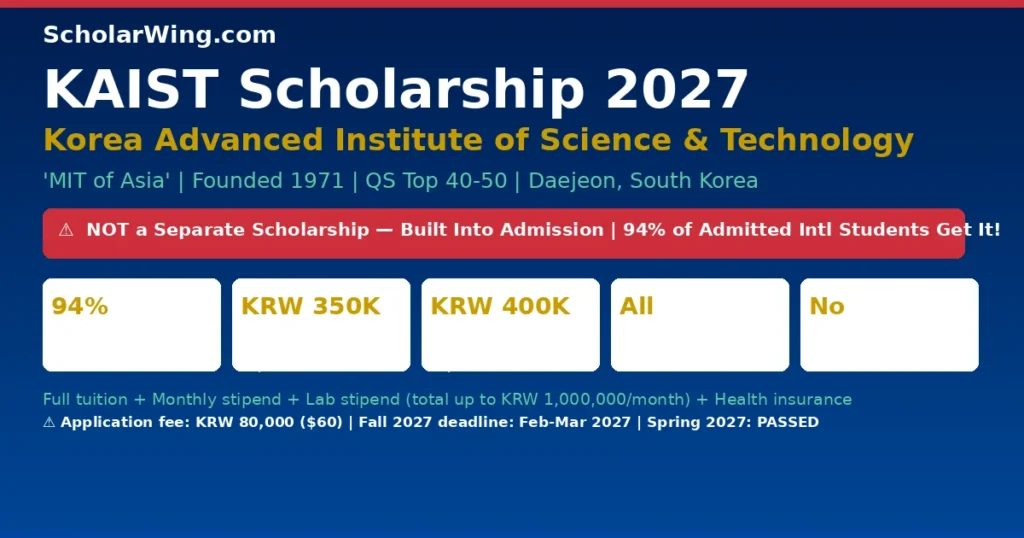
KAIST Scholarship
The KAIST Scholarship Is Not a Separate Program — It Is Built Into Admission, and 94% of International Students Get It
The most important fact about the KAIST scholarship and the one most guides fail to state clearly:
The KAIST International Student Scholarship is a financial aid program built into KAIST’s own graduate admission process, not a separate scholarship you apply for on its own. Students do not submit a separate scholarship application. Instead, they select KAIST as their funding source during the online application.
94% of admitted international students receive KAIST funding.
This changes everything about how you approach the KAIST scholarship. You do not find a scholarship deadline, prepare a scholarship-specific application, and compete against other scholarship applicants. Instead, you:
- Apply for graduate admission to KAIST
- Select KAIST scholarship as your funding source during the application
- If admitted which is itself the competitive part, you almost certainly receive the scholarship
The scholarship is essentially a benefit of admission, not a separate competition after admission.
KAIST the Korea Advanced Institute of Science and Technology is South Korea’s top research university in science, engineering, and technology, known as the MIT of Asia. It was established by the Korean government in 1971 as the nation’s first research-oriented science and engineering institution.
Fall 2027 entry deadline: February-March 2027. Spring 2027 deadline was September 1, 2026 (now passed).
What Is KAIST — The MIT of Asia
KAIST is consistently ranked among Asia’s top universities in science, engineering, and technology often placed in the QS global top 40-50. Its faculty includes Nobel Prize winners and leading researchers across computer science, electrical engineering, mechanical engineering, physics, chemistry, and biological sciences.
Founded in 1971 in Daejeon, South Korea, KAIST was established with a specific mission: to accelerate Korea’s technological development by creating a world-class research institution focused entirely on science and engineering. The model worked, Korea’s transformation from a war-damaged developing country in 1953 to a semiconductor, automotive, and technology powerhouse by 2000 was partly built on KAIST-trained engineers and scientists.
Daejeon — KAIST’s home city is South Korea’s fourth-largest city and its designated science and technology hub. The Daedeok Innopolis (Daeduck Science Town) surrounding KAIST is home to hundreds of research institutes, technology companies, and government laboratories creating one of Asia’s most concentrated science and technology ecosystems.
Key KAIST strengths:
- Computer Science and AI — ranked among the world’s best
- Electrical Engineering — particularly semiconductors and communications
- Mechanical and Aerospace Engineering
- Biological Sciences and Bioengineering
- Physics, Chemistry, Materials Science
- Business and Technology Management (Kim Jaechul Graduate School)
The KAIST Scholarship — Full Financial Package
The KAIST scholarship covers full tuition fee, a monthly stipend of 350,000 KRW for master’s students and 400,000 KRW for PhD students, and health insurance fees covered by the advisor or department.
Base KAIST Scholarship:
| Level | Monthly Stipend | Duration |
|---|---|---|
| Master’s | KRW 350,000/month (~USD $260) | 2 years |
| MS-PhD combined | KRW 400,000/month | 3-4 years |
| PhD | KRW 400,000/month (~USD $295) | 3-4 years |
Plus:
- Full tuition: 100% — all semesters
- Health insurance: Covered by advisor or department
The Lab Stipend — The Real Financial Picture
The base KAIST scholarship stipend (KRW 350,000-400,000) is modest by Korean living cost standards. But most KAIST graduate students earn significantly more through research lab stipends:
Most graduate students also earn supplementary stipends through lab work, teaching assistantships, and project grants. The total monthly income including lab stipend can reach 1,000,000 KRW or more.
In practice:
- Base KAIST scholarship: KRW 350,000-400,000/month
- Research lab stipend (from professor’s grants): KRW 300,000-700,000/month additional
- Total typical: KRW 650,000-1,100,000/month (~USD $480-810)
The research stipend depends heavily on your professor’s funding well-funded labs in AI, semiconductors, and engineering fields tend to provide the highest supplements. This is why finding the right advisor is crucial before applying.
Cost of Living in Daejeon:
- Monthly rent (shared accommodation): KRW 300,000-500,000
- Food: KRW 200,000-350,000
- Transport: KRW 50,000-100,000
- Total comfortable student budget: KRW 700,000-1,000,000/month
Combined KAIST base + lab stipend makes student life in Daejeon comfortable, Daejeon is significantly more affordable than Seoul.
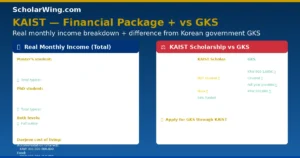
KAIST vs GKS Through KAIST — Important Distinction
Different from the Global Korea Scholarship (GKS), which is a Korean government award you can apply for through KAIST or your local Korean embassy. GKS is more competitive but more generous covering Korean language training, settlement allowance, and airfare in addition to tuition and a higher stipend.
| Feature | KAIST Scholarship | GKS (through KAIST) |
|---|---|---|
| Funder | KAIST university | Korean government |
| Monthly stipend | KRW 350,000-400,000 | KRW 900,000-1,000,000 |
| Airfare | Not covered | Covered |
| Korean language training | Optional (self-arranged) | Full year provided |
| Settlement allowance | No | Yes (KRW 200,000) |
| Competition | 94% admission rate = funded | Very competitive |
| Application | Built into KAIST admission | Separate GKS application |
If you are eligible and competitive for GKS, applying for GKS through KAIST (as your host institution) gives you both KAIST’s world-class research environment AND the Korean government’s more generous financial package. GKS and KAIST scholarship are separate, you can apply for both.
Eligible Countries and Eligibility
Countries:
All countries in the world. Applicants who hold Korean Citizenship (dual citizenship) are NOT eligible to apply as international students.
Note: International applicants of Korean ethnicity who do not meet the conditions above CANNOT apply through International Admissions. They should apply through KAIST General Admission.
Every non-Korean-national from every country worldwide is eligible. The only exclusions are Korean citizens (including dual citizens), who must apply through domestic Korean admissions, not international.
Age Limit:
There is no KAIST scholarship age limit for any applicant.
Academic Requirements:
- Master’s: Bachelor’s degree (or expected to receive by August 31, 2027)
- PhD: Bachelor’s degree (direct PhD) or Master’s degree
- Final-year undergraduates can apply if expected to graduate before enrollment
Fields:
All KAIST graduate programs primarily science, engineering, and technology, plus business (Kim Jaechul Graduate School of Management) and humanities.
English Requirements:
You may request a waiver if you are a citizen of an English-speaking country (e.g., USA, UK, Canada, Australia, etc.) and have completed a degree in that country, or if you hold citizenship of a specified country (e.g., India, Philippines, Ghana, etc.) and have physically studied and completed a Bachelor’s degree or higher in English as the medium of instruction. A certificate proving the medium of instruction is required.
If you do not qualify for a waiver, you need IELTS or TOEFL scores. The minimum typically required:
- IELTS: 6.0-6.5 (program-dependent)
- TOEFL iBT: 83+ (program-dependent)
Pakistan note: Pakistani students who completed their bachelor’s degree in English (most Pakistani universities) can request an English medium of instruction certificate from their university, which may qualify for the IELTS waiver.
Application Process — Two Intake Cycles
KAIST admits students twice a year:
Spring Intake (March 2027 start) — DEADLINE PASSED
Spring 2027 Entry: Application deadline September 1, 2026 at 5 PM KST. Recommendation letter deadline: September 8, 2026. Decision announcement: December 18, 2026.
The Spring 2027 deadline has already passed.
Fall Intake (September 2027 start) — UPCOMING
Expected deadline: February-March 2027 for Fall 2027 entry.
Step-by-Step Application:
Step 1: Find a potential research advisor (CRITICAL) Before applying, identify professors at KAIST whose research aligns with your interests. Email them your CV and research background. A professor who expresses interest in supervising you significantly increases your chances of admission and determines your research lab stipend.
Step 2: Apply online Portal: gradapply.kaist.ac.kr/intergradapply/
Complete the online application form. During the application, select KAIST as your funding source. Then submit all documents before the deadline.
Step 3: Pay application fee Application fee: KRW 80,000 (~USD $60). This is NOT a free application the fee must be paid online.
Step 4: Submit documents
- Official academic transcripts (all degrees)
- Degree certificates
- Passport copy
- Research statement / study plan
- 2-3 recommendation letters
- English proficiency (IELTS/TOEFL or waiver certificate)
- Portfolio or publications (if applicable)
Step 5: Send hard copies The online application should be printed, and a hard copy dispatched along with supporting documents to the KAIST Admissions Office.
Address: #110, 1st Floor, E16-1 B/D, 291 Daehak-ro, Yuseong-gu, Daejeon 34141, Republic of Korea
Step 6: Await decision Spring 2027 cycle: Results December 18, 2026. Fall 2027 cycle: Results approximately June 2027.
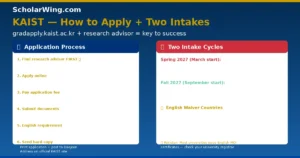
Research Advisor — The Most Important Step
KAIST is a research university every graduate student is attached to a research lab and works under a professor’s supervision. The professor:
- Determines whether your application is competitive
- Provides supplementary research stipend (beyond base KAIST scholarship)
- Defines your research direction for 2-4 years
- Writes a key recommendation letter
How to contact KAIST professors:
- Visit kaist.ac.kr → Departments → Faculty
- Find professors whose research matches your background and interest
- Email them: Brief introduction + CV + your research background + why their work interests you
- Ask if they have openings for Master’s/PhD students in the upcoming intake
A positive response from a professor before applying dramatically improves your chances.
Why KAIST — Korea as a Study Destination
Academic excellence: KAIST is the top science and engineering university in South Korea and one of Asia’s finest globally. An KAIST degree carries enormous weight in the technology sector worldwide.
Korea’s technology ecosystem: KAIST graduates work at Samsung, LG, SK Hynix (world’s major semiconductor companies), Hyundai, Kakao, and hundreds of global and Korean technology companies. Korea is a world leader in semiconductors, displays, electric vehicles, battery technology, and AI.
Safe and modern: South Korea is one of Asia’s safest countries with world-class infrastructure, healthcare, and internet connectivity.
K-culture: Korean food, music, drama, and fashion have global followings studying in Korea is culturally rich.
English medium: Most KAIST programs are conducted in English. Korean language is recommended but not required.
Quick Reference
| Element | Detail |
|---|---|
| University | KAIST — Korea Advanced Institute of Science and Technology |
| Location | Daejeon, South Korea |
| Founded | 1971 |
| Nickname | MIT of Asia |
| QS Ranking | Top 40-50 globally |
| Scholarship type | Built into admission — not separate |
| Funding rate | 94% of admitted international students |
| Levels | Master’s, MS-PhD, PhD |
| Monthly (Master’s) | KRW 350,000 base + lab stipend |
| Monthly (PhD) | KRW 400,000 base + lab stipend |
| Total with lab | Up to KRW 1,000,000/month |
| Health insurance | Covered by advisor/department |
| Application fee | KRW 80,000 (~USD $60) |
| Countries | All — except Korean nationals |
| Age limit | None |
| Spring 2027 deadline | September 1, 2026 — PASSED |
| Fall 2027 deadline | February-March 2027 — UPCOMING |
| Application portal | gradapply.kaist.ac.kr/intergradapply/ |
| GKS alternative | More generous, separate application |
FAQ
Is the KAIST scholarship a separate application?
No, it is built into the KAIST graduate admission process. Students select KAIST as their funding source during the online application. There is no separate scholarship application.
What percentage of international students get funded?
94% of admitted international students receive KAIST funding.
What is the monthly stipend?
KRW 350,000 for Master’s and KRW 400,000 for PhD per month. Plus supplementary lab stipend from professor’s research grants total can reach KRW 1,000,000/month.
Is there an age limit?
No, there is no KAIST scholarship age limit.
What is the application fee?
KRW 80,000 (~USD $60).
Can Korean dual citizens apply internationally?
No, applicants holding Korean citizenship (including dual citizenship) are not eligible for international admission.
What is the Fall 2027 deadline?
Expected February-March 2027 for September 2027 entry. Check: gradapply.kaist.ac.kr for confirmed dates.
What is GKS and how does it differ?
GKS is a Korean government scholarship more generous than the KAIST scholarship covering airfare, Korean language training, a higher stipend (KRW 900,000-1,000,000), and a settlement allowance. GKS requires a separate application and is more competitive.
Free Application Tools
- Motivation Letter: Motivation Letter Generator
- SOP / Study Plan: SOP Generator
- CV: Free CV Builder
- Reference Letter: Reference Letter Generator
- MOI Certificate (if needed): MOI Generator
- Research Proposal (PhD): Research Proposal Generator