
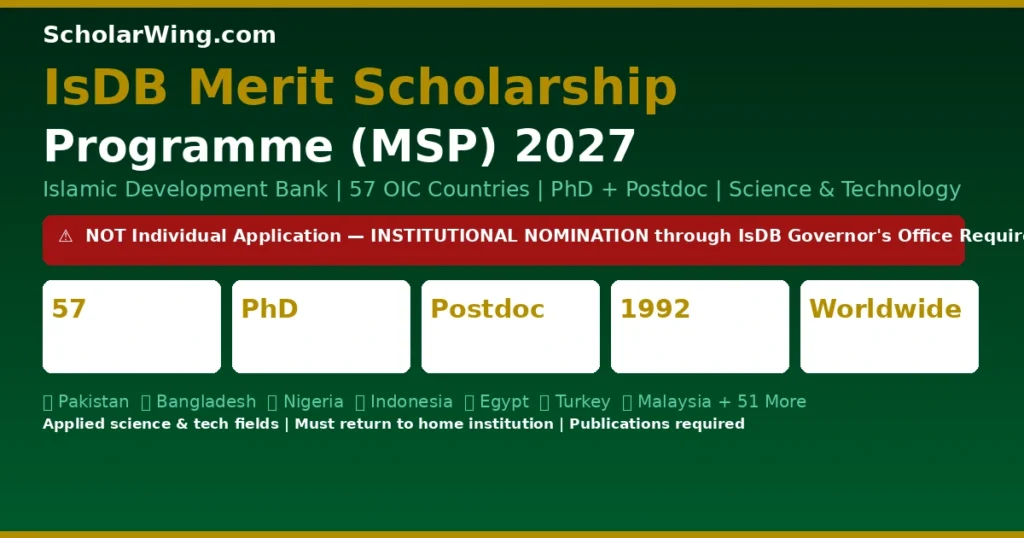
The IsDB Merit Scholarship Cannot Be Directly Applied To — Your Institution Must Nominate You
Most scholarship guides present the IsDB Merit Scholarship Program as a standard application process. They are wrong, and this error causes many talented scientists to waste time preparing applications they cannot submit.
The Merit Scholarship Program does not award scholarships to sole individuals, but to individuals at the institutional level. The institutions are partners in the program. Promising and talented individuals are sponsored and nominated by their institutions and accepted as appropriate by the offices of IsDB Governors in terms of the developmental and scientific needs of the member country.
The process is:
- Your institution (university, research center, government ministry) nominates you
- The IsDB Governor’s office in your country reviews and endorses the nomination
- IsDB reviews the endorsed nominations and selects scholars
If your institution has never engaged with the IsDB Merit Scholarship Program, and if you approach IsDB directly as an individual seeking to apply, nothing will happen. The entry point is your institution and your country’s IsDB Governor’s office, not IsDB’s website.
Merit Scholarship Program (MSP)
The Merit Scholarship Program (MSP) was introduced in 1992. It offers scholarships for higher study at renowned high-tech universities and institutions around the world. The objective of the MSP is to develop technically qualified human resources in IsDB Member Countries by providing scholarships to promising and outstanding scholars and researchers to undertake advanced studies and research in the fields of applied science and technology needed for the development of the member countries.
This does not make the scholarship inaccessible, but it does mean the path to it runs through institutions, not individual initiative. Scientists who want this scholarship must work at institutions that are engaged with the MSP process, and must advocate internally for their nomination.
What Is the IsDB — The Institution Behind the Scholarship
The Islamic Development Bank (IsDB) is a multilateral development bank headquartered in Jeddah, Saudi Arabia. Founded in 1975, it is owned and operated by its 57 member countries, all members of the Organisation of Islamic Cooperation (OIC).
Major shareholders: Saudi Arabia (22.5%), Libya (9%), Indonesia (8%), Iran (8%), Nigeria (7%), Qatar (7%), Egypt (7%), Kuwait (7%), UAE (6%), Turkey (6%).
The IsDB is one of the world’s major multilateral development banks comparable in scale to the African Development Bank or the Asian Development Bank. It finances infrastructure, energy, health, education, and social development projects across 57 member countries. Its scholarship programs are one component of its broader human capital development mandate.
In IsDB’s Realigned Strategy 2023-2025, the Bank dedicated an entire pillar to the support of comprehensive and inclusive human capital development. Through this pillar, IsDB aims to help Member Countries and Muslim communities in non-Member Countries to address development challenges with capacity-development initiatives, including scholarship programs.
The Full IsDB Scholarship Ecosystem — Not Just One Program
IsDB administers multiple scholarship tracks. Understanding the full ecosystem helps identify which track is relevant for each applicant:
Track 1: Merit Scholarship Program (MSP) — PhD + Postdoc [THIS GUIDE]
Launched in 1992. For PhD studies and post-doctoral research in applied science and high technology. For all 57 IsDB Member Countries.
- Institutional nomination model
- Senior researchers with experience
- Study at world-class high-tech institutions globally
Track 2: M.Sc. Scholarship Program
Launched in 1998 as a feeding program for the MSP, for 20 Least Developed Member Countries (LDMCs). Master of Science in relevant fields at top 1000 universities in IsDB member countries.
- For least developed member countries specifically
- Master’s level (not PhD)
- Study within IsDB member countries
Track 3: Scholarship Program for Muslim Communities (SPMC) in Non-Member Countries
For the Scholarship Program for Muslim Communities in Non-Member Countries, eligible countries include: Australia, Cambodia, Croatia, Ethiopia, Fiji, Ghana, India, Kenya, Liberia, Macedonia, Madagascar, Mauritius, Myanmar, Namibia, Nepal, Netherlands, Republic of Congo, Russian Federation, Rwanda, Singapore, South Africa, Sri Lanka, Tanzania, Thailand, The Philippines, Trinidad-Tobago, Vietnam, and Zambia.
This track is for Muslim communities in countries that are NOT IsDB members covering Muslims in India, Ethiopia, Ghana, Kenya, Thailand, Philippines, Vietnam, and others. Undergraduate level primarily.
Track 4: IsDB-ISFD Scholarship
For 21 Least Developed IsDB Member Countries undergraduate level with financial development focus.
The 57 Eligible OIC Member Countries
Membership of the IsDB consists of 57 countries. To become a member, a country should be a member of the Organisation of Islamic Cooperation (OIC) and contribute to the capital of the Bank.
All 57 Countries by Region:
Middle East & North Africa: Saudi Arabia, UAE, Egypt, Libya, Algeria, Morocco, Tunisia, Jordan, Palestine, Lebanon (observer), Yemen, Oman, Qatar, Kuwait, Bahrain, Syria, Iraq, Iran, Mauritania, Comoros, Djibouti
Sub-Saharan Africa: Nigeria ✅, Senegal ✅, Mali ✅, Niger ✅, Chad ✅, Guinea ✅, Guinea-Bissau ✅, Burkina Faso ✅, Benin ✅, Togo ✅, Côte d’Ivoire ✅, Gambia ✅, Sierra Leone ✅, Cameroon ✅, Gabon ✅, Uganda ✅, Mozambique ✅, Somalia ✅, Sudan ✅, Suriname ✅
South & Central Asia: Pakistan ✅, Bangladesh ✅, Afghanistan ✅, Tajikistan ✅, Kyrgyzstan ✅, Kazakhstan ✅, Turkmenistan ✅, Uzbekistan ✅, Azerbaijan ✅, Albania ✅
Southeast Asia: Indonesia ✅, Malaysia ✅, Brunei ✅, Maldives ✅
Turkey: Turkey ✅
Complete list: Visit isdb.org for the current full membership list. All 57 OIC member countries are eligible for the MSP.
Merit Scholarship Program (MSP) — Full Eligibility
To be eligible for the Merit Scholarship Program, applicants must: be from an IsDB Member Country; be up to the age of 35 years for PhD study or 40 years for post-doctoral research; have an MSc for PhD study or a PhD for post-doctoral research in a field of applied science and high technology; have above average academic achievement (Very Good or higher); have work and/or research experience of not less than two years for PhD study or five years for post-doctoral research; and have a record of publications/research in the same field.
Complete Eligibility Requirements:
1. IsDB Member Country National Citizen of one of the 57 OIC/IsDB member countries. Must normally be employed at an institution in that country.
2. Age Limits
- PhD study: Up to 35 years of age
- Post-doctoral research: Up to 40 years of age
3. Academic Qualification
- For PhD: Must hold an MSc degree in a relevant field
- For Postdoc: Must hold a PhD in a relevant field
4. Academic Merit: “Very Good” or Above Academic achievement must be above average — “Very Good” (typically 75%+ or equivalent in the academic grading system of the applicant’s country).
5. Professional/Research Experience
- For PhD: Minimum 2 years of work and/or research experience
- For Postdoc: Minimum 5 years of work and/or research experience
6. Publications Record Have a record of publications/research in the same field. This distinguishes the MSP from student scholarships, applicants must already have demonstrated research output. For PhD applicants, even modest publications (conference papers, journal articles, co-authored work) count. For postdoc, a stronger publication record is expected.
7. Field: Applied Science and High Technology The study/research area must be in applied science or high technology. The specific field must also demonstrate relevance to the member country’s development needs.
8. Institutional Employment You must be employed at an institution in your home country that can formally nominate you.
The Institutional Nomination Process — How It Actually Works
This is what most guides omit, and what most applicants misunderstand.
Step 1: Identify Your Nominating Institution
Your employer a university, research center, government ministry, or relevant organization must be willing to sponsor and nominate you. If you work at a university, your faculty dean or research office is the entry point. If you work at a research institute, the director’s office.
Step 2: Your Institution Prepares the Nomination
The institution prepares a formal nomination package on your behalf, documenting:
- Why you have been selected for nomination
- How your proposed study/research aligns with national development needs in science and technology
- The institution’s commitment to your return and re-employment after the scholarship
Step 3: IsDB Governor’s Office Endorsement
The nomination passes from the institution to the IsDB Governor’s office of your country. Each IsDB member country has an appointed Governor who represents the country in IsDB governance. The Governor’s office reviews the nomination in terms of national development priorities and endorses suitable candidates.
For Pakistan: The Ministry of Finance or Economic Affairs Division coordinates with the IsDB Governor’s office. Similar coordination through Ministry of Finance/Economic Relations Division for Bangladesh. For Nigeria, Indonesia, other members: Through their respective Ministries of Finance or equivalent.
Step 4: IsDB Scholarship Review
IsDB’s scholarship team reviews endorsed nominations from all member countries, evaluates them against MSP criteria, and selects the final cohort.
Step 5: Placement at High-Tech Institution
Selected scholars are placed at renowned high-tech universities and institutions worldwide for their PhD or postdoctoral research.
What the Scholarship Covers
The MSP covers:
| Benefit | Detail |
|---|---|
| Tuition fees | Full tuition at host institution |
| Monthly stipend | Living allowance during study/research period |
| Health insurance | Medical coverage |
| Research expenses | Materials, equipment, research costs |
| Travel allowance | To and from host institution |
| Return obligation | Must return to home institution after completion |
The Return Obligation — Mandatory Commitment
The scholars are expected to return to their countries/institutions to apply new know-how for the development of their member countries.
The MSP is not a pathway to immigration or career advancement in a foreign country. It is specifically designed to bring scientific and technological capacity INTO member countries. Scholars who complete their PhD or postdoc must return to their nominating institution and apply what they have learned to the development challenges of their home country.
This return obligation is:
- A condition of the scholarship
- Enforced through the institutional nomination model (your institution has formally committed to your return)
- Central to the MSP’s entire rationale
M.Sc. Scholarship Program — The Related Track
For scientists from the 20 Least Developed IsDB Member Countries (LDMCs), the M.Sc. Scholarship Program (launched 1998) provides a more accessible entry:
The Master of Science Scholarship Program was launched in 1998 as a feeding program for the MSP, realizing that 20 of the Least Developed Member Countries could not benefit from the MSP.
The MSc scholarship program supports candidates to pursue Master’s of Science studies at top 1000 universities in IsDB member countries.
Key difference from MSP:
- Master’s level (vs PhD/Postdoc in MSP)
- Study within IsDB member countries (vs any world institution in MSP)
- For least developed member countries specifically
The 20 LDMCs include countries like Bangladesh, Mali, Niger, Chad, Guinea-Bissau, Djibouti, Gambia, Guinea, Comoros, Somalia, and others. If your country is among the least developed IsDB members, both MSP (if you qualify) and M.Sc. track are worth exploring with the IsDB Governor’s office.
SPMC — For Muslims in Non-OIC Countries (India, Kenya, Ghana, etc.)
For the Scholarship Program for Muslim Communities in Non-Member Countries, eligible countries include: Australia, Cambodia, Croatia, Ethiopia, Fiji, Ghana, India, Kenya, Liberia, Macedonia, Madagascar, Mauritius, Myanmar, Namibia, Nepal, Netherlands, Republic of Congo, Russian Federation, Rwanda, Singapore, South Africa, Sri Lanka, Tanzania, Thailand, The Philippines, Trinidad-Tobago, Vietnam, and Zambia.
If you are a Muslim from India, Kenya, Ethiopia, Ghana, Philippines, Thailand, or another non-OIC country, the SPMC track is for you. This is undergraduate-focused and operates differently from the MSP.
Quick Reference — IsDB Merit Scholarship Program (MSP)
| Element | Detail |
|---|---|
| Program name | Merit Scholarship Program for High Technology (MSP) |
| Launched | 1992 |
| Funder | Islamic Development Bank (IsDB) — HQ Jeddah, Saudi Arabia |
| Eligible countries | 57 OIC member countries |
| Levels | PhD + Post-doctoral research |
| PhD age limit | ≤35 years |
| Postdoc age limit | ≤40 years |
| PhD academic req. | MSc degree + “Very Good” academic record |
| Postdoc academic req. | PhD degree + publications record |
| Experience (PhD) | Min 2 years work/research |
| Experience (Postdoc) | Min 5 years work/research |
| Fields | Applied science and high technology |
| Study location | Renowned high-tech institutions worldwide |
| Application method | ⚠️ INSTITUTIONAL NOMINATION — not individual |
| Entry point | Your institution + IsDB Governor’s office in your country |
| Return obligation | MANDATORY — return to home institution |
| Related MSc track | For 20 Least Developed Member Countries |
| SPMC track | For Muslim communities in non-OIC countries |
How to Pursue the IsDB MSP — Practical Steps
If you are currently a researcher/faculty at a university or research institution:
- Talk to your department head or research office about the IsDB MSP and ask whether your institution has previously nominated candidates.
- Build your eligibility profile: Ensure your MSc (for PhD track) or PhD (for postdoc) is solid, accumulate research experience, and publish in your field.
- Contact the IsDB Governor’s office in your country either directly or through your institution. Ask about the current cycle’s timeline and requirements.
- Identify a potential host institution for your PhD or postdoc a high-tech university relevant to your field where you want to study. This strengthens your nomination.
- Prepare your research proposal how your proposed study connects to your country’s development in science and technology.
FAQ
What is the IsDB Merit Scholarship Program?
The MSP was introduced in 1992 and offers scholarships for higher study at renowned high-tech universities worldwide. The objective is to develop technically qualified human resources in IsDB Member Countries by providing scholarships for advanced studies and research in applied science and technology.
Can I apply directly to IsDB?
No, the program does not award scholarships to sole individuals.
Which countries are eligible?
All 57 IsDB member countries — all OIC member nations.
What are the experience requirements?
Minimum 2 years for PhD study, 5 years for post-doctoral research.
What is the age limit?
Up to 35 years for PhD study, up to 40 years for post-doctoral research.
What about Muslims in non-OIC countries?
The Scholarship Program for Muslim Communities in Non-Member Countries covers countries including India, Kenya, Ghana, Ethiopia, Philippines, Vietnam, and others.