
Most Guides About Oman Scholarships Get the Three Tracks Wrong — Here’s What’s Actually True
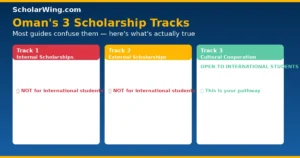
The Oman government scholarship system has three distinct tracks. The vast majority of online guides either don’t know this or lump them together, causing applicants to fill out the wrong forms, miss the right deadlines, and sometimes apply for scholarships they aren’t eligible for at all.
Here is the correct picture, clearly stated:
Track 1 — Internal Scholarships: Reserved exclusively for Omani nationals studying at Omani public universities. International students are not eligible.
Track 2 — External Scholarships: Reserved exclusively for Omani nationals studying abroad in the UK, US, Australia, or Canada. International students are not eligible.
Track 3 — Cultural and Scientific Cooperation Program: This is the track open to international students, specifically students from GCC and other friendly Arab and Muslim-majority countries. It funds non-Omanis to study at Sultan Qaboos University (SQU) and other Omani public universities at bachelor’s, master’s, and PhD levels.
If you are an international student reading a guide that tells you to apply for the “Oman Government Scholarship” without specifying Track 3, that guide is incomplete. This one isn’t.
Sultan Qaboos University (SQU) — The Flagship Institution
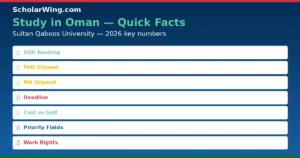
Sultan Qaboos University (SQU) is Oman’s crown jewel of higher education, located in Al-Khoud, Muscat. SQU ranks among the top 500 universities globally (QS World Rankings 2026-27) and top 10 in the Arab region. The campus is among the most modern in the Gulf, with full English-medium instruction across STEM, business, and medicine programs.
Colleges at SQU:
- College of Medicine and Health Sciences
- College of Engineering
- College of Science
- College of Information Technology
- College of Agriculture and Marine Sciences
- College of Economics and Political Science
- College of Law
- College of Education
- College of Arts and Social Sciences
- College of Nursing
- College of Pharmacy
Language of instruction: English for most STEM, business, medicine, and engineering programs. Arabic for humanities, Islamic studies, and law.
Priority fields in 2026-27: Awards in 2026-27 prioritize fields like Artificial Intelligence and Data Science, alongside engineering, medicine, and environmental sciences, all aligned with Oman’s Vision 2040 development goals.
The SQU International Scholarship — What It Actually Covers
The Sultan Qaboos University scholarship for international postgraduate students is one of the most comprehensive packages in the Arab world:
What it covers:
- Full tuition waiver
- On-campus housing
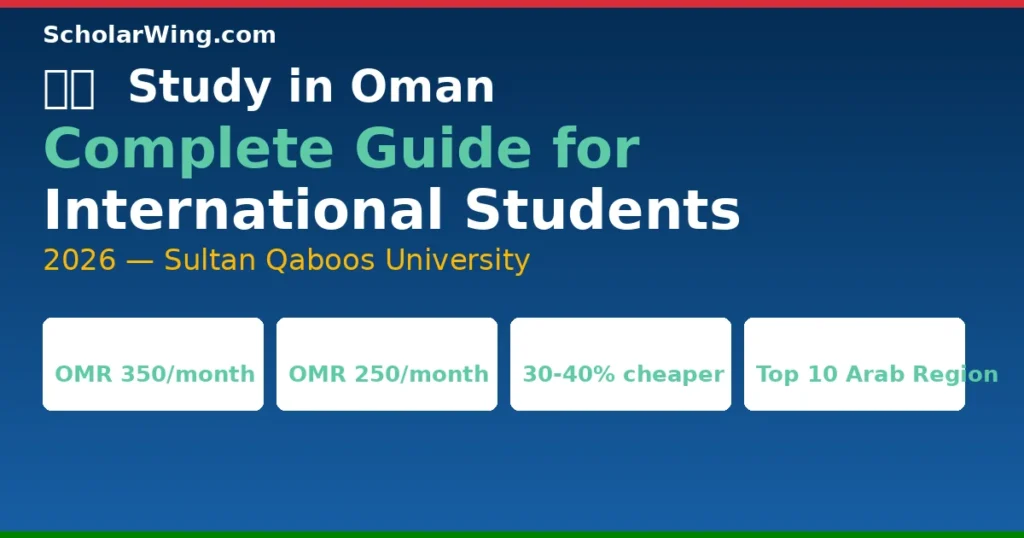
- Monthly stipend of OMR 250 for Master’s students (~USD 650)
- Monthly stipend of OMR 350 for PhD students (~USD 910)
- Annual round-trip economy class airfare
- Full health insurance
Requirements:
- Minimum GPA of 3.00 out of 4.00
- Strong research background for postgraduate applicants
- Nomination is often automatic upon unconditional admission to a qualifying program
Application: Apply through the SQU Deanship of Postgraduate Studies portal at squ.edu.om
Deadline: SQU’s late-February cutoff for scholarship consideration, apply by February each year for the following academic intake.
The Cultural and Scientific Cooperation Program (Track 3) — Undergraduate
For international undergraduate students, the primary pathway is the Omani Program for Cultural and Scientific Cooperation, administered by the Ministry of Higher Education, Research, and Innovation (MoHERI) and the Higher Education Admission Center (HEAC).
What it covers:
- Full tuition waiver at SQU or partner Omani public universities
- Monthly allowance of OMR 200 (~USD 520) — if the university provides housing, the allowance is adjusted to OMR 140
- Access to university facilities
Requirements:
- Student from a GCC or friendly nation with a bilateral cultural cooperation agreement with Oman
- Maximum age 23 at time of application
- High school average of at least 75%
- Must apply through your home country’s embassy in Muscat or Ministry of Higher Education
HEAC Application Timeline 2026:
- Registration phase: April – June 2026
- Change of preference period: July 2026 (after final grades released)
- Deadline for international government grants: August 20, 2026
Apply through: heac.gov.om and your home country’s embassy in Muscat
A’Sharqiyah University — Scholarship for Any Nationality
Beyond SQU, A’Sharqiyah University offers dedicated international undergraduate scholarships that are open to citizens of any country worldwide not just Arab or GCC countries.
What it covers:
- Full tuition and registration fees for four years
- No monthly stipend (tuition-only coverage)
Requirements:
- Must maintain a CGPA of 3.0 throughout studies
- Open to students from developing nations specifically (encouraged to apply)
A’Sharqiyah University is located in Ibra, in Oman’s Al-Sharqiyah (Eastern) region, a more relaxed setting than Muscat, with lower living costs than the capital.
Apply at: asu.edu.om
Other Universities in Oman Accepting International Students
University of Nizwa — receives Cultural Cooperation Program placements. Strong in Islamic studies, engineering, and IT. English-medium programs available.
Dhofar University — located in Salalah, Oman’s second city. Receives Cultural Cooperation placements. Known for business and engineering.
Sohar University — receives Cultural Cooperation placements. Located in Sohar, industrial region of Oman. Strong engineering and computer science.
Tip from SQU alumni: Contact a Sultan Qaboos University faculty member in your target department before applying. A short email introducing your research interests and asking about ongoing projects often triggers informal support during admissions review. This is similar to the DAAD PhD approach and significantly strengthens postgraduate applications.
Student Visa for Oman
International students admitted to Omani universities require a student visa to enter and remain in Oman for study.
Process:
- Receive official admission letter from your Omani university
- University submits visa sponsorship application to the Oman Royal Police (ROP) on your behalf
- Collect your entry visa from the Omani Embassy or consulate in your home country
- On arrival, register with the Royal Oman Police within the first week
Documents typically required:
- Valid passport (minimum 6 months validity)
- Official admission letter from the university
- Medical fitness certificate
- Police clearance certificate from your home country
- Passport-size photographs
Processing time: 3-6 weeks. Begin the process as soon as you receive your admission offer.
Work rights: International students on student visas are generally not permitted to work in Oman during their studies, this is different from Hong Kong and Luxembourg, where student work rights exist.
Cost of Living in Oman — A Real Advantage
The cost of living in Muscat is significantly lower than Dubai, Doha, or Riyadh, approximately 30-40% cheaper overall.
Typical monthly costs for students in Muscat:
- Accommodation: OMR 120-200/month (university hostel much cheaper; private market OMR 150-250)
- Food: OMR 80-120/month (cafeteria and local restaurants affordable)
- Transportation: OMR 20-40/month
- Personal expenses: OMR 30-50/month
Total typical budget: OMR 300-450/month (~USD 780-1,170)
The SQU scholarship context: An OMR 250/month Master’s stipend with university housing covers basic living comfortably. The OMR 350/month PhD stipend leaves room for modest savings after covering living expenses, a meaningful advantage compared to Gulf neighbors where the same stipend covers far less.
Why Oman for International Students?
1. Political stability and safety Oman is consistently rated one of the Middle East’s most stable and safe countries. Its neutral foreign policy, low crime rate, and welcoming cultural environment make it genuinely hospitable for international students.
2. Arabic language environment — an advantage for Arab students For students from Arab countries who want to maintain language fluency while pursuing an English-medium degree, Oman’s Arabic-immersion social environment is a significant draw that doesn’t exist in predominantly English-speaking academic destinations.
3. Oman Vision 2040 — demand for graduates Oman’s economic diversification agenda (Vision 2040) creates domestic demand for graduates in AI, engineering, environmental science, and health, and scholarship priorities reflect this. Graduates who study in Oman have a ready-made narrative for return plan essays.
4. Islamic Development Bank (IsDB) connection Oman is an OIC member country meaning students from IsDB LDMC priority countries who are studying in Oman may be able to access IsDB scholarship programs alongside Omani university scholarships. Check isdb.org for current eligibility.
5. Gateway to the Gulf job market A degree from SQU or another accredited Omani university is recognized across the GCC. For students whose career goals include the broader Gulf region, studying in Oman provides access to a regional network unavailable from European institutions.
Practical Tips for Applying to Oman
1. Apply through Track 3 — not Tracks 1 or 2 If you are an international student, the Cultural and Scientific Cooperation Program (Track 3) is your pathway. Contact your home country’s Ministry of Higher Education or Omani Embassy to confirm your country’s bilateral quota before applying.
2. Contact SQU faculty before applying to postgraduate programs A brief, specific email to a potential supervisor at SQU, explaining your research interests and referencing one of their publications — often results in informal support during the admissions review. This is a known-effective strategy among successful SQU scholarship applicants.
3. Use ScholarWing’s free document tools for your application The SQU postgraduate scholarship requires an SOP, CV, research proposal, and recommendation letters. Use ScholarWing’s free generators: SOP Generator · Free CV Builder · Free Research Proposal Generator
4. Check your country’s bilateral cultural agreement with Oman Not all countries have bilateral agreements with Oman for the Cultural Cooperation Program. Confirm your eligibility through your Ministry of Higher Education or the Omani Embassy in your country before investing time in the application.
5. Diversify your university choices Don’t apply only to SQU. Omani universities including Nizwa, Dhofar, and Sohar also receive Cultural Cooperation Program placements and have lower competition than the flagship institution.
FAQ
Which scholarship is available for international students in Oman?
The primary pathway for international students is the Cultural and Scientific Cooperation Program (Track 3 of the Oman government scholarship system). This funds non-Omani students from GCC and friendly nations at Sultan Qaboos University and other Omani public universities. A’Sharqiyah University also offers a separate scholarship open to any nationality.
What does the SQU postgraduate scholarship cover?
Full tuition waiver, on-campus housing, monthly stipend (OMR 250 for Master’s, OMR 350 for PhD), annual round-trip airfare, and full health insurance.
What is the HEAC application deadline for 2026?
The deadline for international government grants through the Higher Education Admission Center (HEAC) is August 20, 2026. Initial registration runs April-June 2026 at heac.gov.om.
Is Oman cheaper to live in than other Gulf countries?
Yes, Muscat’s cost of living is approximately 30-40% lower than Dubai, Doha, or Riyadh, making the OMR scholarship stipend significantly more livable in Oman than equivalent-value stipends in neighboring Gulf countries.
Can international students work in Oman during their studies?
Generally no, international students on student visas are not permitted to work in Oman. Factor this into your financial planning alongside your scholarship stipend.
Which fields are prioritized in Oman scholarships in 2026?
Artificial Intelligence, Data Science, engineering, medicine, and environmental sciences are the 2026 priority areas, aligned with Oman’s Vision 2040 economic diversification agenda.