
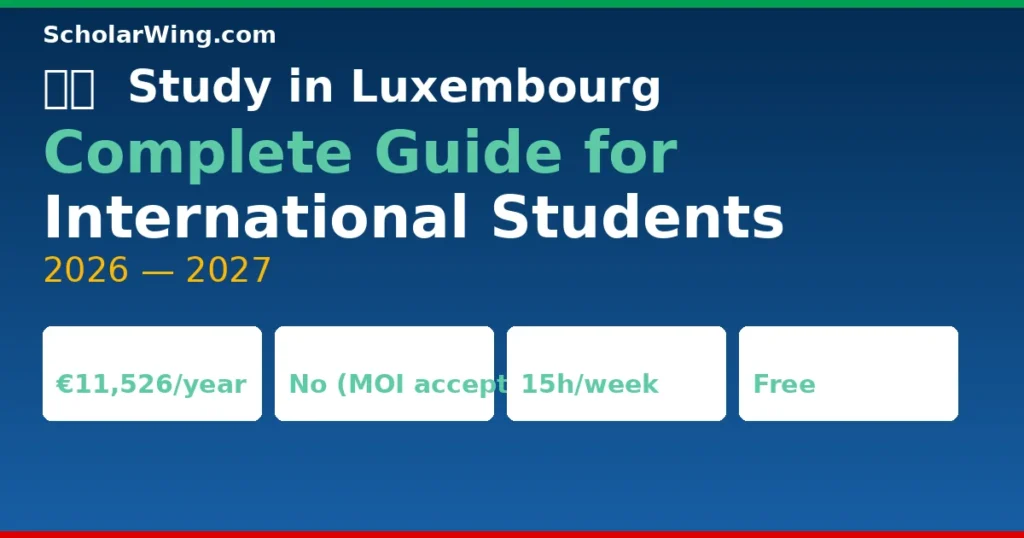
Luxembourg Is One of Europe’s Most Overlooked Study Destinations — And That’s a Competitive Advantage
Most international students have Germany, UK, France, or the Netherlands on their radar. Very few target Luxembourg specifically. That’s precisely what makes it interesting from a scholarship perspective.
Luxembourg has one public university — the University of Luxembourg, that is genuinely world-class, trilingual, research-intensive, and situated in the heart of Europe. The country has the highest GDP per capita in the European Union. Its degree recognition extends across the EU and beyond. And it has an active scholarship program — the Guillaume Dupaix International Master’s Scholarship — that most ScholarWing readers have never heard of.
Less competition. Genuine academic quality. A scholarship worth €11,526 per year. In one of Europe’s smallest, wealthiest, and most strategically located countries.
This guide covers everything an international student needs to know about studying in Luxembourg in 2026.
Why Luxembourg?
1. Europe’s financial and legal hub Luxembourg hosts the European Court of Justice, the European Investment Bank, and is one of Europe’s leading financial centres. For students in law, economics, finance, and European affairs, this proximity to major EU institutions is a genuine career asset.
2. Genuinely multilingual environment The University of Luxembourg teaches in English, French, and German. Programs are offered in all three languages, and many are English-medium. This means Luxembourgish proficiency is not required for most international students.
3. One top university — but a very good one Luxembourg has only one public university, but it’s ranked in the top 26% in the QS World University Rankings. With 17 Bachelor’s programs and 46 Master’s/PhD programs, it covers STEM, law, economics, finance, humanities, education, and social sciences.
4. EU-recognized degree A degree from the University of Luxembourg is fully recognized across all 27 EU member states and widely recognized internationally. For students who want a European qualification, Luxembourg is a credible and practical option.
5. Less competitive than Germany or UK Because fewer international students target Luxembourg specifically, scholarship competition is lower than at equivalent-quality German or UK institutions. This is a structural advantage worth using.
The Guillaume Dupaix International Master’s Scholarship — The Main Funding Opportunity
The Guillaume Dupaix International Master’s Scholarship is awarded by the Luxembourg Ministry of Foreign and European Affairs and administered through the University of Luxembourg. It is the primary scholarship for international Master’s students and the most important financial opportunity for non-EU applicants.
What it covers:
- 5,763€ per semester = 11,526€ per annum, covering living expenses and accommodation, not tuition fees
- Up to 2 years (standard Master’s duration)
- Part of the scholarship finances accommodation in a university residence (up to EUR 650/month for up to 2 years)
- Remaining amount paid in instalments at the beginning of each semester
Who is eligible:
- International students applying for a Master’s or Bachelor’s degree at the University of Luxembourg
- Visiting PhD candidates from partner universities
- For talented students from the Western Balkans, Ibero-American countries, Thailand, Vietnam, Belarus, Egypt, India, Moldova, Russia, the United Kingdom, Türkiye, and Ukraine who are applying for a Master’s
Key conditions:
- Only Master programmes that run their two-year programme in Luxembourg are eligible. Master programmes that have a mandatory semester or year abroad are not eligible.
- Full-time students only
- Not eligible for State Financial Aid for Higher Education in Luxembourg
- Subject to performance evaluation, may be withheld for academic misconduct or poor performance
How the selection works: Step 1: Master’s application by 24 March 2026, Submission via the online admissions portal and assessment of academic excellence by the Directors of each Master’s program. Step 2: Email invitations to apply for the Guillaume Dupaix scholarship are sent to the students whose applications are deemed excellent.
This means you apply for admission first. If your academic record is assessed as excellent by the Master’s program directors, you receive an invitation to apply for the scholarship. You cannot apply for the scholarship directly without first being assessed for admission.
Apply at: uni.lu
Other Scholarship Opportunities in Luxembourg
Faculty-Specific Scholarships Various faculties at the University of Luxembourg offer additional program-specific scholarships funded by corporate and private partners including ATOZ Foundation, Advanzia Bank, Allen & Overy, and others. These are listed on the University’s scholarship page and change from year to year.
Luxembourg Government Scholarships through MFA The Luxembourg Ministry of Foreign Affairs and European Affairs offers bilateral scholarships for students from specific partner countries. These target specific regions and change by cycle, check mae.gouvernement.lu for current opportunities.
Erasmus+ Grants As a Luxembourg institution, the University of Luxembourg participates in Erasmus+ programs. Students already enrolled can access Erasmus+ mobility grants for exchange semesters at partner European universities.
Scholarships for the Master of European Legal Studies at EIPA Full funding international scholarship offered by the Ministry of Foreign and European Affairs of Luxembourg for students from Albania, Bosnia and Herzegovina, Kosovo, North Macedonia, Montenegro, Serbia, Turkey, Ukraine, and Moldova. Covers full tuition fee, travel expenses, accommodation and meals. Deadline: June 15, 2026.
Admission Process — Step by Step
Step 1: Choose your program Students can choose from programs in Science, Technology, Medicine, Law, Economics, Finance, Humanities, Education, and Social Sciences. You can apply to up to three Bachelor or Master programs simultaneously.
Step 2: Check English proficiency requirements Many Master’s programmes are fully taught in English. IELTS is not mandatory if you can provide proof that your previous degree was taught entirely in English. This makes the University of Luxembourg accessible for students who want to avoid the IELTS expense. Use ScholarWing’s free MOI Certificate Generator to prepare.
Step 3: Prepare required documents Standard documents required include:
- Transcript of Bachelor’s degree
- Two recommendation letters
- CV (short resume)
- Motivation letter or Statement of Purpose
- Study plan or Research Proposal
- Passport (for international students)
- English proficiency certificate from last institution or IELTS
Use ScholarWing’s free document generators:
Step 4: Apply online All applications are submitted through the University of Luxembourg’s online admissions portal. No application fee for most programs. The University explicitly states it does not collaborate with student recruitment agencies, apply directly.
Step 5: Wait for assessment and scholarship invitation If your academic profile is assessed as excellent, you’ll receive an email invitation to apply for the Guillaume Dupaix scholarship. This assessment happens after you submit your admission application.
Student Visa for Luxembourg
Non-EU international students need a Type D long-stay visa for Luxembourg to study for programs longer than 90 days.
Key steps:
- Receive admission letter from the University of Luxembourg
- Apply for a Type D visa at the Luxembourg Embassy or consulate in your home country
- Obtain a Residence Permit upon arrival in Luxembourg (required within the first few weeks)
Documents typically required:
- Valid passport (at least 6 months beyond your stay)
- University admission letter
- Proof of financial means (scholarship letter if applicable)
- Proof of accommodation
- Health insurance coverage
- Completed visa application form
Processing time: Allow 4-8 weeks for visa processing. Apply as early as possible after receiving your admission letter.
Work rights: All students enrolled at the University of Luxembourg are authorized to work during their studies, irrespective of their nationality, during the school holidays (40 hours/week) and/or throughout the year (15 hours/week).
Cost of Living in Luxembourg
Luxembourg is one of Europe’s most expensive countries. Budgeting realistically is essential for students on scholarships.
Typical monthly costs:
- Accommodation: EUR 600-900/month (university residence is cheaper, private market is expensive)
- Food: EUR 250-400/month
- Transportation: Students get subsidized or free public transport
- Health insurance: Required — check student health coverage options
- Personal expenses: EUR 100-200/month
Total typical budget: EUR 1,200-1,700/month
The Guillaume Dupaix scholarship provides EUR 11,526/year (EUR 961/month), which covers basic needs but leaves limited margin. Students are permitted to work 15 hours per week during term, which can supplement this meaningfully.
Good news: Luxembourg has a comprehensive public transport network, and the government made all public transport free. This eliminates one major cost category that burdens students in other European countries.
Programs Available for International Students
Faculty of Science, Technology and Medicine: Computer Science, Mathematics, Physics, Life Sciences, Medicine.
Faculty of Law, Economics and Finance: Law, Finance, Accounting and Auditing, European Law, Banking and Finance Management.
And Faculty of Humanities, Education, and Social Sciences: Psychology, Education Sciences, European Cultures, Language and Cultural Studies
Language of instruction: English, French, or German depending on the program. Many Master’s programs are English-medium.
Strong programs for international students seeking career relevance:
- MSc in Finance (Luxembourg is a major EU financial centre)
- MSc in Computer Science
- Master in European Law (proximity to EU institutions)
- Master in Learning and Development in Multilingual and Multicultural Contexts
Why Luxembourg Is Underused — And Why That’s Your Advantage
Most international scholarship guides focus on Germany, UK, Netherlands, and France. Luxembourg appears rarely. This means:
- Fewer competing applications for the Guillaume Dupaix scholarship
- A smaller applicant pool than equivalent German or French programs
- Less visibility means strong candidates who do apply stand out more
The caveat: Luxembourg is genuinely competitive at the program admission level, the scholarship is invitation-only for academically excellent applicants. But the total applicant pool is smaller than competing European destinations, and the “Why Luxembourg?” question has real, specific, compelling answers (EU institutions, financial sector, multilingual environment) that motivated applicants can use effectively.
Practical Tips for Applying to Luxembourg
1. Apply for admission before the March 24 deadline The Guillaume Dupaix scholarship requires excellent assessment from program directors before you can even apply for it. Submit your admission application early, before March 24, 2027 for the 2027-28 intake.
2. Use your MOI Certificate instead of IELTS If your previous degree was taught in English, a free MOI Certificate is accepted. Get it from your university registrar before applying.
3. Write a strong motivation letter with Luxembourg-specific reasons Generic “I want to study in Europe” motivation letters will not impress the University of Luxembourg’s directors. Specific reasons, EU institutions, Luxembourg’s financial sector, a specific faculty’s research, multilingual academic environment are what excellent applicants write.
4. Apply directly — no agencies The University of Luxembourg explicitly does not collaborate with student recruitment agencies. Apply through the official admissions portal at uni.lu. Any agent claiming they can improve your application to Luxembourg is taking your money for nothing.
5. Plan finances honestly The Guillaume Dupaix scholarship covers living expenses and accommodation but not tuition fees. Research whether tuition fees apply to your specific program (many programs charge minimal or no tuition for EU students; non-EU students should verify). Budget for the cost gap between scholarship provision and actual monthly costs.
FAQ
Who is eligible for the Guillaume Dupaix International Master’s Scholarship?
International students applying for a Master’s or Bachelor’s degree at the University of Luxembourg and visiting PhD candidates from partner universities. Applications from students in Western Balkans, Ibero-American countries, Thailand, Vietnam, Belarus, Egypt, India, Moldova, Russia, UK, Turkey, and Ukraine are specifically mentioned.
Does Luxembourg require IELTS?
No, if your previous degree was taught entirely in English, a proof of English-medium instruction (MOI Certificate) is accepted instead. IELTS is required only if your previous degree was not in English.
How much is the Guillaume Dupaix scholarship?
€5,763 per semester (€11,526 per year) for up to 2 years, covering living expenses and accommodation. Part of this covers university residence accommodation (up to EUR 650/month).
Can international students work in Luxembourg?
Yes, students can work during school holidays (40 hours/week) and throughout the year (15 hours/week), regardless of nationality.
Is Luxembourg’s degree recognized internationally?
Yes, degrees from the University of Luxembourg are recognized across all EU member states and widely recognized internationally.
When is the application deadline?
The 2026 deadline for Master’s application and scholarship application was March 24, 2026. For the 2027-28 intake, watch for a similar March deadline on uni.lu.