
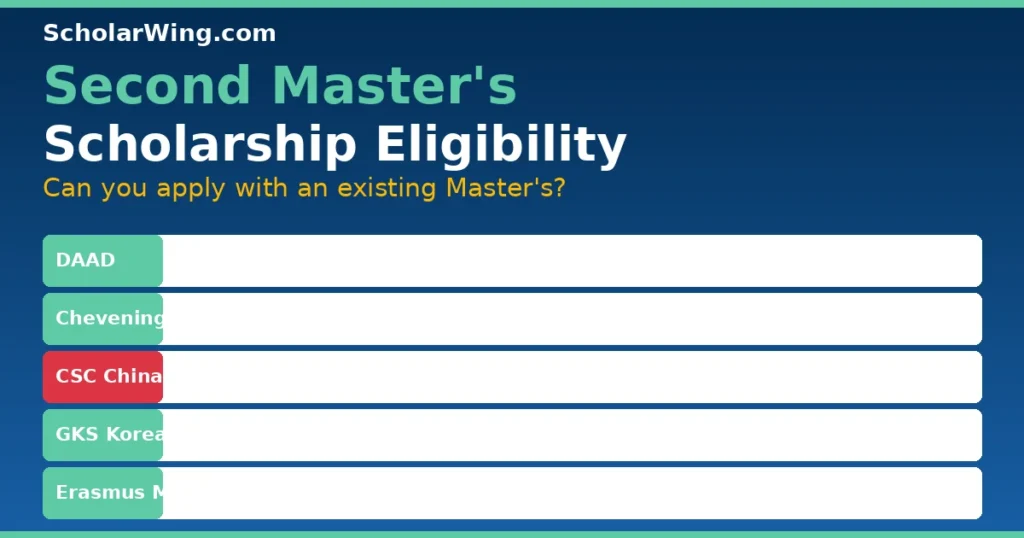
Most Students With an Existing Master’s Assume They Can’t Apply Again — Most Are Wrong
This is one of the most common misconceptions about international scholarship eligibility. Students who already hold a Master’s degree, whether Pakistani, Ghanaian, Ethiopian, or from any other country, frequently assume they are ineligible for Master’s-level scholarships because they already have a graduate degree.
In most cases, this assumption is incorrect. The rules vary by scholarship and by what you want to study next, but the blanket assumption that “I already have a Master’s, so I can’t get another scholarship” is wrong for the majority of programs.
This guide gives you the specific rules for each major scholarship, when a second Master’s is permitted, and when pursuing a PhD-level scholarship is the better strategic choice.
DAAD — The 6-Year Rule Applies, Second Master’s Generally Possible
DAAD’s eligibility rule is primarily time-based, not degree-count-based: your most recent academic degree should not be older than 6 years at the time of application.
What this means for second Master’s applicants:
- If your existing Master’s was completed within the last 6 years → you are within the DAAD window
- DAAD Study Scholarships are described as scholarships for graduates with a first academic degree wishing to continue their academic training, but many DAAD programs accept Master’s holders for further Master’s study or PhD programs
DAAD PhD vs second Master’s: DAAD research grants for PhD candidates are open to applicants who hold a Master’s degree. If you already have a Master’s and want to continue to PhD level, DAAD is strongly oriented toward PhD funding for Master’s holders, this is actually the more natural pathway.
Key restriction: DAAD scholarships cannot be combined with other German government scholarships, if you previously held a DAAD scholarship, check whether you are eligible to reapply for the same or a different program. DAAD generally permits reapplication but not concurrent government scholarship holding.
Read This: DAAD Helmut Schmidt Scholarship 2027
Chevening — One Award Per Lifetime (With Exceptions)
Chevening has a specific rule: if you have already studied in the UK on a government-funded scholarship, you are not eligible to apply again.
What this means in practice:
- If you received Chevening previously → you cannot apply for Chevening again
- If you received a different government-funded UK scholarship → you are similarly ineligible
- If you held a non-government scholarship for UK study → this restriction does not apply
For second Master’s specifically: Chevening funds one-year Master’s programs. If you hold a Master’s from a non-UK institution and have not previously held a UK government scholarship, you are eligible to apply for Chevening, your existing Master’s does not disqualify you.
Whether a second Master’s makes sense strategically is a different question from eligibility. Chevening committees evaluate your leadership narrative and career plan, if you can compellingly explain why a second Master’s in a different or related field serves a specific leadership goal, the application is viable.
Read This: Chevening Scholarship 2026 – Complete Guide
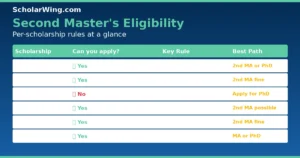
CSC China — Master’s Holders Can Apply for PhD, Not Another Master’s
China’s Scholarship position is the clearest of any major scholarship: academic progression is expected.
CSC China hierarchy:
- Bachelor’s holders → apply for Master’s programs
- Master’s holders → apply for PhD programs
- The CSC scholarship is not designed to fund a second Master’s for someone who already holds a Master’s degree
Why this matters: If you have an existing Master’s and want to study in China, apply for a CSC PhD, not a Master’s. CSC PhD applicants must hold a Master’s degree, and a well-developed research proposal with professor contact is essential.
Age limits for CSC PhD: Under 40 years old.
Read This: CSC China Scholarship 2026 — Fully Funded
GKS Korea — Second Master’s Generally Possible
GKS Korea does not publish a hard rule against second Master’s degrees. The primary eligibility constraints are:
- Age (under 40 for most tracks)
- Minimum GPA (2.64/4.0)
- Must not currently hold another Korean government scholarship
If you hold an existing Master’s from outside Korea and meet the age and GPA requirements, GKS Korea for a second Master’s in a different field is generally possible. Contact the Korean Embassy in your country to confirm current eligibility specifics for your situation.
Read This: GKS Fully Funded Scholarship 2026
Erasmus Mundus — No Restriction on Prior Degrees
Erasmus Mundus Joint Master’s programs publish no general rule against applicants holding existing Master’s degrees. Individual program consortiums may have specific requirements, check each program’s eligibility statement directly.
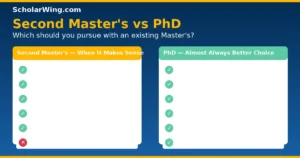
When a Second Master’s Makes Sense vs When PhD Is Better
Second Master’s may make sense when:
- Your first Master’s was in a substantially different field and you need disciplinary foundation in your new direction
- You need professional accreditation that requires a specific degree (e.g., a clinical psychology master’s when your first was in social work)
- The target country scholarship system (like GKS Korea) doesn’t restrict second Master’s and the specific program offers career value your existing degree doesn’t
PhD is almost always better when:
- You already hold a Master’s in the same or related field
- Your goal is research, academia, or senior technical roles
- You are applying to CSC China (where PhD is the expected progression)
- Your existing Master’s meets the PhD prerequisite
The practical reason: A PhD-level scholarship pays more, is open to Master’s holders by design, and represents genuine academic progression rather than repetition. DAAD, CSC China, MEXT, and GKS Korea all offer fully funded PhD programs for Master’s holders, pursuing these is a stronger use of your existing qualification than seeking a second Master’s in a related area.
FAQ
Can I apply for DAAD with an existing Master’s degree?
Yes, DAAD’s primary constraint is the 6-year rule (your most recent degree must be within 6 years). Holding a Master’s degree makes you eligible for DAAD PhD research grants and for some DAAD Master’s programs if your Master’s is in a different field or the program is a specialized professional degree.
Can I apply for Chevening with an existing Master’s degree?
Yes, if you have not previously received a UK government-funded scholarship. Your existing Master’s does not disqualify you. What matters is the two-year work experience requirement and the quality of your leadership narrative.
Does CSC China allow a second Master’s scholarship?
Generally no, CSC China expects academic progression. Master’s holders should apply for CSC PhD programs. Applying for a second Master’s through CSC as a Master’s holder is unlikely to be approved.
Should I apply for a second Master’s or a PhD?
If you already hold a Master’s in the same or related field, a PhD is almost always the better strategic choice. It pays a higher stipend, represents academic progression, and is what scholarship programs expect for Master’s-level graduates.
Does an existing Master’s from another country affect eligibility?
For most programs, DAAD, Chevening, GKS Korea, Erasmus Mundus, a prior Master’s from another country is not a disqualifier. It is a qualification. For CSC China, it is the expected entry point for PhD applications.